Algeria
 Egypt
 Libya
 Morocco
 Sudan
 Tunisia
 Benin
 Burkina Faso
 Cabo Verde
 Ghana
 Guinea
 Guinea-Bissau
 Liberia
 Mali
 Mauritania
 Niger
 Nigeria
 Senegal
 Sierra Leone
 The Gambia
 Togo
 Cameroon
 Central African Republic
 Chad
 DR Congo
 Equatorial Guinea
 Gabon
 Republic of the Congo
 São Tomé and Príncipe
 Burundi
 Comoros
 Djibouti
 Eritrea
 Ethiopia
 Kenya
 Madagascar
 Malawi
 Mauritius
 Mozambique
 Rwanda
 Seychelles
 Somalia
 South Sudan
 Tanzania
 Uganda
 Angola
 Botswana
 Eswatini
 Lesotho
 Namibia
 South Africa
 Zambia
 Zimbabwe
When poultry drives the maize market
In several West African countries, poultry is no longer just a staple food. It is also becoming a driver of investment, processing and regional trade. As farms become more industrialised, demand for compound feed is rising, with maize at the heart of the equation. This shift is attracting foreign exporters, but above all it raises a strategic question: who will capture the value created by this new demand — local grain producers or imported suppliers?
The issue sits within a West African environment in which livestock, poultry farming and food security are increasingly intertwined. In Guinea and Côte d’Ivoire, public authorities want to reduce dependence on poultry meat imports, strengthen biosecurity and develop longer value chains. Across the sub-region, these choices intersect with national agricultural policies and ECOWAS markets and, for Côte d’Ivoire, its role as a trade hub for Mali and Burkina Faso.
US market exploration at the right time
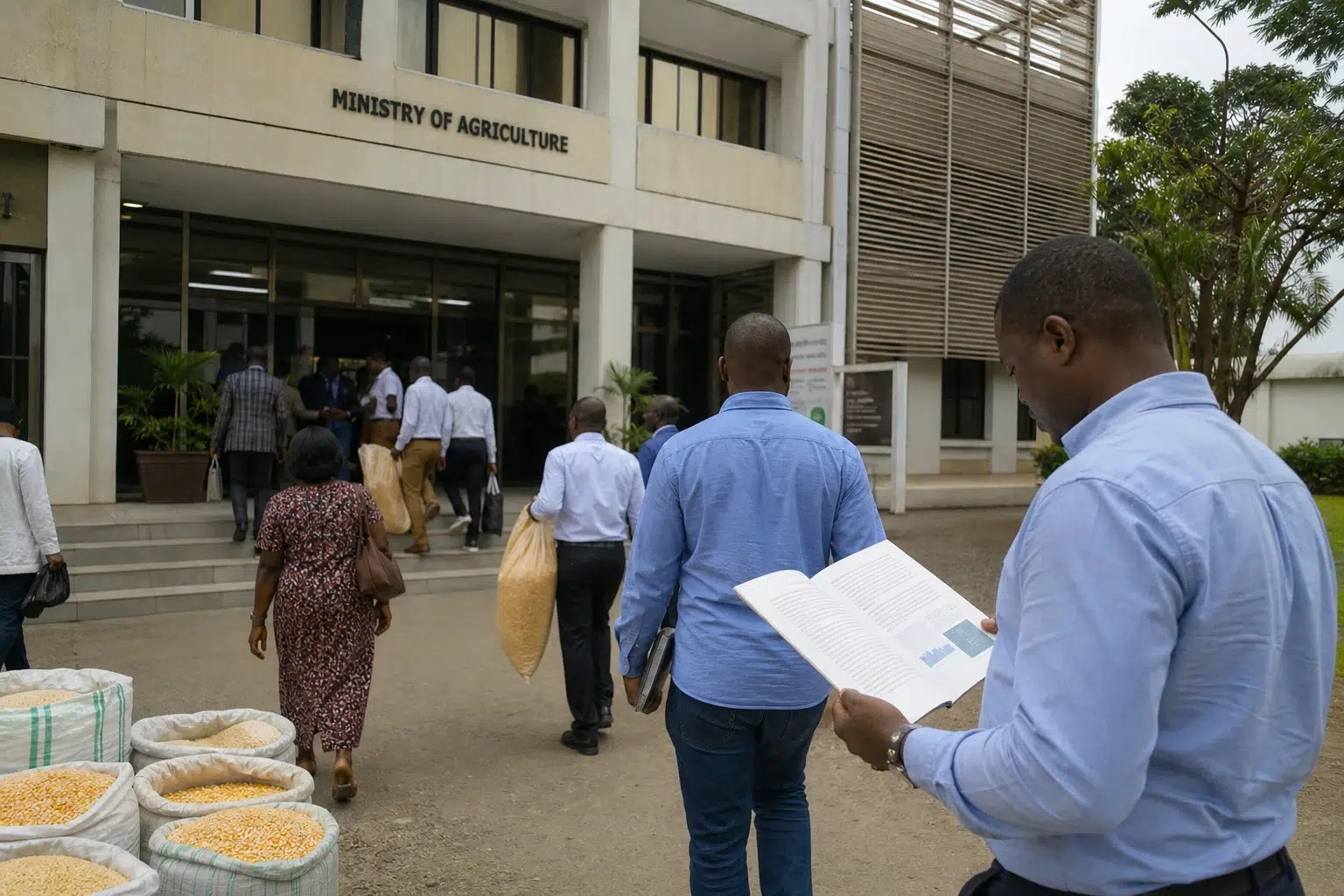
In July 2026, representatives of the U.S. Grains & BioProducts Council, a US organisation specialising in developing export markets for maize, barley, sorghum and their co-products, conducted market exploration missions in Guinea and Côte d’Ivoire. The organisation says it sees this as a commercial opening among animal-feed players. The move is no coincidence. It comes as both countries seek to increase poultry production and modernise their livestock and poultry feed industries.
The US council is no stranger to the West African coast. It has already organised a conference in Abidjan bringing together African buyers and sellers, with participants from US grain markets. This repeated presence shows that Côte d’Ivoire is now serving as a commercial foothold for part of West Africa, at least in the specialist grains and animal-feed segments.
The strategy targets an expanding market. Globally, the FAO notes that poultry meat trade remains highly sensitive to animal diseases and trade policies, while developing countries are becoming increasingly dependent on imports. Against this backdrop, any rise in demand for animal feed creates an opportunity for maize exporters, but also for local manufacturers able to offer competitive costs and reliable volumes.
Guinea wants to rebuild its industry
In Conakry, the challenge is first and foremost one of catching up. In 2026, the Guinean government presented a national poultry development strategy for 2026–2030, with an announced investment plan of $563 million. Its stated aim is clear: to reduce what it considers heavy dependence on poultry meat imports, estimated at about 80% of the country’s needs in the framework document published by the authorities.
The figures show the scale of the task. According to the FAO, Guinea’s chicken meat imports rose from 57,421 tonnes in 2020 to 88,590 tonnes in 2024, while local production remained limited, averaging around 13,800 tonnes a year between 2020 and 2024. In other words, the gap between local supply and demand continues to be filled from abroad.
The constraint is not just industrial; it is also a health issue. Guinea experienced its first documented outbreak of highly pathogenic avian influenza in 2022, and further episodes have since highlighted the vulnerability of farms to health crises. For the industry, biosecurity, veterinary monitoring and the availability of safe feed have therefore become as important as production capacity itself.
In Côte d’Ivoire, moving upmarket changes the scale
In Côte d’Ivoire, the industry is more structured and more visible. In April 2026, the Ivorian Ministry of Animal Resources said poultry meat production had reached about 115,000 tonnes, while the poultry industry association has set a target of 200,000 tonnes by 2030. Another official presentation of the integrated poultry project also cites this target, linking it to a system for producing feed, operating hatcheries and processing products.
Investment is multiplying to support this trajectory. Dutch group De Heus has announced plans for an animal-feed plant in Korhogo, in the north of the country, while SIPRA has attracted a $23.5 million investment from the Norfund fund. These moves confirm a simple trend: the more professional the poultry industry becomes, the greater its needs for raw materials, logistics and processing capital.
Côte d’Ivoire also plays a regional role. The country has a strong enough commercial position to serve neighbouring markets such as Mali and Burkina Faso, two landlocked states whose supplies depend heavily on coastal logistics corridors. For grain traders, Abidjan is therefore not just a domestic destination. It is a gateway to a broader West African market.
The real debate: imports or local value creation?
Interest from US maize exporters does not tell the whole story. Above all, it reveals a major tension. If poultry growth is fuelled by grain imports, it can support meat supply in the short term but leave regional maize producers out. Conversely, if governments succeed in linking livestock farming to local grain-producing areas, the economic gains can spread more widely across rural areas, peri-urban zones and small processing businesses.
In practice, everything will depend on the price of maize, the quality of storage infrastructure, the reliability of supplies and the ability of governments to enforce health standards. In Guinea, the challenge is to rebuild an industry almost from the ground up. In Côte d’Ivoire, it is more a matter of supporting growth already under way without sending animal-feed costs soaring. In both cases, the poultry industry is becoming a test of economic sovereignty as well as a promising market.
At continental level, the issue illustrates an increasingly common reality: agricultural policies, grain imports and the growth of animal-protein consumption are moving together. What is at stake in Guinea and Côte d’Ivoire also concerns other ECOWAS countries, where urban food demand is rising rapidly, logistics chains remain fragile and the choices between local production and imports will carry significant weight in the years ahead.