Algeria
 Egypt
 Libya
 Morocco
 Sudan
 Tunisia
 Benin
 Burkina Faso
 Cabo Verde
 Côte d'Ivoire
 Ghana
 Guinea
 Guinea-Bissau
 Liberia
 Mali
 Mauritania
 Niger
 Nigeria
 Senegal
 Sierra Leone
 The Gambia
 Togo
 Cameroon
 Central African Republic
 Chad
 Equatorial Guinea
 Gabon
 Republic of the Congo
 São Tomé and Príncipe
 Burundi
 Comoros
 Djibouti
 Eritrea
 Ethiopia
 Kenya
 Madagascar
 Malawi
 Mauritius
 Mozambique
 Rwanda
 Seychelles
 Somalia
 South Sudan
 Tanzania
 Uganda
 Angola
 Botswana
 Eswatini
 Lesotho
 Namibia
 South Africa
 Zambia
 Zimbabwe
Peace announced, but the situation on the ground has not changed
In Kinshasa, hopes for a swift easing of tensions in the east of the Democratic Republic of the Congo soon ran up against realities on the ground. People in North Kivu and South Kivu continue to live with shifting front lines, repeated displacement and persistently fragile security. The agreement signed in Washington had raised hopes of a tangible change.
But a diplomatic timetable is not enough to stop the guns. By mid-July 2026, the withdrawal of Rwandan troops expected by Washington had not taken place, according to Radio Okapi, which noted that no official departure had been observed by 15 July. This impasse offers a straightforward measure of the problem: the text exists, but implementation remains incomplete.
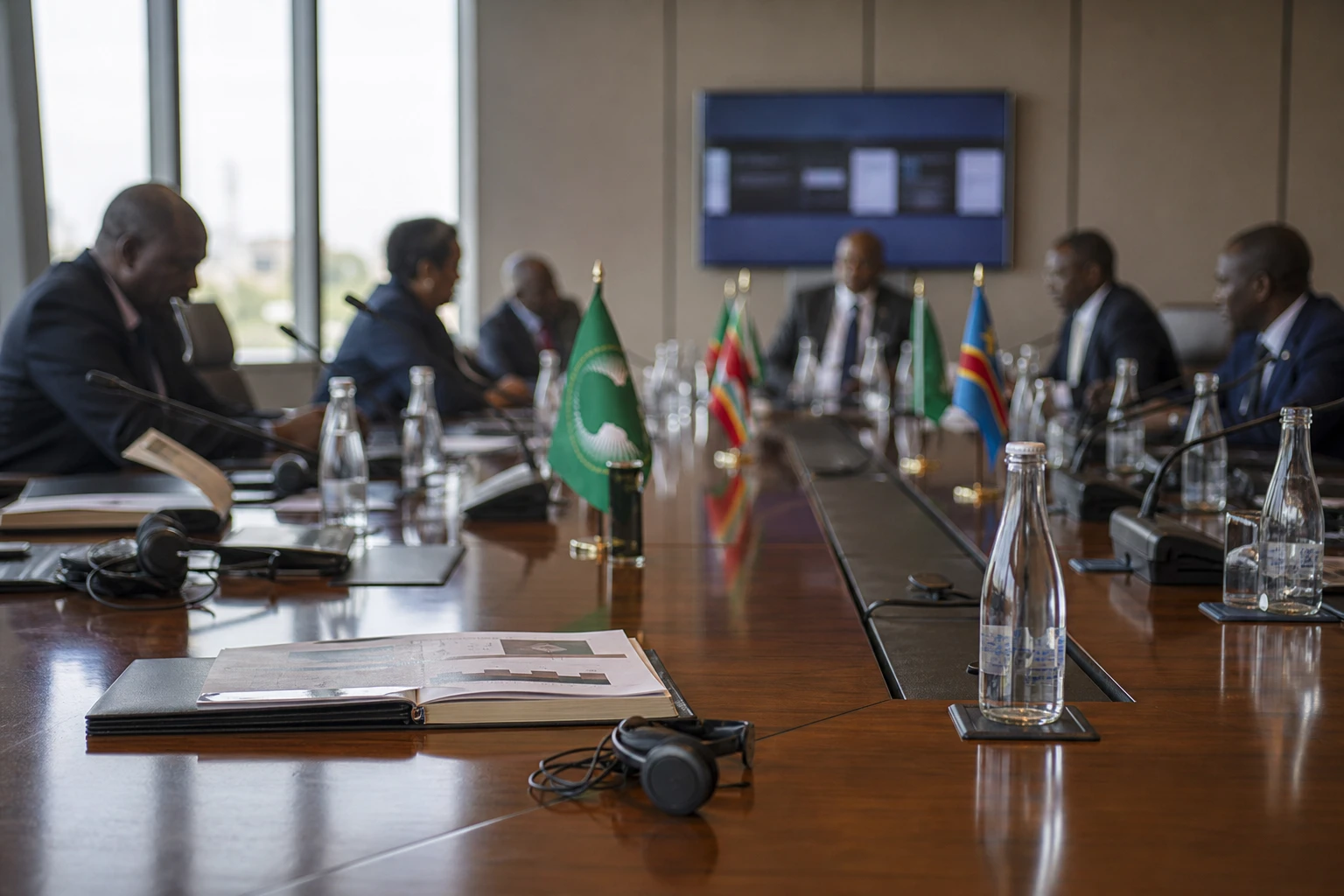
Washington, Doha and the African Union: three tracks, one test
The Congolese crisis is not being handled at a single negotiating table. It advances, or retreats, through a tangle of diplomatic frameworks. There is Washington, where the DRC and Rwanda signed a peace agreement on 27 June 2025. There is Doha, where Kinshasa and the AFC/M23 have also begun talks. And there is the African framework, led by the African Union and regional mechanisms in the Great Lakes. The AU welcomed the signing of the Washington agreement and called on the parties to honour their commitments.
The Congolese Ministry of Foreign Affairs had described the agreement as “binding, orderly and verifiable”, providing for the full withdrawal of Rwandan troops and their auxiliaries within a maximum of 90 days. The same document also announced a joint security coordination mechanism, due to begin operating within 30 days. On paper, the framework is clear. In practice, implementation remains the main stumbling block.
What the failure to withdraw means for the DRC
For the DRC, the stakes go beyond diplomatic symbolism. In the east, every delay fuels uncertainty over front lines, undermines the return of displaced people and hampers economic recovery. Trade routes, artisanal mining, freight transport and even schools remain exposed to the shocks of conflict. When fighting intensifies, it is households, traders, health workers and displaced people who pay the price first.
The assessment echoes warnings from the UN. On 29 June 2026, its envoy for the region told the Security Council that the period remained marked by human rights violations and persistent tensions in the Congolese east. The AP subsequently reported UN experts’ findings of no or limited withdrawals, and of significant numbers of Rwandan troops still present in the Kivus at the end of 2025, with no significant withdrawal observed afterwards. These findings reinforce the view that an announced ceasefire does not automatically translate into a real disengagement.
In this context, Kinshasa is seeking more than a diplomatic victory. The government wants to restore state authority over an area where the regular army, rebel groups and regional influence coexist. Kigali, for its part, continues to frame its view of the conflict around the threat posed by the FDLR, the Democratic Forces for the Liberation of Rwanda, a Hutu armed group that emerged from the 1994 genocide. This interpretation is well known. But it does not resolve the central question raised in Washington: who withdraws what, from where, and by when?
A Congolese crisis, but also a regional signal
The deadlock over the Rwandan withdrawal has consequences beyond the borders of the DRC. It tests the credibility of US diplomacy in the Great Lakes, as well as that of African crisis-management frameworks. For the African Union, the case is a reminder that an agreement signed outside the continent has value only if it fits within a coherent regional architecture, is acceptable to local actors and is backed by monitoring guarantees. That is precisely where the difference lies between a diplomatic ceasefire and lasting peace.
The United Nations Security Council has already reiterated, through its resolutions on eastern Congo, the requirement for foreign forces to withdraw and for external support to armed groups to end. But in the Great Lakes region, texts alone solve nothing. They must be backed by verification mechanisms, sustained political pressure and an African understanding of the balance of power. Without that, deadlines slip, front lines shift and civilians remain on the front line.
What happens next will therefore depend less on a date on the calendar than on measurable action: a verified withdrawal, an upheld ceasefire, effective security coordination and clearer links between Washington, Doha and African frameworks. For the DRC, the stakes are immediate. For the region, they are broader: whether a negotiated peace can still produce tangible results in eastern Congo.