Algeria
 Egypt
 Libya
 Morocco
 Sudan
 Tunisia
 Benin
 Burkina Faso
 Cabo Verde
 Côte d'Ivoire
 Ghana
 Guinea
 Guinea-Bissau
 Liberia
 Mali
 Mauritania
 Niger
 Nigeria
 Senegal
 Sierra Leone
 The Gambia
 Togo
 Cameroon
 Central African Republic
 Chad
 DR Congo
 Equatorial Guinea
 Gabon
 Republic of the Congo
 São Tomé and Príncipe
 Burundi
 Comoros
 Djibouti
 Eritrea
 Ethiopia
 Kenya
 Madagascar
 Malawi
 Mauritius
 Mozambique
 Rwanda
 Seychelles
 Somalia
 South Sudan
 Tanzania
 Uganda
 Angola
 Botswana
 Eswatini
 Lesotho
 Namibia
 South Africa
 Zambia
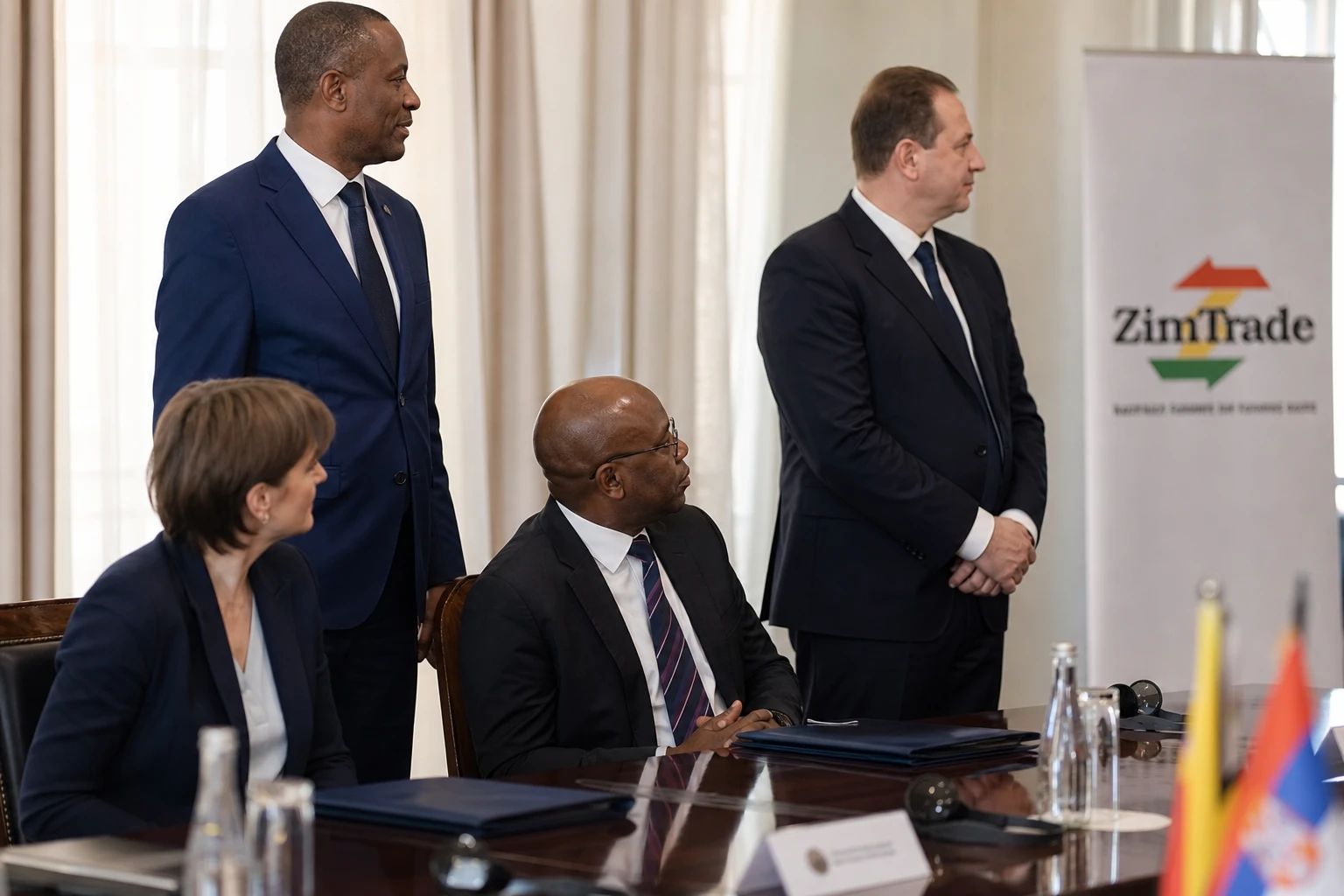
A modest agreement, but a useful signal for Zimbabwean exporters
When two countries trade little, every bridge matters. For Zimbabwe, the issue is not simply signing agreements. It is turning longstanding diplomatic ties into concrete opportunities for businesses, from Harare to production areas seeking more stable markets. On 4 August in Belgrade, this approach took the form of a memorandum of understanding between ZimTrade, the national trade promotion agency, and Serbia Export, the Serbian platform for internationally focused businesses.
The issue is all the more interesting because trade remains very low compared with the ambitions on display. According to Serbia’s Ministry of Foreign Affairs, trade in goods between Serbia and Zimbabwe reached €2.1 million in 2025, with €88,000 in Serbian exports and €2.0 million in imports. The same document notes that bilateral relations date back to 1980 and are described as “traditionally close and friendly”.
Harare, Belgrade and the logic of niche markets
Zimbabwe has for several years pursued a strategy of market diversification. Its economic planning documents list ZimTrade among the instruments intended to support market access, export development and integration into regional and global value chains, notably under the AfCFTA, the African Continental Free Trade Area, and SADC’s industrial strategy, the Southern African Development Community.
Serbia, for its part, is expanding the mechanisms it uses to connect its businesses with external partners. Serbia Export describes itself as a digital platform launched by the Serbian Chamber of Commerce and Industry to showcase the capabilities, products and services of businesses ready to export. This structure explains the kind of agreement signed in Belgrade: it is less about a major treaty than a practical mechanism for making connections.
What the memorandum signed in Belgrade provides for
The memorandum concluded on 4 August provides for several practical tools: sharing trade information, holding joint business forums and directly connecting companies. The stated aim is straightforward: to streamline contacts and generate contracts, investment and export flows. The agreement also forms part of preparations for EXPO 2027 in Belgrade, an event Serbia presents as a major international showcase.
For Zimbabwe, this kind of framework could be useful in sectors already identified as promising. In Belgrade, during a meeting in March 2026 with the Serbian Chamber of Commerce and the Serbian Development Agency, a Zimbabwean delegation including ZimTrade representatives highlighted the country’s potential in mining, agriculture, tourism and processing. Serbian counterparts also cited these sectors as areas for cooperation.
Why this development also matters to Zimbabwe’s economy
The first issue is diversification. Zimbabwe still exports too often to a limited number of markets and remains exposed to commodity price fluctuations and logistics costs. A Zimbabwean parliamentary report on the Ministry of Foreign Affairs and International Trade also notes that the slow growth in export earnings is partly explained by volatile global prices and logistical constraints. In this context, opening up more avenues for trade is not a luxury. It is a necessity.
The second issue concerns medium-sized businesses, which are often the first to benefit from an agreement of this kind. They need reliable information, identified partners and easier access to business networks. This is precisely the role ZimTrade says it fulfils: supporting exporters, strengthening their capabilities and opening up new markets. The agreement with Serbia Export could therefore act as a catalyst, especially for higher value-added products.
The third issue is sectoral complementarity. On the Zimbabwean side, discussions in Belgrade in March highlighted minerals, agriculture, tourism and processing. Serbian exporters, meanwhile, are looking to expand their markets beyond their immediate neighbourhood. The agreement thus creates a space for cooperation in very practical sectors: equipment, inputs, processed agricultural products, trade-related services and logistics.
A regional significance extending beyond the Harare–Belgrade axis
The significance of this rapprochement is not confined to the two capitals. Across Africa, it reflects a broader trend: countries are seeking to turn diplomacy more effectively into contracts, and their chambers of commerce into trade bridges. For Zimbabwe, a member of SADC and participant in the AfCFTA, each bilateral agreement can serve as a test for more regular, better-documented exports that are less dependent on a single partner.
For Serbia, relations with Zimbabwe also form part of a strategy of engagement with Africa, as Serbia Export’s communications make clear. The platform features content dedicated to faster and more effective cooperation with the continent. In the coming months, the real measure will not be the signature itself, but the number of business meetings, contracts and trade flows that follow, particularly as EXPO 2027 in Belgrade approaches.
Ultimately, this memorandum tells less of a spectacular breakthrough than of a change in approach. Between Harare and Belgrade, the task now is to move from longstanding diplomatic relations to measurable economic cooperation. It is often through this kind of discreet but targeted agreement that the true depth of a partnership takes shape.