Algeria
 Egypt
 Libya
 Morocco
 Sudan
 Tunisia
 Benin
 Burkina Faso
 Cabo Verde
 Côte d'Ivoire
 Ghana
 Guinea
 Guinea-Bissau
 Liberia
 Mali
 Mauritania
 Niger
 Nigeria
 Senegal
 Sierra Leone
 The Gambia
 Togo
 Cameroon
 Central African Republic
 Chad
 DR Congo
 Equatorial Guinea
 Gabon
 Republic of the Congo
 São Tomé and Príncipe
 Burundi
 Comoros
 Djibouti
 Eritrea
 Ethiopia
 Kenya
 Madagascar
 Malawi
 Mauritius
 Mozambique
 Rwanda
 Seychelles
 Somalia
 South Sudan
 Tanzania
 Uganda
 Angola
 Botswana
 Eswatini
 Lesotho
 Namibia
 South Africa
 Zimbabwe
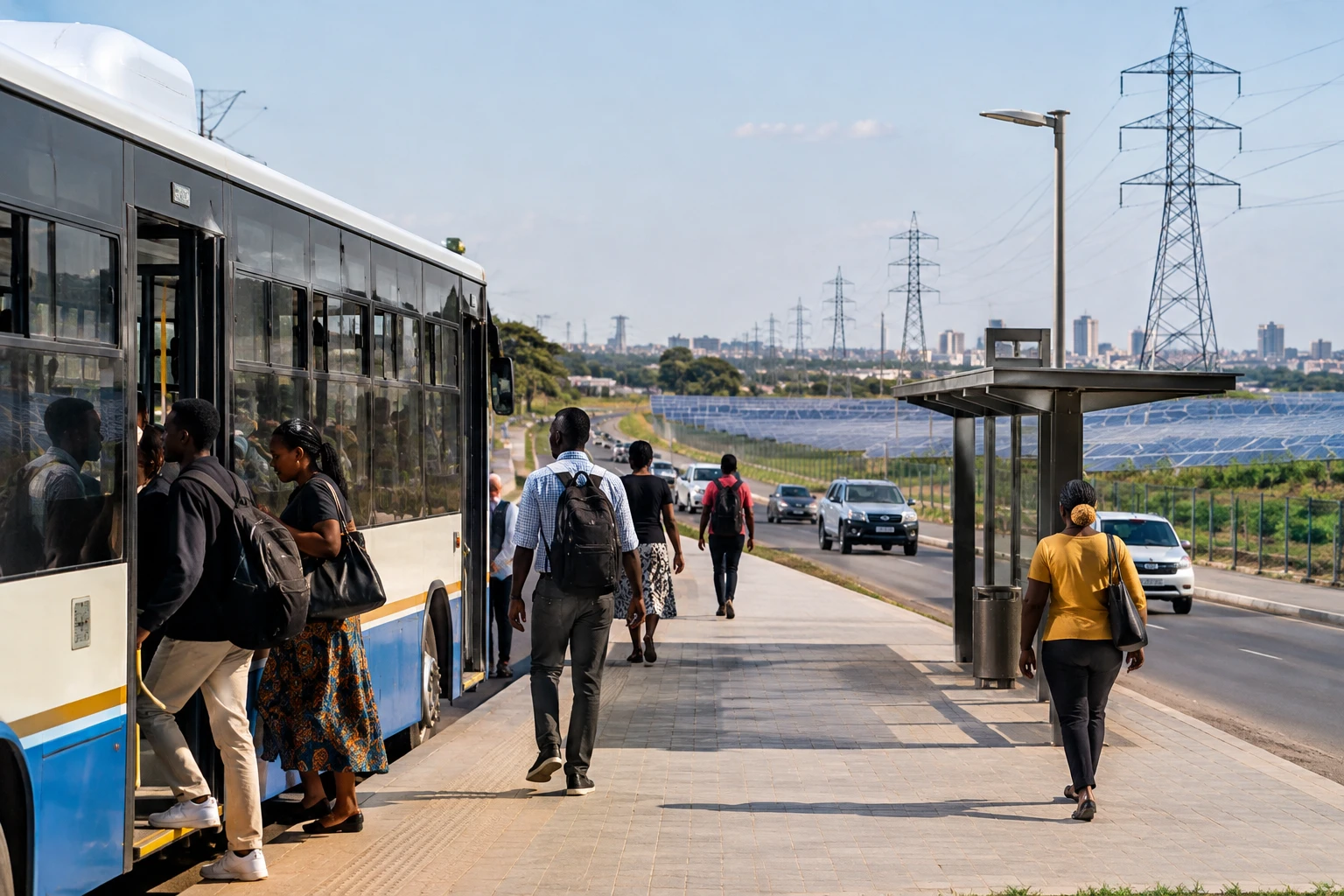
A solar power plant can add megawatts to Zambia’s electricity system. But for them to supply homes, businesses and mines, lines are also needed to carry the power. This is now the challenge posed by the rapid rise of solar in Zambia.
A changing power mix
In Lusaka on 7 October 2026, Vice-President Mutale Nalumango read a speech by President Hakainde Hichilema at the opening of the third Energy Forum for Africa. The figures presented point to rapid change: installed electricity capacity is said to have risen from 3,777 megawatts (MW) in 2024 to 4,722.3 MW in 2026. Solar capacity, meanwhile, is said to have increased from 178 to 1,027.5 MW.
These government figures were also reported by Zambian media outlets ZNBC and Lusaka Times. Their comparison indicates that solar accounts for about 90% of the net increase in capacity since 2024, and nearly 22% of current capacity. This is installed capacity, not electricity generated continuously: panels do not supply the same amount of energy at every hour of the day.
The official target of 1,000 MW of solar by 2026 has therefore been exceeded, according to these figures. The government is also aiming for 10,000 MW of electricity capacity by 2031. But meeting these targets on paper does not, by itself, guarantee a stable supply in every region.
Drought exposed the cost of heavy reliance on hydropower
Efforts to diversify follow the severe drought of 2024. Lower water inflows reduced hydropower generation, particularly around the Kariba Dam, which is shared with Zimbabwe. The International Monetary Fund described an increase in reliance on electricity imports and costly fuels to make up for the shortfall in generation.
This vulnerability has had effects beyond the energy sector. When supply falls, businesses have to cope with outages or seek backup solutions. Households, small businesses and producers do not all have the same means to absorb these costs. National capacity figures alone do not, however, show how outages and tariffs are distributed between cities, rural areas and consumer groups.
Solar provides a complementary source that does not depend on reservoir levels. Several large-scale projects have contributed to the expansion, including the second phase of the 136 MW Itimpi power plant, inaugurated in Kitwe in May 2026. The Ministry of Energy also cites the second phase of the Chisamba project, with a capacity of 100 MW. These installations illustrate the growing role of independent producers and private investment alongside public-sector players.
Generating more is not enough
The president highlighted another link in the chain: transmission and distribution networks. Power plants can increase available capacity, but a congested line or inadequate connection limits the electricity they can actually deliver. The problem is particularly acute when new generation is far from centres of consumption or major industrial sites.
For the Copperbelt’s mines, a central sector of the Zambian economy, a predictable supply is vital for production and investment. For households and small businesses, the issue is more immediate: being able to rely on electricity without having to pay for backup equipment. The network must therefore be strengthened alongside new power plants; otherwise, the benefits of increased capacity risk remaining unevenly accessible.
Solar also has a familiar limitation: its output varies with sunlight and cannot, on its own, meet needs at night or during periods of high demand. Storage, grid management and complementarity with hydropower and other sources are becoming essential. Diversification reduces exposure to a single resource, but does not remove technical constraints or the need to invest in the system as a whole.
A Zambian challenge with regional implications
Zambia is a member of the Southern African Development Community (SADC), which brings together countries in the region, and participates in the Southern African Power Pool, the regional electricity trading network. This interconnection enables member countries to exchange energy when capacity and transmission lines allow. The 2024 drought nevertheless showed that a regional shortfall can limit import opportunities precisely when several countries need them.
At the Lusaka forum, the government also called for closer regional co-operation. The idea of a less fragmented electricity system will depend on concrete decisions: new interconnections, transit rules, funding for transmission lines and co-ordination between suppliers. Ambitions for a “borderless market” will benefit consumers only if the infrastructure keeps pace.
Zambia’s progress thus highlights two realities at once: solar capacity can be deployed quickly, but its value depends on whether it can be integrated into the grid and the electricity distributed. The next step to watch will be the delivery of announced investments in transmission and distribution, alongside the national target of 10,000 MW by 2031.
Sources consulted: Zambian Ministry of Energy, ZNBC, Lusaka Times, Zambian Presidency, International Monetary Fund and SADC.