Algeria
 Egypt
 Libya
 Morocco
 Sudan
 Tunisia
 Benin
 Burkina Faso
 Cabo Verde
 Côte d'Ivoire
 Ghana
 Guinea
 Guinea-Bissau
 Liberia
 Mali
 Mauritania
 Niger
 Nigeria
 Senegal
 Sierra Leone
 The Gambia
 Togo
 Cameroon
 Central African Republic
 Chad
 DR Congo
 Equatorial Guinea
 Gabon
 Republic of the Congo
 São Tomé and Príncipe
 Burundi
 Comoros
 Djibouti
 Eritrea
 Ethiopia
 Kenya
 Madagascar
 Malawi
 Mauritius
 Mozambique
 Rwanda
 Seychelles
 Somalia
 South Sudan
 Tanzania
 Uganda
 Angola
 Botswana
 Eswatini
 Lesotho
 Namibia
 South Africa
 Zimbabwe
Voting began before dawn in Lusaka
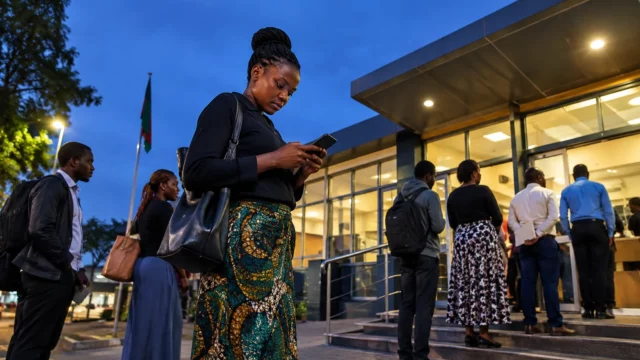
In Zambia, the presidential election first took the form of a queue. In Lusaka, several voters arrived before polling stations opened, wrapped up against the morning cold, to make their voices heard in the early hours. The gesture says much about the stakes of the election: in a country where voting remains a powerful civic act, everyone understands that the next term will weigh on daily life far more than on party balances alone.
Election day is taking place within a clearly defined institutional framework. The 13 August 2026 poll is to renew not only the presidency but also the National Assembly and local councils. In March 2026, Zambia’s National Assembly said the provisional register contained 8,861,918 registered voters, a more precise figure than the rounded estimates often cited during the campaign. The electoral authorities, for their part, confirmed that voting would take place in a single day, with results expected to be announced the following Monday.
An election against the backdrop of an uneven economic recovery
President Hakainde Hichilema is seeking a second term in a climate shaped less by promises than by choices and trade-offs. Since he came to power in 2021, his government has made notable progress on debt and macroeconomic stability. The International Monetary Fund says Zambia has restructured a large part of its public debt and that growth has resumed, while inflation has fallen sharply from the peaks seen earlier in the term. But the same institution also notes that the cost of living, food prices and social tensions remain at the heart of people’s concerns.
The country is also emerging from a difficult economic period. Drought has weighed on agriculture and energy, while power cuts have held back several sectors. The World Bank describes an economy in recovery, driven by copper, agriculture and tourism, but still vulnerable to climate shocks and fluctuations in mining revenues. In a state so dependent on copper exports, the promise of stability is judged not only by the trend in national indicators; it is also measured by household bills, the price of maize and the reliability of the electricity supply.
The election is therefore seen as a test of economic credibility. Hichilema is banking on his record, notably the normalisation of relations with creditors and the revival of investment. His opponents, meanwhile, are capitalising on more immediate discontent: squeezed wages, scarce jobs and the persistent high cost of living. Six months before polling day, local media and analysts were already describing a campaign dominated by three concrete issues: the cost of living, jobs and governance. The big ideological debates have taken a back seat; the ballot is chiefly a way to judge what has, or has not, been delivered since 2021.
A Zambian vote, but a signal for all of southern Africa
The presence of observers from the European Union and the Southern African Development Community, SADC, is a reminder that Zambia never votes in isolation from the region. On 13 August 2026, SADC deployed an election observation mission in the country, in line with its revised electoral principles. In previous elections, the African Union had already stressed the importance of transparency and trust in Zambia’s electoral institutions. In southern Africa, where peaceful transfers of power carry considerable weight in regional assessments of democracy, Lusaka is being watched closely.
Zambia also matters because it is a strategic economic player. A major copper producer, it is landlocked but connected to the region’s mining and logistics corridors, and has an influence on southern Africa’s supply chains. If the incumbent president is re-elected, the message will be one of economic continuity and continued reform. If the opposition overturns the trend, the signal will be political as well as economic: voters will have made their decision based on how they feel about the cost of living, rather than growth indicators alone.
For the population, the stakes are immediate. For the executive, they are strategic. Between the capital, Lusaka, the mining centres of the Copperbelt, university towns and rural areas more dependent on food prices, the vote does not mean the same thing everywhere. That is precisely what makes this presidential election a major political moment: it measures a government’s ability to turn a macroeconomic recovery into tangible improvement, and it will also show whether Zambians are still willing to give Hakainde Hichilema more time to deliver on his promise of recovery.
In the coming hours, attention will shift to the count and then to the publication of the results, which the electoral authority expects on Monday. Until then, the scene in Lusaka has already set the tone for the election: a country voting early, in large numbers, and convinced that the ballot box remains the most direct way to judge five years of reforms, budgetary constraints and promises still unfulfilled.