Algeria
 Egypt
 Libya
 Morocco
 Sudan
 Tunisia
 Benin
 Burkina Faso
 Cabo Verde
 Côte d'Ivoire
 Ghana
 Guinea
 Guinea-Bissau
 Liberia
 Mali
 Mauritania
 Niger
 Nigeria
 Senegal
 Sierra Leone
 The Gambia
 Togo
 Cameroon
 Central African Republic
 Chad
 DR Congo
 Equatorial Guinea
 Gabon
 Republic of the Congo
 São Tomé and Príncipe
 Burundi
 Comoros
 Djibouti
 Eritrea
 Ethiopia
 Kenya
 Madagascar
 Malawi
 Mauritius
 Mozambique
 Rwanda
 Seychelles
 Somalia
 South Sudan
 Tanzania
 Uganda
 Angola
 Botswana
 Eswatini
 Lesotho
 Namibia
 South Africa
 Zimbabwe
When digital waste becomes a jobs market
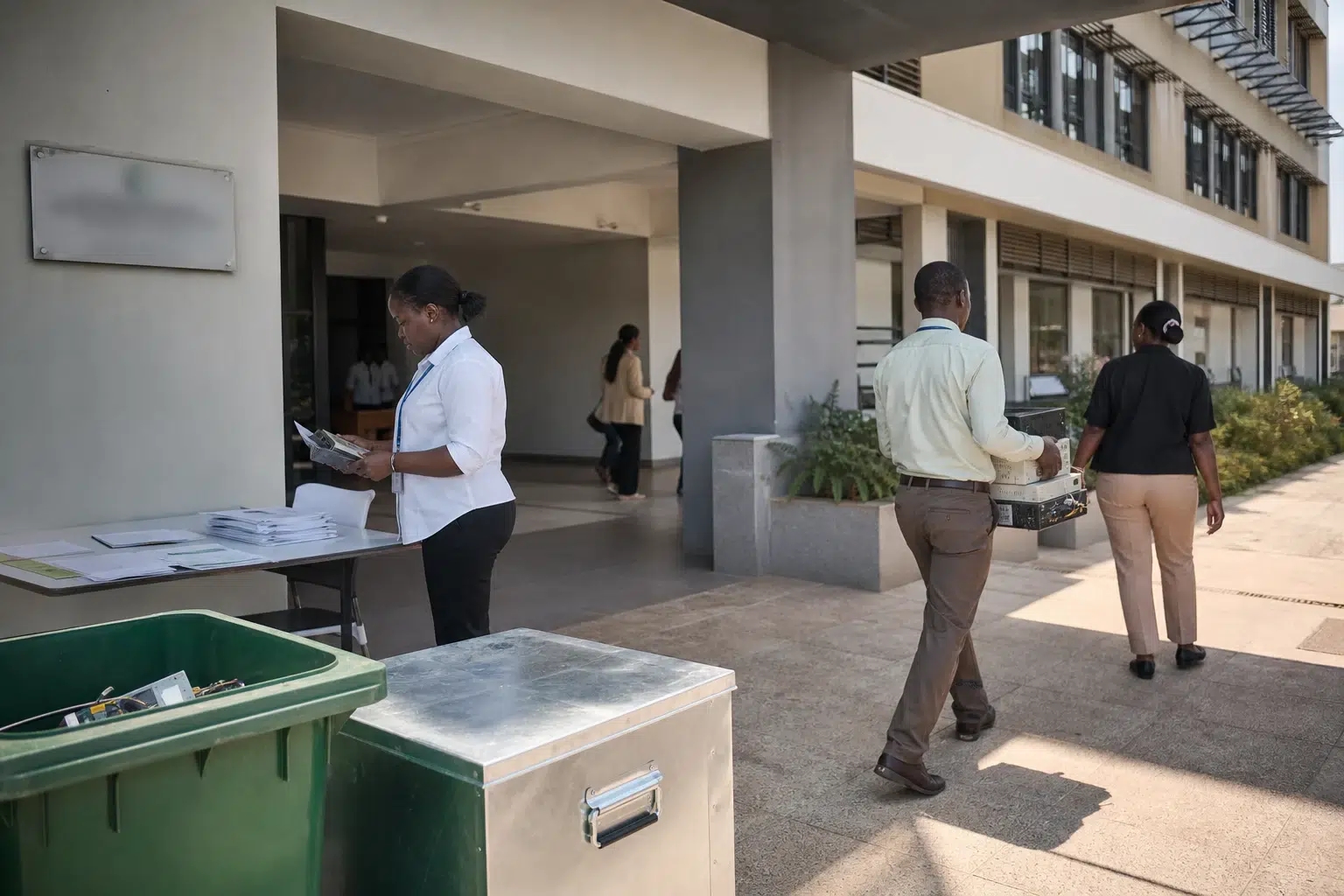
In Lusaka, the question is not just what to do with old phones, cables and computers that no longer work. It is broader: how can a clean industry be built without sidelining those who are already recovering the value contained in these devices, out of sight? In Zambia, the answer now lies in a project seeking to bring together the environment, employment and the formalisation of the green economy.
This debate is part of a well-known regional trajectory in southern Africa. Zambia is a landlocked country and a founding member of SADC, the Southern African Development Community, which is pushing its members towards greater economic integration and regulatory coherence. In a country where the economy still depends heavily on mining, the growth of electronic waste raises a fundamental question: how can the value of these materials be captured without increasing health and environmental risks?
In Lusaka, a pilot project aims to change the equation
The initiative launched in Lusaka brings together the Zambian government, the International Labour Organization and Japan. According to the information available, it was presented as a sustainable electronics recycling initiative with a very practical goal: to create green businesses and decent jobs in e-waste treatment. The project primarily targets young people, women and people with disabilities.
The issue is far from marginal. The Global E-waste Monitor 2024 reports that 62 billion kilograms of e-waste were generated worldwide in 2022, but only 22.3% was collected and recycled formally and in an environmentally sound manner. The same report notes that in Africa, the share officially collected and recycled remains below 1%. In other words, the continent remains both the lowest polluter by volume and one of the least equipped to handle this growing waste stream.
In this context, Zambia is not starting from scratch. A legal framework is already in place. The Environmental Management Act of 2011, overseen by the Zambia Environmental Management Agency, stipulates, among other things, that producers of goods liable to cause pollution must take measures to minimise waste through treatment, reuse, recovery or recycling. ZEMA also notes that electronic waste is one of the country’s emerging areas of environmental regulation.
But there is still a wide gap between the law and what happens on the ground. ZEMA says that, in the absence of sufficient investment in technology and infrastructure, e-waste in Zambia is still often buried, dumped illegally or burned. This is a serious concern, as such waste contains heavy metals and toxic substances such as lead, mercury and cadmium.
Formalising without disrupting the existing ecosystem
The real challenge for the Zambian project lies here: it is not just about opening a recycling centre, but about turning a scattered activity into a clearly defined industry. The project brief available from the ILO refers to training young people, women and people with disabilities in the reuse, recycling and safe disposal of equipment. It also provides for business management support, with a view to establishing small enterprises able to operate in compliance with standards.
This approach matters because the informal sector does not disappear by decree. In many African countries, it already handles collection, sorting, parts recovery and a share of the economic value. The problem is that this often happens without adequate protection for workers or effective environmental controls. In Zambia, the challenge is therefore to bring these workers into a formal value chain rather than push them to the margins.
This approach also aligns with part of Zambia’s employment agenda. The ILO’s country pages show active cooperation on skills, apprenticeships and youth employability. The new e-waste project is therefore part of a broader policy: using economic and energy transitions to create jobs, not merely to publish regulations.
Employers in Zambia, through the Zambia Federation of Employers, also see an economic case for organising the sector. Their support matters, because without businesses ready to buy, process and add value to materials, a green industry remains theoretical. This is where the project could make a difference: it brings regulation, training and the private sector together within the same framework.
What this means for Zambia and beyond
For urban residents, particularly in Lusaka and smaller urban centres, the potential impact is twofold. Better collection reduces exposure to hazardous substances. At the same time, a formal industry can provide more stable incomes for young people already working in recovery chains. For local authorities, it also means less pressure on landfills and informal burning sites.
For the national economy, the issue is one of productive modernisation. The country has a population of 21.9 million in 2025, according to the World Bank, with economic growth forecast at 3.8% that year. In this context, the creation of micro-enterprises in recycling is not a minor social concern; it is a test of the ability to turn an environmental challenge into an organised economic activity.
The initiative also extends beyond Zambia’s borders. Across SADC, many countries face the same equation: rising digital use, limited treatment capacity, a large informal sector and growing demand for urban jobs. If Zambia succeeds in connecting regulation, training and economic opportunities, it could offer a model that can be replicated in southern Africa. This would be all the more useful given that global projections remain bleak: the volume of e-waste continues to grow faster than formal recycling.
The next stage will therefore be decisive. Success will not be measured simply by the project’s launch, but by its ability to outlast the initial publicity, create sustainable jobs and reduce burning, burial and hazardous recovery. In a country seeking to combine youth employment with a green transition, the credibility of the sector will be put to the test here.