Algeria
 Egypt
 Libya
 Morocco
 Sudan
 Tunisia
 Benin
 Burkina Faso
 Cabo Verde
 Côte d'Ivoire
 Ghana
 Guinea
 Guinea-Bissau
 Liberia
 Mali
 Mauritania
 Niger
 Nigeria
 Senegal
 Sierra Leone
 The Gambia
 Togo
 Cameroon
 Central African Republic
 Chad
 DR Congo
 Equatorial Guinea
 Gabon
 Republic of the Congo
 São Tomé and Príncipe
 Burundi
 Comoros
 Djibouti
 Eritrea
 Ethiopia
 Madagascar
 Malawi
 Mauritius
 Mozambique
 Rwanda
 Seychelles
 Somalia
 South Sudan
 Tanzania
 Uganda
 Angola
 Botswana
 Eswatini
 Lesotho
 Namibia
 South Africa
 Zambia
 Zimbabwe

US customs turns its attention to Africa
Global trade is no longer played out only in ports, railways and factories. It is also about the origin of goods, a box that can tip a customs bill, an export contract or access to the US market. Against this backdrop, Washington is taking a tougher line and says it wants to track down routes where a product changes its paperwork more easily than it gains added value.
Morocco and Kenya have thus been named among the countries to watch as part of efforts to combat illicit trans-shipment — the passage of goods through a third country to conceal a product’s true origin or artificially secure a tariff advantage. The US warning does not prove that Rabat or Nairobi is organising fraud; it signals a perceived risk in increasingly fragmented value chains.
For the continent, the stakes go beyond trade diplomacy. They concern the way Africa fits into global industrial chains: as a mere logistics corridor, an assembly base or a place of genuine transformation. The distinction matters, because the same port, free-trade zone or factory can serve legitimate industrialisation projects while also attracting suspicion from foreign customs authorities.
Morocco between a free-trade deal and industrial ambition
Morocco has a rare advantage in North Africa: a free-trade agreement with the United States, which entered into force on 1 January 2006. The agreement opened up preferential access to the US market, while imposing rules of origin designed to prevent a product from a third country from simply being relabelled “made in Morocco”.
It is precisely this mix of openness and vigilance that makes the issue sensitive. The kingdom has attracted Chinese industrial companies in the automotive, components and battery sectors. In July 2026, the African Development Bank approved a €100 million loan to Gotion Power Morocco for an LFP gigafactory in the Rabat-Salé-Kénitra free-trade zone. The project, led by Gotion High-Tech, is set to produce cells and packs for electric vehicles.
In the longer term, this investment illustrates Morocco’s strategic choice: to attract Asian capital, move up the value chain in the automotive industry and consolidate its status as an export platform between Europe, Africa and North America. Rabat highlights local processing, industrial employment and supplier integration. Washington, meanwhile, is focused above all on the ability to prove that a product has not merely passed through Moroccan territory before entering its market.
The debate extends beyond Morocco. In the European Union, too, the growth of Chinese investment in Morocco is fuelling questions about the indirect re-export of industrial overcapacity. The issue is not new. But it is becoming more fraught as major powers raise trade barriers and seek to close off routes for circumvention.
Kenya, a regional hub under scrutiny
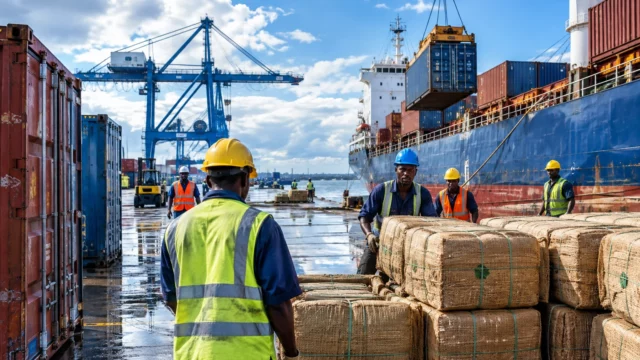
Kenya features in a different context: as a logistics platform for East Africa. The ports of Mombasa and Lamu are described by the port authorities as transit and trans-shipment hubs. Lamu port, part of the LAPSSET corridor, even aspires to become a major deep-water trans-shipment hub.
This role as a crossroads is an economic strength. It supports port revenues, cargo handling, road and rail freight, as well as a host of informal activities around the terminals. But it also exposes the country to greater pressure over rules of origin, especially as the Kenya Revenue Authority tightened certificate-of-origin requirements for imports in 2025. The message is clear: facilitate legitimate trade while closing documentary loopholes.
In the US assessment, Kenya is not accused of having organised state-backed fraud. It is listed among countries where infrastructure that is useful for trade can also serve as a conduit for Asian flows seeking to avoid customs duties. This reading says much about the new trade war: ports are no longer judged solely on their capacity, but also on their customs transparency and the quality of oversight across production chains.
For Nairobi, the issue is delicate. The country wants to attract more investment in economic zones, modernise its corridors and consolidate its position in the East African Community, where rules governing the movement of goods are based on preferential origin. The faster flows grow, the more administrations need to be able to distinguish transit, genuine processing and mere commercial relabelling.
What Washington is changing — and what Africa should watch
The US crackdown is not based solely on political statements. The White House has already ordered tighter customs surveillance, more documentation on the origin of goods and targeted action against under-valuation, misclassification and illegal trans-shipment. US customs authorities also say they are counting on automation and artificial intelligence to detect anomalies in trade flows.
For serious African businesses, the impact can cut both ways. On the one hand, companies genuinely investing in local processing stand to benefit from stricter rules, which better distinguish factories from mere commercial fronts. On the other, the proliferation of checks lengthens delays, raises compliance costs and can penalise small and medium-sized enterprises that lack legal or customs teams. In economies where the informal sector remains powerful, the cost of proof quickly becomes a cost of market access.
The debate is therefore continental. Africa is seeking to sell more processed goods, expand intra-African trade through the AfCFTA, the African Continental Free Trade Area, and attract industrial capital. But moving up the value chain requires transparent supply chains, credible certificates of origin and administrations able to document genuine added value. Without them, the most open countries risk being caught between two fires: suspected by partners in the North and challenged by their own industrialists, who above all want stable rules.
The next stage will unfold over the coming months, as Washington turns its suspicions into concrete checks. Morocco will have to defend the industrial substance of its free-trade zones. Kenya will have to prove that its ports remain gateways serving legal trade, not grey areas. Across the continent, the real question is how to industrialise quickly without letting other powers write the rules on their own about what does, or does not, count as African origin.