Algeria
 Egypt
 Libya
 Morocco
 Sudan
 Tunisia
 Benin
 Burkina Faso
 Cabo Verde
 Côte d'Ivoire
 Ghana
 Guinea
 Guinea-Bissau
 Liberia
 Mali
 Mauritania
 Niger
 Nigeria
 Senegal
 Sierra Leone
 The Gambia
 Togo
 Cameroon
 Central African Republic
 Chad
 DR Congo
 Equatorial Guinea
 Gabon
 Republic of the Congo
 São Tomé and Príncipe
 Burundi
 Comoros
 Djibouti
 Eritrea
 Ethiopia
 Kenya
 Madagascar
 Malawi
 Mauritius
 Mozambique
 Rwanda
 Seychelles
 South Sudan
 Tanzania
 Uganda
 Angola
 Botswana
 Eswatini
 Lesotho
 Namibia
 South Africa
 Zambia
 Zimbabwe
A word spoken at a US rally does not amount to diplomatic recognition. But for Somaliland, every signal from a major power matters in a battle that has been under way for more than 30 years. On 12 October 2026, a remark by Donald Trump revived expectations in Hargeisa and renewed concerns in Mogadishu.
A campaign phrase, not a diplomatic act
At a rally in Ohio focused on the midterm elections, the US president attacked Minnesota’s Somali community. He then played on the words “Somalia Land” and “Somaliland”, adding that the latter was “a very different country”. The US news agency Associated Press confirmed the general substance of the remarks and their political context.
The statement quickly circulated in the media and on social networks. Somaliland’s authorities presented it as a favourable sign. In a statement published on 13 October, the territory’s foreign ministry welcomed what it described as recognition of its sovereign status. That is Hargeisa’s interpretation, not the announcement of a US decision. Somaliland’s official statement says the government wants to deepen its relations with the Trump administration.
The distinction is essential. Diplomatic recognition requires an official decision by the state concerned. At this stage, the remarks reported at the rally do not constitute an announcement from the White House or a formal change in US policy. They have therefore not, by themselves, altered the territory’s international status.
A de facto secession, still contested
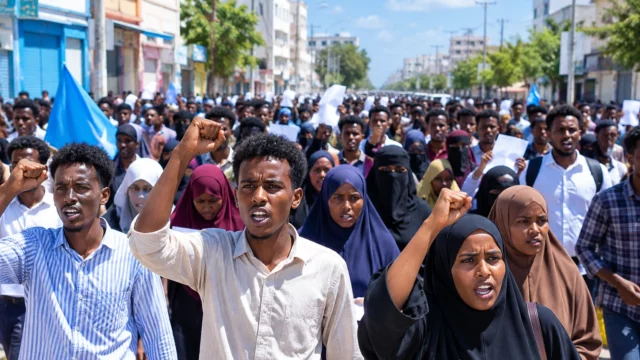
Somaliland, in north-western Somalia, declared independence in 1991, when Somalia’s central government collapsed. It has since had its own institutions and exercises effective control over much of the territory it claims. But Mogadishu still regards the region as an integral part of the Federal Republic of Somalia.
The issue took on a new dimension in December 2025, when Israel became the first UN member state to officially recognise Somaliland. The decision prompted protests from Somalia and several regional actors. On 6 January 2026, the African Union’s Peace and Security Council reaffirmed its support for Somalia’s sovereignty, unity and territorial integrity. The African Union warns that unilateral recognition could set a precedent and undermine regional stability.
This position is part of a broader political history. African states have often defended the preservation of borders inherited at independence, in order to limit conflicts linked to their redrawing. But Somaliland’s case remains distinctive: its leaders point to three decades of self-government and the territory’s historical distinction before its union with Somalia in 1960. The two perspectives — territorial integrity and self-determination — fuel a dispute that foreign statements alone cannot resolve.
Between diplomatic hope and regional tensions
For Somaliland’s authorities, the stakes go beyond symbolism. If officially granted, US recognition could open the way to broader diplomatic relations and strengthen the territory’s ability to negotiate partnerships. Hargeisa has long sought to highlight its institutions, its position on the Gulf of Aden and its economic ties. But a remark at a rally guarantees neither investment, a security agreement nor support in international organisations.
In Mogadishu, the reaction reported in the original text calls on Washington to respect Somali sovereignty. However, no independent verification of this specific statement was found. Caution is therefore warranted about its wording. The Somali government’s general position is clear: it rejects any recognition of Somaliland as an independent state and regards such initiatives as an infringement of its territorial integrity.
Tensions are not confined to the two administrations. Neighbouring countries are monitoring the possible consequences for security and the balance of power around the Gulf of Aden and the Red Sea, where trade routes and strategic interests intersect. The Intergovernmental Authority on Development (IGAD), an East African regional organisation, has also reiterated its support for Somalia’s sovereignty and unity. The IGAD statement stresses that disputes must be handled without escalation.
The effects of a diplomatic battle are also unevenly distributed. Leaders seek support and room to negotiate. For residents, status has a more tangible impact on travel, trade, administrative services and economic prospects. A foreign announcement does not resolve these everyday issues; it can, however, alter relations between authorities and complicate local discussions.
The next challenge: distinguishing signals from decisions
Donald Trump’s remarks gave Somaliland’s officials an opportunity to present Washington as a potential partner. They also brought the Somali dispute back into the US election campaign, in which Minnesota’s Somali community was targeted. This domestic dimension matters: the president’s words primarily serve the logic of US politics, even when they provoke reactions abroad.
The episode’s continental significance will therefore depend less on the phrase uttered in Ohio than on any decisions that might follow. A political statement, official recognition and a shift in the US position in multilateral forums must be distinguished. For the African Union and IGAD, the challenge remains to preserve regional stability without erasing Somaliland’s political claims. For Mogadishu and Hargeisa, the central question remains that of a dialogue capable of addressing the territory’s status and its practical consequences.