Algeria
 Egypt
 Libya
 Morocco
 Sudan
 Tunisia
 Benin
 Burkina Faso
 Cabo Verde
 Côte d'Ivoire
 Ghana
 Guinea
 Guinea-Bissau
 Liberia
 Mali
 Mauritania
 Niger
 Nigeria
 Senegal
 Sierra Leone
 The Gambia
 Cameroon
 Central African Republic
 Chad
 DR Congo
 Equatorial Guinea
 Gabon
 Republic of the Congo
 São Tomé and Príncipe
 Burundi
 Comoros
 Djibouti
 Eritrea
 Ethiopia
 Kenya
 Madagascar
 Malawi
 Mauritius
 Mozambique
 Rwanda
 Seychelles
 Somalia
 South Sudan
 Tanzania
 Uganda
 Angola
 Botswana
 Eswatini
 Lesotho
 Namibia
 South Africa
 Zambia
 Zimbabwe
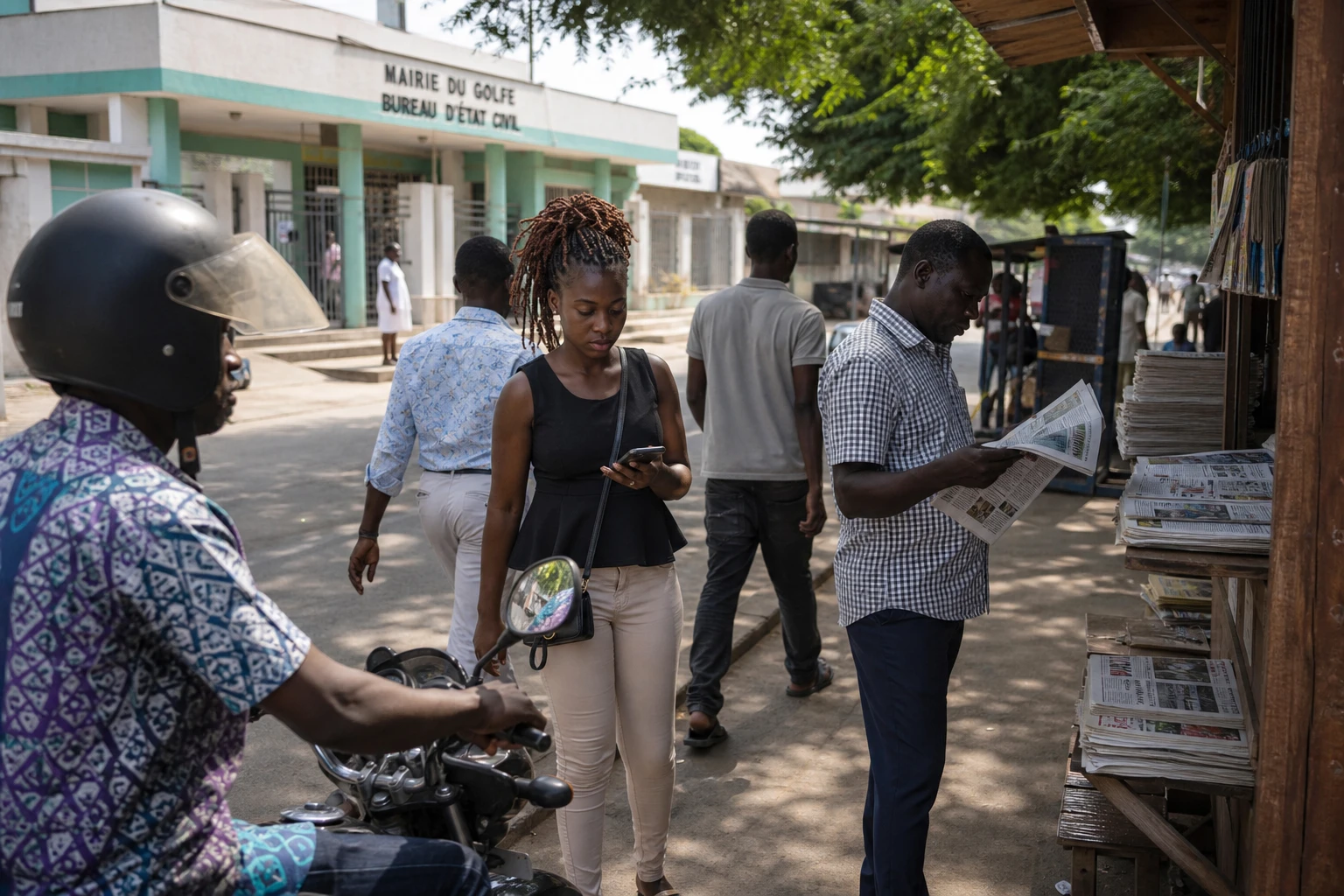
A press case that extends beyond the courtroom
In Lomé, a decision to grant provisional release brought an end, for now, to several weeks in detention for two French documentary-makers and their Togolese collaborator. But the episode points to something broader: it shows how reporting in Togo can run up against a tense security environment and heightened political scrutiny of information.
The case is set against a particular national backdrop. Since 2021, northern Togo, especially the Savanes region, has faced incursions attributed to armed groups linked to jihadism in the Sahel. The UN further strengthened its presence in the area in April 2026, opening a joint office focused on conflict prevention and community resilience. Meanwhile, ECOWAS remains a key player in regional balances, as Togo shares sensitive borders with Benin and Burkina Faso.
In this climate, journalists’ freedom and the control of accreditations take on significance beyond that of a single shoot. In recent years, Togo has already experienced several disputes with foreign media and information professionals. RSF notes that the suspension of RFI and France 24, imposed in June 2025, affected the local media landscape. The country has also been marked by recurring warnings about the spread of false information, an issue the authorities now treat as a matter of public security.
What is known about the detention and provisional release
The facts are established on one central point. Gaël Mocaër, Sebastian Perez Pezzani and their Togolese fixer Fred Vedomey were arrested on 27 July 2026 in northern Togo while filming an episode of the documentary series “Les Routes de l’impossible”. They were then transferred to Lomé and detained there, before Sebastian Perez Pezzani was first granted provisional release on medical grounds, followed by Gaël Mocaër and Fred Vedomey, who were also provisionally released on 1 September.
Togolese justice accuses them of “false declarations” relating to their visas or assignment, as well as the alleged use of a drone in an area deemed sensitive. The journalists and their production company dispute the allegations. RSF, which has followed the case, describes the proceedings as unjustified and disproportionate. The AP, for its part, reported that the authorities believe the journalists failed to follow certain authorisation procedures. At this stage, the public account of events therefore remains fragmented, and every sensitive claim must be attributed to its source.
Another factor matters: the location of the shoot. According to several sources, the arrest took place near Kara, in the north of the country, close to a border area exposed to threats from Burkina Faso. This detail partly explains the sensitivity of the case. In this part of Togo, the authorities are combining security surveillance, an increased military presence and cooperation with the United Nations to prevent the Sahel front from spreading south.
Security, the state’s image and civic space
For the Togolese authorities, the case also reflects a policy of controlling territory and the state’s image. In a climate where public officials regularly denounce disinformation, any filming crew that is not clearly identified can be seen as a risk. In other periods of domestic tension, the government has already argued that certain broadcasts could fuel public disorder. This perspective gives a central role to procedures, accreditations and permits to work in the field.
For Togolese journalists and foreign correspondents, the issue is different. It is the ability to report in an environment where security, diplomacy and media regulation are increasingly intertwined. Togo nevertheless has an active media ecosystem, supported by professionals, radio stations and local platforms that play an essential role in regional capitals and border areas alike. But this space remains fragile when the authorities, regulation and security conditions on the ground are all in play at once.
The situation of the Togolese fixer also deserves close attention. In cases of this kind, the local collaborator often takes the greatest risk: they know the area, speak the languages and facilitate contacts, yet remain the most exposed legally and socially. His release from provisional detention does not therefore resolve the problem. Rather, it highlights the vulnerability of those working at the intersection of international media, local realities and areas under tension.
A Togolese case with West African implications
Across West Africa, this episode resonates far beyond Lomé. It touches on three issues that are now converging in several countries in the region: security in the north of coastal states, the role of foreign media in more closed political environments, and the rise in disputes over disinformation. Togo is not alone in this trend. Like several neighbours, it faces the same dilemma: preserving public order without strangling information.
The continental significance is clear. Across a wider Sahel where armed groups are shifting the lines of control, the movement of journalists, technicians and fixers is becoming more difficult. Rules on access to sensitive areas are tightening, while states seek to regain control of the narrative around their security. The case of the three professionals in Togo illustrates this new and unstable balance between security imperatives, information sovereignty and press freedom. The next point to watch is therefore not so much their release from detention as how Lomé will handle reporting from the north of the country in the future.