Algeria
 Egypt
 Libya
 Morocco
 Sudan
 Tunisia
 Benin
 Burkina Faso
 Cabo Verde
 Côte d'Ivoire
 Ghana
 Guinea
 Guinea-Bissau
 Liberia
 Mali
 Mauritania
 Niger
 Nigeria
 Senegal
 Sierra Leone
 The Gambia
 Togo
 Cameroon
 Central African Republic
 Chad
 DR Congo
 Equatorial Guinea
 Gabon
 Republic of the Congo
 São Tomé and Príncipe
 Burundi
 Comoros
 Djibouti
 Eritrea
 Ethiopia
 Madagascar
 Malawi
 Mauritius
 Mozambique
 Rwanda
 Seychelles
 Somalia
 South Sudan
 Tanzania
 Uganda
 Angola
 Botswana
 Eswatini
 Lesotho
 Namibia
 South Africa
 Zambia
 Zimbabwe
When conservation must also feed families
In south-eastern Kenya, wildlife protection is not confined to national parks. It also depends on what residents can earn from their own land without exhausting the soil or cutting off animal migration routes. In Taita-Taveta County, this equation has become central to communities living around the Tsavo landscape.
The area is among the country’s most strategically important community conservation landscapes. The Taita Taveta Wildlife Conservancies Association brings together 35 ranches and conservancies covering more than 4,046 km², at the heart of a corridor linking Tsavo East, Tsavo West and, to the south, Tanzania’s Mkomazi. In this kind of landscape, conservation cannot be conceived in opposition to local residents. It has to work with them.
From macadamias to beehives, a local response to a wider crisis
Farmers in Taita-Taveta are now turning to macadamias, fruit trees and beekeeping. This is no arbitrary choice. In a semi-arid region, annual crops leave households more exposed to unpredictable seasons. Agroforestry systems, by contrast, combine trees, crops and sometimes livestock. They diversify incomes and strengthen soil resilience. The FAO notes that agroforestry can improve water retention, soil fertility and the resilience of small-scale farmers in dry areas of Kenya, Uganda and Tanzania.
This approach also responds to very real climate pressures. In its planning documents, Taita-Taveta County acknowledges that drought weakens agriculture and livestock farming, as well as the area’s ability to withstand shocks. The county government highlights agroforestry and climate-smart agricultural practices as adaptation tools.
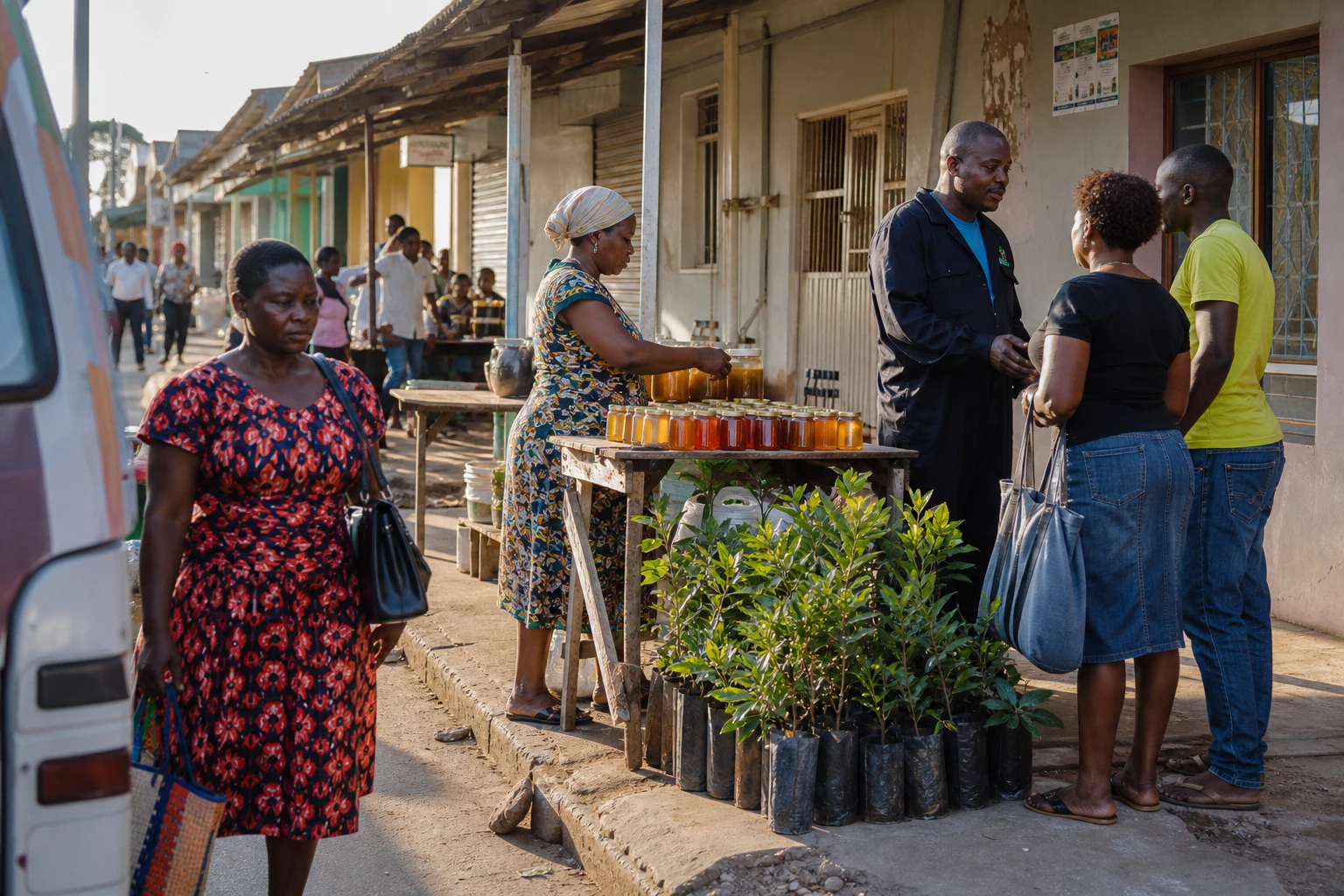
In villages, bees are taking up the slack. Beekeeping requires less land than livestock farming and can coexist with cultivated plots. It also provides a steady, small-scale income. Honey sold locally helps cover everyday expenses and reduces dependence on activities that are more damaging to pastures and trees. In the case reported in the field, a beekeeper explains that a hive can produce 8 to 10 kilos per harvest, with several harvests a year, providing meaningful supplementary income for a rural household. This estimate is local, but it illustrates a simple and accessible economic model.
Conservancies in the area are also encouraging this diversification because it addresses a structural problem: as the population grows, competition intensifies between habitats, crops, pastures, mining and charcoal production. In the same landscape, trees are a resource, a means of protecting soil and a barrier against degradation. The TTWCA works with conservation partners in this spirit, maintaining wildlife corridors while supporting local livelihoods.
What Taita-Taveta says about Kenya’s model
The example of Taita-Taveta extends far beyond the county. Conservancies are playing an increasingly important role in Kenya’s conservation policy. The KWCA estimates that 65% of the country’s wildlife lives on community or private land, and notes that conservancies aim to connect parks with inhabited areas. The model has become a major part of Kenya’s compromise between protecting biodiversity and delivering benefits to communities.
This compromise is particularly visible in the south of the country, where Tsavo’s migration corridors intersect with human settlement, ranches and pastoral land use. When residents earn money from honey, tree seedlings or other perennial crops, pressure on forests, pastures and wildlife eases. Conversely, when income is lacking, charcoal production, overgrazing and certain forms of land exploitation take over. This is where the difference between a living landscape and a fragmented territory is made.
The issue is also institutional. Kenya’s conservancies rely on multiple actors: the Kenya Wildlife Service, county authorities, conservancy associations and technical partners. This framework embeds conservation in local realities, but it requires stable funding, clarified land rights and strong local governance. Without these, the promise of shared benefits remains fragile. The KWCA notes that community conservancies make up the majority of its members and cover most of the land under conservation.
For Nairobi, the benefits are clear. Kenya is seeking to combine climate adaptation, food security and biodiversity conservation. For East Africa, the significance is even greater. More frequent droughts, population pressure and competition for land affect the whole region. Solutions combining agroforestry, beekeeping and community conservation could therefore serve as a testing ground for other East African Community countries, provided they are adapted to local realities.
At the continental level, this experience is a reminder of a simple truth: nature protection is more robust when it creates credible incomes for those living near ecosystems. In the Tsavo landscape, honey and trees are not symbols. They are tools for negotiating between the rural economy, wildlife and the future of the land.