Algeria
 Egypt
 Libya
 Morocco
 Sudan
 Tunisia
 Benin
 Cabo Verde
 Côte d'Ivoire
 Ghana
 Guinea
 Guinea-Bissau
 Liberia
 Mali
 Mauritania
 Niger
 Nigeria
 Senegal
 Sierra Leone
 The Gambia
 Togo
 Cameroon
 Central African Republic
 Chad
 DR Congo
 Equatorial Guinea
 Gabon
 Republic of the Congo
 São Tomé and Príncipe
 Burundi
 Comoros
 Djibouti
 Eritrea
 Ethiopia
 Kenya
 Madagascar
 Malawi
 Mauritius
 Mozambique
 Rwanda
 Seychelles
 Somalia
 South Sudan
 Tanzania
 Uganda
 Angola
 Botswana
 Eswatini
 Lesotho
 Namibia
 South Africa
 Zambia
 Zimbabwe
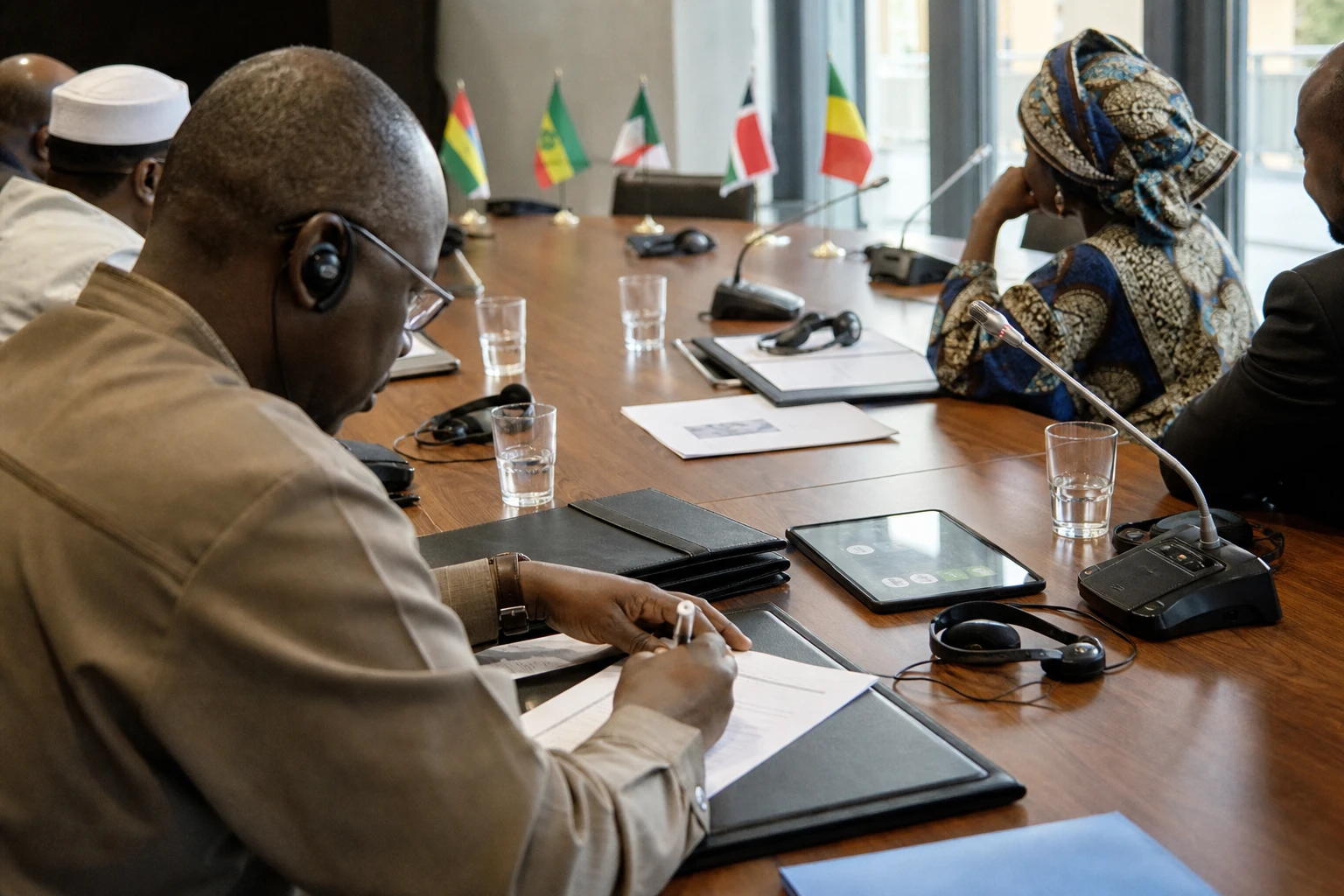
In the three countries of the Confederation of Sahel States, the battle for information is now also being fought on television platforms. Tafouk TV, the joint channel of Burkina Faso, Mali and Niger, is carried by Canal+ Afrique. At the same time, it has announced a partnership with RT, a Russian media outlet targeted by EU restrictions. This coexistence is not enough to establish a breach. It does, however, require close scrutiny of the programmes exchanged and the responsibilities of each party.
A channel designed as a regional tool
Tafouk TV began broadcasting its regular schedule on 16 September 2026, from Bamako, at 8am. Its launch had been announced for 1 June, before being postponed by about 15 weeks. The channel had, however, already been available in Burkina Faso since March, notably on digital terrestrial television and on the Canal+ Afrique platform.
This timeline distinguishes two realities: the technical availability of the service and the start of its full programming. The channel is also available by satellite, while its distribution on Canal+ Afrique is part of a paid package offered to subscribers.
The project stems from an agreement signed on 21 December 2025 by Burkina Faso, Mali and Niger. The three states have left the Economic Community of West African States, the regional organisation known by its French acronym ECOWAS, and are now building their own confederal framework around the Alliance of Sahel States, which has become the Confederation of Sahel States.
Based in Bamako, Tafouk TV complements the AES’s joint media network. This also includes Daandè Liptako radio. Sahelian authorities present these media outlets as instruments of information sovereignty — tools intended to produce and disseminate a regional narrative from the capitals concerned.
This approach reflects a specific context. In Burkina Faso, Mali and Niger, several French media outlets or outlets based in France have been suspended or banned in recent years. The transitional governments accuse them of biased coverage of security and political issues. The media concerned, for their part, dispute these accusations or denounce restrictions on press freedom.
The RT partnership changes the scope of the issue
On 8 July 2026, Tafouk TV and RT signed a memorandum of understanding in Niamey, on the sidelines of a visit by Russian Foreign Minister Sergei Lavrov. According to information available, the agreement provides for content exchanges, the sharing of expertise and reciprocal coverage of current affairs in Russia and the Sahel region.
RT described Tafouk TV as its first international partner among the AES’s joint media outlets. The names used are not entirely consistent, however: some communications refer to RT, while others mention TV-Novosti, the publishing entity behind the Russian network. This legal distinction matters because EU sanctions target specifically identified legal persons and entities.
The partnership therefore does not automatically mean that Tafouk TV is itself sanctioned. The Sahelian channel is not, at this stage, among the Russian media listed in Annex XV to EU Regulation 833/2014. The question becomes more specific if reports, programmes or footage are supplied directly by an RT entity covered by that annex.
It would then be necessary to establish the exact origin of the content, its producer, the rights holder, the entity that transmitted it and the brand under which it is broadcast. A general exchange agreement alone does not show which programmes have actually been rebroadcast.
Why Canal+ Afrique is affected
EU regulations prohibit operators from broadcasting, facilitating or contributing to the broadcast of content produced by entities listed in Annex XV. The rule applies in particular to cable, satellite and IPTV, as well as several forms of digital distribution. The text also applies to legal persons established under the law of a member state when they operate outside EU territory.
Since Canal+ International is a French company, the fact that Tafouk TV is broadcast in Burkina Faso, Mali or Niger is not enough to rule out the application of EU law. The location of the viewer is not the only decisive factor. The identity of the distributor, the nature of the content and the legal link to the sanctioned entity may also be relevant.
The regulations do not, however, make every commercial relationship with a non-European media outlet an offence. Tafouk TV’s presence in a package may be covered by a standard distribution contract. Canal+ Afrique distributes many national, regional and specialist channels. Local media can also make its packages more attractive in African markets.
The sensitive point, then, is the content supplied under the partnership. Can a channel that is not itself on a sanctions list rebroadcast programmes produced by a prohibited entity? The answer would depend on the facts, the contracts and the interpretation adopted by the competent authorities. It cannot be inferred from the logo displayed on screen alone.
A distributor already under pressure in Burkina Faso
The issue arises in a tense regulatory environment. In June 2026, Burkina Faso’s Superior Council for Communication fined Canal+ International 50 million CFA francs for failing to make the channels of Radiodiffusion-Télévision du Burkina available to subscribers free of charge, including after their subscriptions had expired.
A second fine of 200 million CFA francs was subsequently imposed, according to information available, after the first ruling was deemed to have been inadequately implemented. Free access to Burkina Faso’s public channels was reportedly activated on 27 August 2026. These penalties fall under Burkinabè national law and are separate from the EU regime targeting Russian media.
For Canal+, the Tafouk TV case therefore adds a further constraint to an already delicate relationship with the authorities in Ouagadougou. The operator must contend with the demands of African regulators while continuing to comply with French and European rules that remain binding on its parent company and the subsidiaries concerned.
What needs to be checked before alleging a breach
No public information currently supports the claim that a breach of the EU sanctions regime has occurred. Several checks are still needed: the precise list of programmes exchanged, the Russian entity supplying them, the terms of the contract between Tafouk TV and RT, and the control mechanisms used by Canal+ International.
It would also be necessary to establish whether Russian content is broadcast in full, adapted, commented on or merely used as footage. These differences could alter the legal analysis. They also make it possible to distinguish general editorial cooperation from the direct redistribution of programmes produced by a sanctioned media outlet.
For viewers in Bamako, Niamey and Ouagadougou, the issue is concrete. Tafouk TV is seeking to establish a joint service in a region where access to information is already highly politicised. Canal+ remains a major player in regional audiovisual distribution. Monitoring the content broadcast will therefore matter both for the operator’s legal compliance and for the credibility of the new confederal channel.
The next step will be less diplomatic than documentary: identifying what is actually going out on air. That traceability, rather than the announcement of the partnership alone, will make it possible to determine whether cooperation between Tafouk TV and RT is compatible with Canal+’s European obligations.