Algeria
 Egypt
 Libya
 Morocco
 Sudan
 Tunisia
 Benin
 Burkina Faso
 Cabo Verde
 Côte d'Ivoire
 Ghana
 Guinea
 Guinea-Bissau
 Liberia
 Mali
 Mauritania
 Niger
 Nigeria
 Senegal
 Sierra Leone
 The Gambia
 Togo
 Cameroon
 Central African Republic
 Chad
 DR Congo
 Equatorial Guinea
 Gabon
 Republic of the Congo
 São Tomé and Príncipe
 Burundi
 Comoros
 Djibouti
 Eritrea
 Ethiopia
 Kenya
 Madagascar
 Malawi
 Mauritius
 Mozambique
 Rwanda
 Seychelles
 Somalia
 South Sudan
 Tanzania
 Uganda
 Angola
 Botswana
 Eswatini
 Lesotho
 Namibia
 Zambia
 Zimbabwe
A technical issue becomes a political test
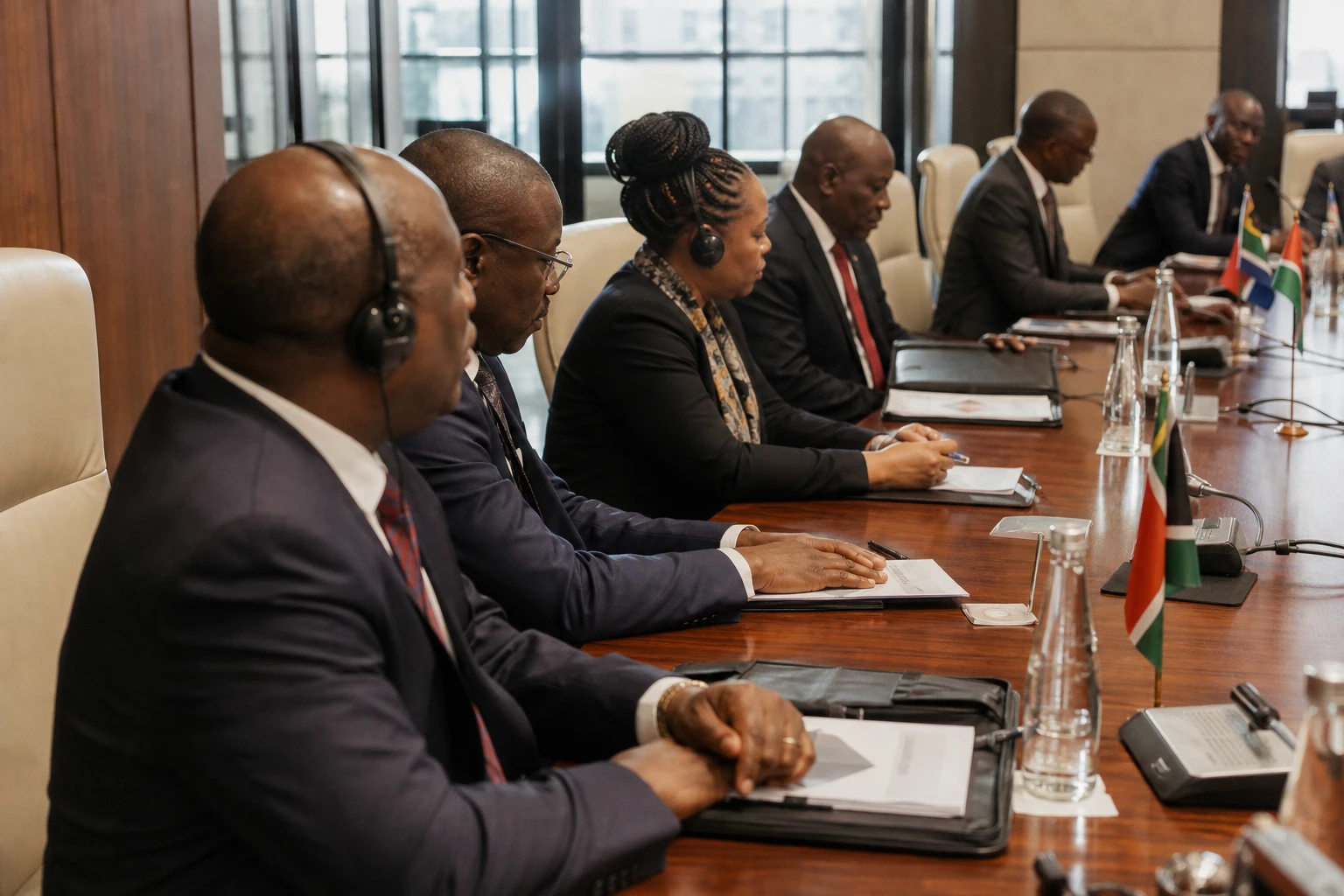
In Pretoria, the debate over VAR has moved off the pitch and into ministers’ offices and the corridors of Parliament. In South Africa, the technology intended to correct refereeing errors has also become a test of governance, budgetary discipline and the credibility of local football.
The issue affects a country that remains one of the sporting heavyweights in southern Africa, within SADC, and whose league serves as a commercial as well as sporting showcase. In this context, the absence of VAR from local competitions weighs on the image of South African football, while several federations on the continent have already incorporated the tool into major events or their national leagues.
R20 million, a separate account and a timetable gone awry
The starting point of the dispute is clear. South Africa’s Department of Sport says it transferred the first tranche of R20 million to the South African Football Association, SAFA, as part of a three-year rollout plan. The government says the funding was intended to cover the purchase of equipment as well as referee training.
The timetable, meanwhile, became increasingly strained as the weeks passed. According to the timeline published after the latest parliamentary hearings, the money was paid in early March 2026, a request for a report followed in April, and SAFA confirmed in May that it intended to proceed, while requesting a fresh budget review. In July, its chief executive said no funds had been used. On 13 August, the department requested immediate repayment of the sum, before granting a final 21-day extension on 19 August.
In Parliament, MPs were concerned enough to adjourn the sitting after SAFA president Danny Jordaan failed to attend. The department says letters sent to the association went unanswered, while the association says it had to check regulatory requirements before committing the expenditure lawfully.
What the government says, and the federation’s response
South African Sports Minister Gayton McKenzie has put the issue at the centre of his political agenda. In an official speech on 4 March 2026, he confirmed that his department had transferred the first tranche of R20 million to SAFA and recalled that the total cost of the operation had initially been announced as R80 million. He also defended a gradual approach, explaining that implementation had to comply with FIFA and IFAB standards; IFAB is the body that sets the rules of the game.
Since then, the tone has hardened. The department believes VAR is needed to modernise local competitions, reduce disputes and make the league more attractive to broadcasters, sponsors and foreign clubs. McKenzie has even said that the absence of the technology could hamper the country’s ability to host major matches. In Parliament, he also said public money had to be protected and that the association must now be held to account.
SAFA, for its part, does not deny that the funds exist. Its finance chief told MPs that the R20 million had been placed in a separate account, along with the interest earned. The association maintains, however, that the project can proceed only after a series of internal checks, particularly on the budget, procurement and compliance. In other words, it says it wants to secure the process before ordering a system that is both costly and sensitive.
Beyond refereeing, a battle over how to proceed
This case goes beyond the convenience of referees. It reveals a familiar tension in South African sport: the state wants to move quickly, the federation wants to tighten procedures, and each accuses the other of holding up the project. In a country where football attracts considerable public attention, any delay immediately becomes political. Supporters see it as a promise unkept. Clubs, meanwhile, fear that uncertainty will prolong controversies over refereeing decisions.
The stakes are also financial. The government now links VAR to a broader drive for commercial returns. It believes better organisation can attract international fixtures, increase the league’s value and give South African football a more professional image. Conversely, a poorly controlled rollout would expose the state to criticism over the use of public funds. This is precisely why pressure is being brought to bear on SAFA, along with the threat of demanding repayment if the timetable is not met.
The debate also says something about the place of South African football in the region. In southern Africa, where sport often serves as a marker of influence, Pretoria does not want to appear to be an administrative giant incapable of implementing a technology that has become commonplace elsewhere. The message is simple: the country wants to remain competitive within SADC, as well as in African football, where the modernisation of competitions is becoming a marker of credibility.
What to watch in the coming days
The next step is clear: SAFA must submit a detailed report on the project’s status, the revised timetable and the precise status of the R20 million. The government has already drawn a line in the sand: without tangible progress, it could demand the money back. The planned meeting between Gayton McKenzie and Danny Jordaan will therefore show whether the issue moves towards a technical compromise or a more serious budgetary dispute.
The outcome will be watched far beyond Johannesburg. If South Africa manages to roll out VAR without another crisis, it will strengthen its reputation as a reliable organiser in southern Africa. If it fails, the project will become another example of a public promise stalled between sports governance, financial procedures and impatience in the stands.