Algeria
 Egypt
 Libya
 Morocco
 Sudan
 Tunisia
 Benin
 Burkina Faso
 Cabo Verde
 Côte d'Ivoire
 Ghana
 Guinea
 Guinea-Bissau
 Liberia
 Mali
 Mauritania
 Niger
 Nigeria
 Senegal
 Sierra Leone
 The Gambia
 Togo
 Cameroon
 Central African Republic
 Chad
 DR Congo
 Equatorial Guinea
 Gabon
 Republic of the Congo
 São Tomé and Príncipe
 Burundi
 Comoros
 Djibouti
 Eritrea
 Ethiopia
 Kenya
 Madagascar
 Malawi
 Mauritius
 Mozambique
 Rwanda
 Seychelles
 Somalia
 South Sudan
 Tanzania
 Uganda
 Angola
 Botswana
 Eswatini
 Lesotho
 Namibia
 Zambia
 Zimbabwe
In South Africa, the ballot box reshuffled the cards without producing an undisputed winner in the major cities. Since the municipal election on 4 November 2026, the question has therefore been not only which party won the most votes, but also who can assemble a council majority, and with which partners.
The African National Congress (ANC), which governed the country for three decades after the end of apartheid, remains the largest force nationally. But its retreat confirms a shift already visible at the 2024 general election: no party can any longer count on a guaranteed majority. In municipalities, this fragmentation has translated into close negotiations and shared executives.
Majority-less councils and shifting alliances
Final results published by the Electoral Commission of South Africa put the ANC at around 31% of the national vote. The party is ahead of its rivals, but that score does not automatically give it control of municipalities. In several major cities, no group won enough seats to govern alone. The commission recorded 140 councils without an absolute majority among those whose results had been declared.
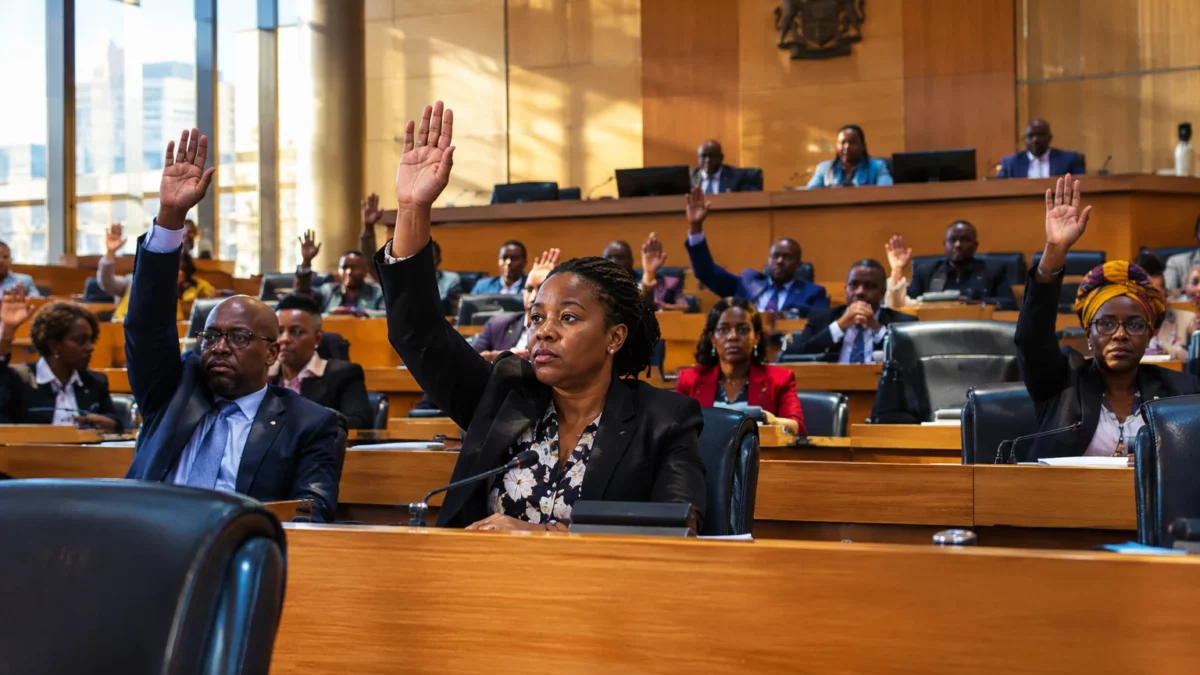
This situation forces elected representatives to negotiate coalition agreements — bringing several parties together to secure a council majority. The agreements cover the posts of mayor and council speaker, as well as the composition of the municipal executive and management priorities. In Johannesburg and eThekwini, the metropolitan municipality that includes Durban, the choice of partners has thus mattered as much as the election ranking.
On 27 November, Johannesburg’s council elected Herman Mashaba, leader of ActionSA and a former mayor of the city, to head the municipality. His election followed discussions between competing parties, including the ANC, ActionSA and the Congress of the People (EFF). On the same day, eThekwini’s council elected Mxolisi Phakathi of the uMkhonto weSizwe (MK) party, with ANC support. These votes show that the country’s largest party can take part in local majorities without retaining the mayor’s office.
The ANC’s approach has not been consistent. Its secretary-general, Fikile Mbalula, described agreements with the Democratic Alliance (DA), its main rival, as a last resort. In practice, the party has also negotiated with ActionSA and the MK, a party led by former president Jacob Zuma, who was expelled from the ANC. These choices reflect local power dynamics, where elected representatives must count seats and weigh the political cost of each alliance.
Municipal services at the heart of the vote
Municipal elections have a direct impact on everyday life. Councils oversee water supply, waste collection, local roads and some public services. Coalition negotiations are therefore about more than sharing out posts. They determine an administration’s ability to pass its budget, maintain services and carry out works.
In Johannesburg, a major economic centre in Gauteng province, the new majority will have to meet the expectations of very different neighbourhoods, from the business district to residential areas and poorer communities. Maintenance delays and service disruptions do not affect all residents in the same way: households able to pay for private alternatives can adapt more easily than those who rely on public provision. The coalition’s stability will matter, but its practical results will also be closely watched.
In eThekwini, in KwaZulu-Natal province, the agreement between the MK and the ANC puts a recently formed party at the head of a major city, while the ANC retains a presence in the municipal balance of power. Phakathi’s election, confirmed by the municipality and reported by public broadcaster SABC, marks a further step in the MK’s establishment. It does not, however, guarantee the majority’s cohesion or continuity in municipal decision-making.
For the ANC, its loss of influence in several urban centres adds to the decline recorded in the 2024 national election, when the party lost its parliamentary majority for the first time since 1994. It then joined a government of national unity that includes the DA. At local level, however, alliances vary from city to city. Municipal compromises therefore do not mechanically replicate the agreement reached in Pretoria.
A test for coalitions and local democracy
This reshaping of the political landscape is also playing out in a regional context. South Africa belongs to the Southern African Development Community (SADC), a regional cooperation organisation. The management of its major cities has economic implications beyond their administrative boundaries: Johannesburg is a hub for financial and commercial activity, while eThekwini is home to an important port for trade. Stable municipal governance can support services and economic activity, but the effects will depend on the decisions taken and how they are implemented.
The election does not mean the ANC has disappeared from the political arena. Rather, it shows that a party that comes first may have to give up the mayor’s office, and that smaller parties can become pivotal when no group has a majority. For residents, the measure of these agreements will be tangible: budgets passed, services delivered and councils’ ability to last. For the parties, the next step will be to show that their alliances can govern, not merely muster enough votes to elect a mayor.