Algeria
 Egypt
 Libya
 Morocco
 Sudan
 Tunisia
 Benin
 Burkina Faso
 Cabo Verde
 Côte d'Ivoire
 Ghana
 Guinea
 Guinea-Bissau
 Liberia
 Mali
 Mauritania
 Niger
 Nigeria
 Senegal
 Sierra Leone
 The Gambia
 Togo
 Cameroon
 Central African Republic
 Chad
 DR Congo
 Equatorial Guinea
 Gabon
 Republic of the Congo
 São Tomé and Príncipe
 Burundi
 Comoros
 Djibouti
 Eritrea
 Ethiopia
 Kenya
 Madagascar
 Malawi
 Mauritius
 Mozambique
 Rwanda
 Seychelles
 Somalia
 South Sudan
 Tanzania
 Uganda
 Angola
 Botswana
 Eswatini
 Lesotho
 Namibia
 Zambia
 Zimbabwe
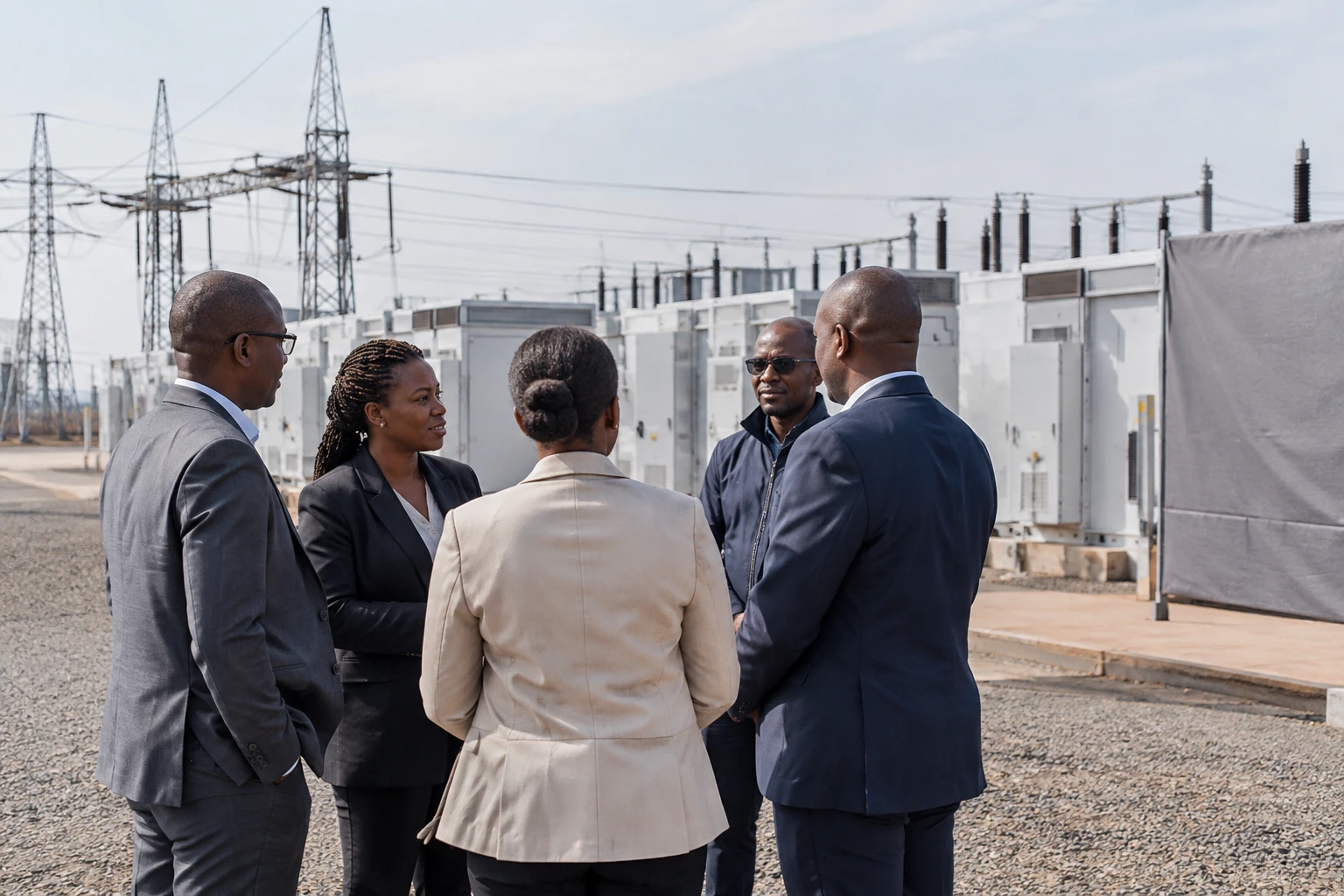
In South Africa, producing more electricity is no longer enough. When the grid cannot transport all the available energy, renewable installations have to reduce their output. The government therefore wants first to make better use of this electricity and ensure access to fast-response capacity, before adding new solar and wind power.
A grid under pressure despite progress in supply
The Minister of Electricity and Energy, Kgosientsho Ramokgopa, announced on 7 October 2026 the first implementation decision under the Integrated Resource Plan, IRP 2025. It covers 4,600 megawatts (MW) of battery storage and 5,000 MW of gas-fired generation, 9,600 MW in total. The announcement was reported by South Africa’s public broadcaster and confirmed by several media outlets in the country.
The problem being addressed is curtailment: a power plant could generate electricity, but the system cannot absorb or transport it, either because of a lack of grid capacity or because supply exceeds demand at a particular time. The energy is then lost, while the costs of equipment and contracts remain. This can happen even as some households and businesses need a reliable power supply.
South Africa is still marked by years of load-shedding, although improved power station availability and the growth of private generation have changed how the system operates. The Council for Scientific and Industrial Research, the CSIR, monitors generation by Eskom, independent power producers and private solar facilities, among others. The challenge is evolving: it is not just about generating more, but about transporting electricity and making it available at the right time.
Batteries shift electricity through time
A large-capacity battery charges when electricity is abundant, then feeds it back into the grid when demand rises or solar and wind generation falls. It can also respond quickly to frequency fluctuations and help stabilise the grid. However, it does not create energy: its usefulness depends on where it is connected, its capacity and the periods when it can charge.
The country has already embarked on projects on a more modest scale. In June 2025, five storage projects, totalling 513 MW and 2,052 megawatt-hours (MWh), were under construction after clearing financial and commercial milestones. The public storage programme reported these five projects. The announced 4,600 MW therefore represents a significant change in scale, but not yet operational installations: tenders, financing, grid connections and construction are still to come.
Grid reinforcement will be just as decisive. South Africa’s transmission plans estimate that more than 14,000 kilometres of lines will need to be built over the next decade to integrate new generation. Private investors are being considered for line projects, while the transmission operator must co-ordinate connections. Without this infrastructure, batteries and power stations risk running into the same bottlenecks as existing installations.
Gas offers dispatchable capacity, but costs are uncertain
Gas-fired power stations serve a different purpose. They can be brought online when renewable generation falls or demand surges. Unlike batteries, they do not store surplus solar or wind power. Their contribution depends on sufficiently flexible power stations, as well as an available and affordable fuel supply.
The government is therefore calling for future projects to be assessed on the basis of how quickly they can start up, their ability to adjust output and their minimum operating level. The delivered price of gas, ports, pipelines, electricity connections and timelines will also need to be examined. These conditions are particularly important for a country that must organise import infrastructure and for which gas supply is a major industrial issue.
The choice is being viewed differently across South Africa. Civil society organisations, including The Green Connection, warn about the cost of gas infrastructure and the risk of locking consumers into fossil energy for the long term. The government, meanwhile, presents these power stations as a way to complement renewables and secure supply. The trade-off will depend on contracts, the prices actually paid and how often the power stations are used, not just on their announced capacity.
Delivery and regional co-operation will shape what comes next
The first decision does not provide for new volumes of wind or solar power. The government says a later phase will address these technologies, hybrid projects combining renewable generation and batteries, and pumped-storage hydropower. IRP 2025 sets out a trajectory for more than 105,000 MW of new electricity capacity by 2039. This is a planning target, not capacity that has already been built.
For the public, the immediate concerns are the reliability and cost of electricity. For businesses, particularly energy-intensive industries, predictable supply can affect production and employment. Local benefits will also depend on where equipment is installed, the jobs created during construction and how its costs are shared among operators, taxpayers and customers.
The issue also extends beyond national borders. South Africa is part of the Southern African Power Pool, the SADC mechanism that facilitates co-ordination and electricity trading between countries in the region. Better-sized grids and cross-border trading can complement national capacity, without replacing the investment needed in domestic transmission.
The next indicators will be concrete: the publication of tenders, the ability to secure fuel, the actual start of line construction and the timetable for the new renewables procurement process. The success of the IRP will be measured less by the megawatts listed in the plan than by the electricity actually delivered, its price and equitable access to the grid.