Algeria
 Egypt
 Libya
 Morocco
 Sudan
 Tunisia
 Benin
 Burkina Faso
 Cabo Verde
 Côte d'Ivoire
 Ghana
 Guinea
 Guinea-Bissau
 Liberia
 Mali
 Mauritania
 Niger
 Nigeria
 Senegal
 Sierra Leone
 The Gambia
 Togo
 Cameroon
 Central African Republic
 Chad
 DR Congo
 Equatorial Guinea
 Gabon
 Republic of the Congo
 São Tomé and Príncipe
 Burundi
 Comoros
 Djibouti
 Eritrea
 Ethiopia
 Kenya
 Madagascar
 Malawi
 Mauritius
 Mozambique
 Rwanda
 Seychelles
 South Sudan
 Tanzania
 Uganda
 Angola
 Botswana
 Eswatini
 Lesotho
 Namibia
 South Africa
 Zambia
 Zimbabwe
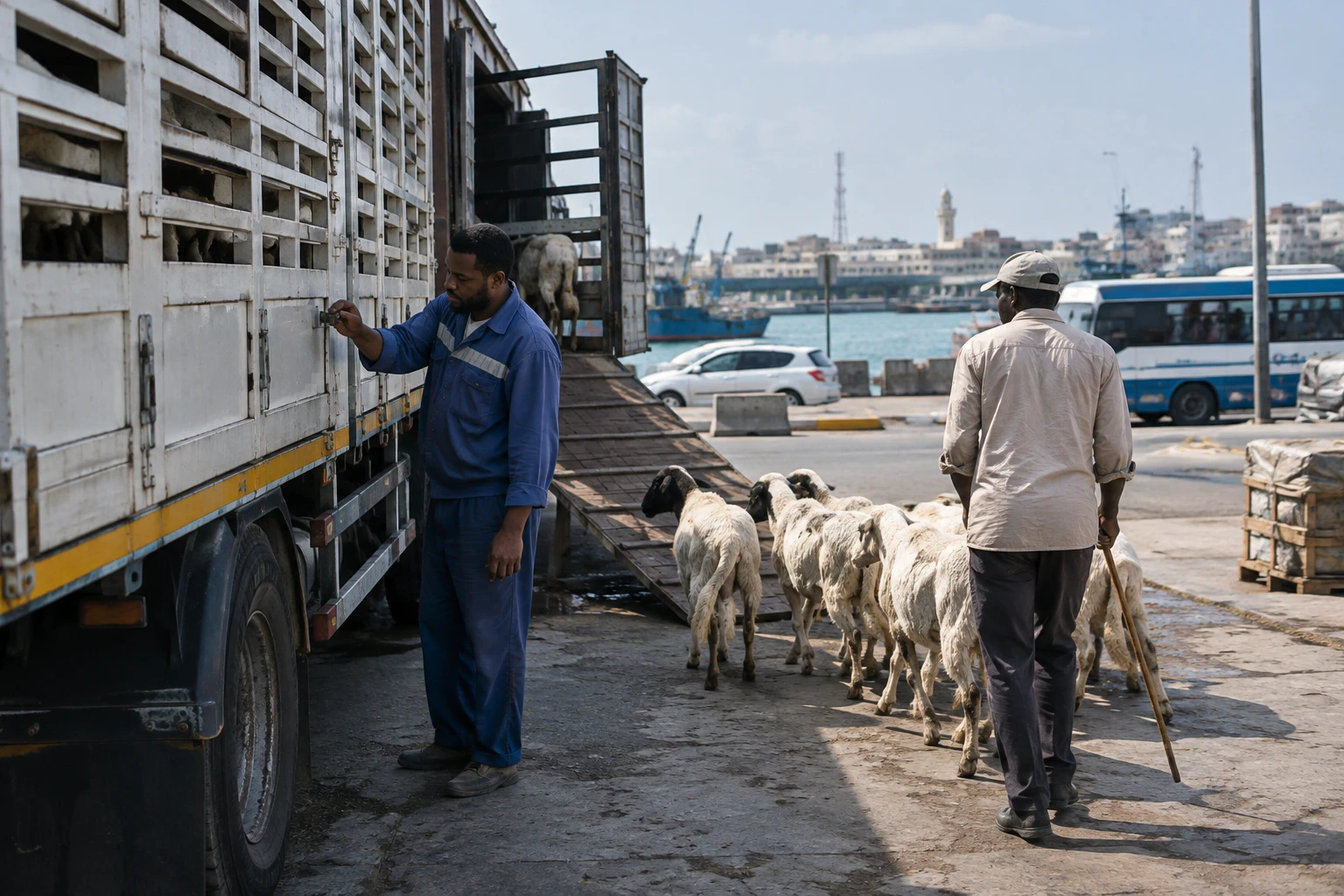
For Somali livestock farmers and traders, opening up a new market is about more than finding buyers. They must also ensure animal health, organise transport and compete with established suppliers. Iraq could become an additional market, but talks between Mogadishu and Baghdad have yet to set the terms for a first shipment.
A key sector exposed to market fluctuations
In Somalia, livestock provides income for many households and accounts for a large share of exports. The sector profile published by the East African Community (EAC), a regional organisation of which Somalia is a member, says Gulf countries absorb more than 80% of livestock exports. In 2023, the United Arab Emirates, Oman and Saudi Arabia were among Somalia’s main trading destinations.
This concentration creates significant market opportunities, particularly during periods of high demand linked to religious holidays. It also leaves sellers vulnerable to fluctuations in demand and health restrictions imposed by importing countries. Diversifying destinations could therefore reduce dependence on a handful of buyers, provided new markets are genuinely accessible.
National data illustrate both the sector’s importance and the stakes in diversification. According to the Somali National Bureau of Statistics, the value of livestock exports fell from $950.93 million in 2024 to $922.91 million in 2025. This decline of about 3% relates to the reported value and is not, on its own, enough to explain changes in volumes or the incomes of different players.
Diplomatic talks, not yet a trade deal
On 19 October 2026, Somalia’s Foreign Minister, Abdisalam Abdi Ali, met his Iraqi counterpart, Fuad Hussein, in Baghdad. The meeting took place on the sidelines of the 52nd session of the Council of Foreign Ministers of the Organisation of Islamic Cooperation (OIC), held on 17 and 18 October.
According to Somali outlet Shabelle Media Network, citing information from Somalia’s Ministry of Foreign Affairs, the two officials discussed reviving their joint committee and expanding economic and agricultural cooperation. Mogadishu expressed interest in exporting live animals to Iraq.
So far, no start date for shipments, target volume or veterinary protocol has been made public. The meeting therefore signals political intent, not the effective opening of a trade route. The joint committee could help clarify procedures, but its timetable and decisions remain to be determined.
A real but volatile and competitive market
Iraq imports live livestock, but its purchases vary sharply from year to year. Shafaq News, an Iraq-based outlet, reports that Iraqi imports of live animals totalled $300.1 million in 2025, down from $577.3 million in 2024, according to data from the International Trade Centre. Cattle accounted for more than 95% of the value of purchases in 2025. The figures point to a significant market, but also to highly variable external demand.
The composition of demand matters to Somali exporters. Somali export herds consist largely of sheep and goats, while Iraqi imports recorded in 2025 were concentrated mainly in cattle. The presence of buyers therefore does not guarantee that the species available in Somalia will match Iraqi needs, or that prices will cover transport and inspection costs.
Competition is another factor. World Bank trade statistics, compiled from customs data, show that Brazil and Colombia were among Iraq’s suppliers of live cattle in 2024. To establish a foothold, Somali exporters would need to negotiate prices, meet health requirements and secure a reliable supply chain through to buyers.
Benefits will also depend on infrastructure
If an agreement is reached, the effects could extend beyond exporters alone. Livestock farmers, traders, transporters and workers at quarantine facilities could benefit from additional demand. But the share reaching pastoral communities would depend on purchase prices, the intermediaries involved and the costs of preparing animals for export.
Market access will depend in particular on common rules governing veterinary certificates, inspections, quarantine and shipping conditions. These steps are crucial to limiting disease risks and satisfying the importer. They also require veterinary services and infrastructure capable of operating beyond the capital, Mogadishu, so that livestock-producing regions can take part in trade.
The EAC profile already lists Somali instruments relating to animal health and export quarantine stations. However, the existence of national frameworks does not mean Iraqi formalities have been settled. The relevant authorities will need to reach an explicit agreement and organise inspections in practice before shipments can leave.
A test of regional trade diversification
For Somalia, the prospect of trade with Iraq is part of a broader strategy: selling beyond traditional Gulf markets and strengthening its commercial ties in East Africa and the Middle East. Its EAC membership provides a regional framework, while bilateral relations and the OIC offer other forums for dialogue. These frameworks do not, however, replace the health and trade approvals required by each market.
The next concrete step will therefore be less a partnership declaration than the definition of applicable rules: accepted species, required certificates, inspection procedures and transport conditions. Until these points are clarified, Iraq will remain a potential avenue for diversification, not an established market. The challenge for Somali players will be to turn diplomacy into regular orders without creating a new dependence on a single market.