Algeria
 Egypt
 Libya
 Morocco
 Sudan
 Tunisia
 Benin
 Burkina Faso
 Cabo Verde
 Côte d'Ivoire
 Ghana
 Guinea
 Guinea-Bissau
 Liberia
 Mali
 Mauritania
 Niger
 Nigeria
 Senegal
 Sierra Leone
 The Gambia
 Togo
 Cameroon
 Central African Republic
 Chad
 DR Congo
 Equatorial Guinea
 Gabon
 Republic of the Congo
 São Tomé and Príncipe
 Burundi
 Comoros
 Djibouti
 Eritrea
 Ethiopia
 Kenya
 Madagascar
 Malawi
 Mauritius
 Mozambique
 Rwanda
 Seychelles
 South Sudan
 Tanzania
 Uganda
 Angola
 Botswana
 Eswatini
 Lesotho
 Namibia
 South Africa
 Zambia
 Zimbabwe
Baidoa, political crossroads and fault line
In Baidoa, a city connected by roads in south-western Somalia to Mogadishu and neighbouring rural areas, security is never decided by Kalashnikovs alone. It is also shaped by relations between the federal government, federal member states and local networks that control the ground. In today’s Somalia, an urban clash often says much more than a simple armed confrontation.
Baidoa, the administrative and cultural capital of the South West State, occupies a distinctive position. Somali government agencies describe it as a major administrative centre, while European analyses note that the city serves as the de facto capital of the federal member state, even though the official capital of the South West State is Barawa. This institutional ambiguity weighs on every local crisis. It heightens the city’s strategic value, but also its vulnerability.
What happened and why the crisis quickly spilled over
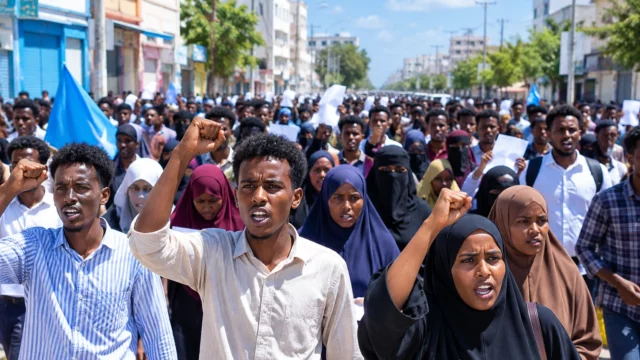
On 30 May 2026, fighting broke out in Baidoa between the Somali army and fighters loyal to Abdiaziz Hassan Mohamed Laftagareen, the former president of the South West State. Somali state radio said the army had repelled the attack and regained control of the city after an offensive launched at dawn. Local media reported exchanges of gunfire in several neighbourhoods and casualties on both sides, but no independently verified toll has been established.
The federal government also accused the attackers of seeking to destabilise the city. In its statements, it described the groups involved as hostile to public order and referred to a swift response by national forces. Somali media, for their part, reported that forces loyal to Laftagareen had briefly occupied some positions before withdrawing.
One detail caught observers’ attention: Mogadishu’s reference to possible support from fighters linked to Al-Shabaab. This is a serious accusation. It should be treated with caution until confirmed by an independent investigation. It does, however, highlight a long-established reality: the lines between local political rivalries, community security and the jihadist threat remain porous in the south of the country.
Care provided to the wounded at least confirms the intensity of the episode. MSF did report in May 2026 that its facilities in Baidoa were receiving a growing number of patients, against a backdrop already marked by malnutrition and displacement. In its publicly available publications, the organisation did not link every case to the 30 May fighting, but it confirmed that the city is under exceptional pressure on its health services.
Beyond the attack, a test for Somali federalism
This crisis extends beyond Baidoa. It is part of a sequence that began in spring 2026, when federal forces took control of the city after a political rupture with the previous administration. SONNA had presented the operation as a restoration of control backed by residents and local officials opposed to the outgoing regional executive’s position. Since then, the central government has sought to consolidate its presence. But every territorial gain remains fragile unless it is followed by a credible local political agreement.
The heart of the problem is institutional. Somalia is built on an unfinished federal system, in which responsibilities between Mogadishu and the federal member states remain contested. In the South West State, as elsewhere, leadership rivalries, electoral issues and control of the security apparatus fuel recurring tensions. IGAD, the regional organisation for the Horn of Africa, called for dialogue and restraint in Somalia in April and again in June 2026, underscoring how closely neighbouring countries are monitoring any escalation.
For residents, the effects are immediate. Families living in the city fear gunfire, checkpoints and access closures. Traders suffer losses whenever movement is disrupted. Patients, meanwhile, pay a heavy price when health facilities have to cope with war casualties, malnutrition cases and ordinary emergencies at the same time. In Baidoa, a city hosting displaced people from rural areas hit by drought and insecurity, a single security shock is enough to unsettle the entire social balance.
For the federal government, the challenge is the opposite: to show that it can hold a regional capital without leaving room for armed groups or competing loyalties. But a show of force cannot replace mediation. If tensions around the South West State remain unresolved, they risk giving Al-Shabaab room to manoeuvre, as it exploits every division in southern Somalia. That is what gives the issue national significance.
A warning for the whole Horn of Africa
Baidoa is not an isolated case. In the Horn of Africa, the stability of an urban centre such as this shapes logistics routes, humanitarian corridors and political balances that extend far beyond Somalia. IGAD has repeatedly stressed that peace in Somalia is a regional, not merely national, issue. The city therefore lies at the intersection of three urgent concerns: security, governance and humanitarian assistance.
The next thing to watch is not just the toll from the fighting. It is whether Mogadishu and the South West State authorities can prevent another spiral of violence. If security coordination holds, the city can remain a hub for the south-west. If it fractures, Baidoa will once again become a major flashpoint, with knock-on effects for the Mogadishu–Baidoa road, displaced populations and the wider effort to stabilise the country.