Algeria
 Egypt
 Libya
 Morocco
 Sudan
 Tunisia
 Benin
 Burkina Faso
 Cabo Verde
 Côte d'Ivoire
 Ghana
 Guinea
 Guinea-Bissau
 Liberia
 Mali
 Mauritania
 Niger
 Nigeria
 Senegal
 Sierra Leone
 The Gambia
 Togo
 Cameroon
 Central African Republic
 Chad
 DR Congo
 Equatorial Guinea
 Gabon
 Republic of the Congo
 São Tomé and Príncipe
 Burundi
 Comoros
 Djibouti
 Eritrea
 Ethiopia
 Kenya
 Madagascar
 Malawi
 Mauritius
 Mozambique
 Rwanda
 Seychelles
 South Sudan
 Tanzania
 Uganda
 Angola
 Botswana
 Eswatini
 Lesotho
 Namibia
 South Africa
 Zambia
 Zimbabwe
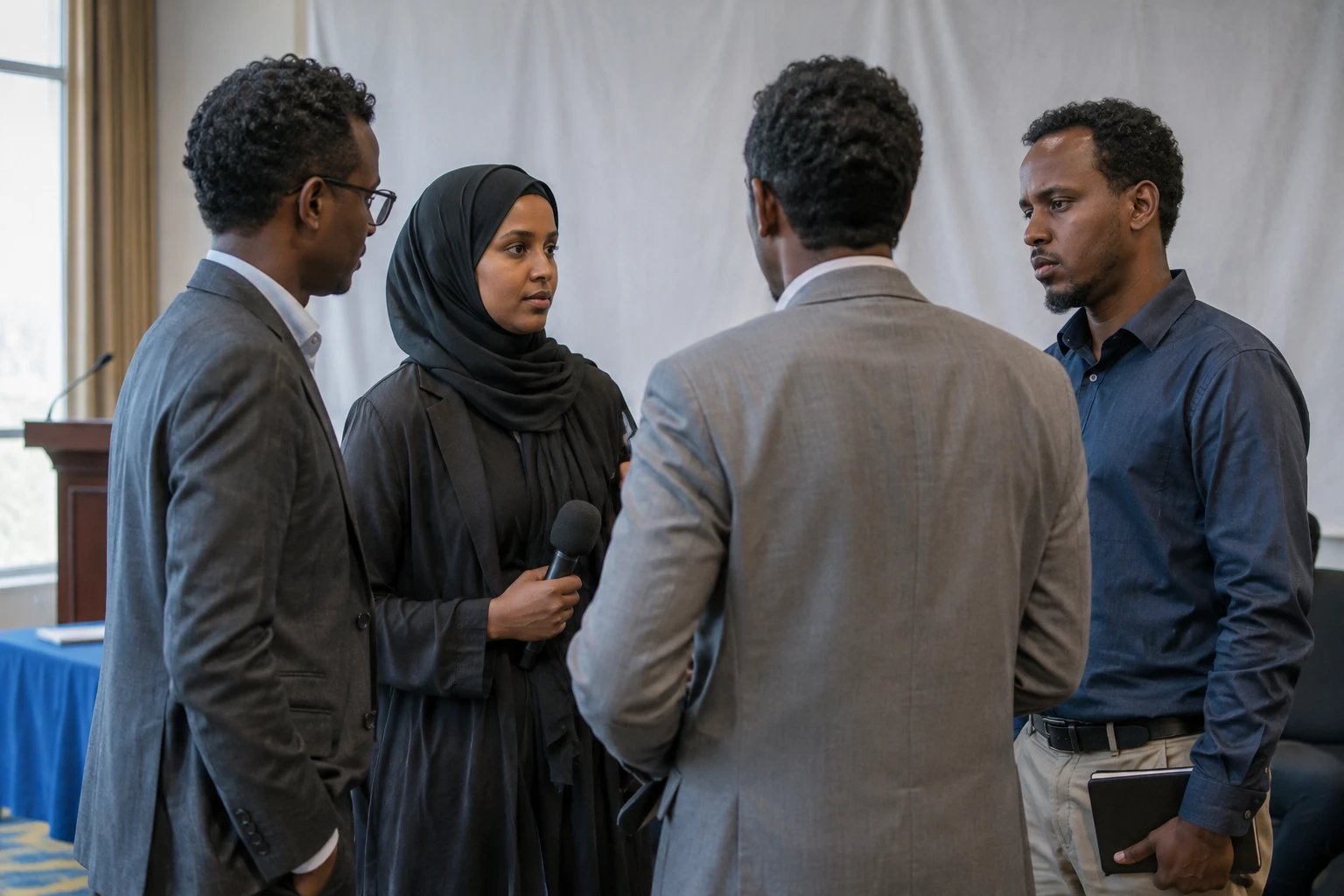
When a taxi driver speaks about rising prices and evictions in Mogadishu, her testimony can become a matter for the courts. In 2026, the story of Sadia Moalim Ali also exposed the risks faced by Somali journalists covering criticism of those in power.
A case followed into the courtroom
Somalia is going through a period in which political tensions and security concerns weigh on the work of the media. In Mogadishu, journalists cover federal institutions, security forces and decisions that directly affect residents. In this context, reporting an arrest or an eviction can quickly put a reporter at the centre of a political dispute.
The country is a member of the Intergovernmental Authority on Development (IGAD), a regional organisation in the Horn of Africa. The freedom to report therefore also concerns the circulation of accounts of population displacement, governance and security. But circumstances differ from one country and region to another: the Sadia case falls first and foremost under Somali institutions and the Banadir court.
Sadia Moalim Ali, a taxi driver and Somali activist active on social media, spoke out in particular about rising prices, forced evictions and violence against women. Arrested on 12 April 2026, she said she had suffered violence in detention. These allegations are attributed to her and should not be presented as independently established facts.
On 25 June, a court in Mogadishu sentenced her to three years in prison. The Banadir Court of Appeal overturned the sentence on 12 August and ordered her release. Two separate sources, Amnesty International and the Somali media outlet Hiiraan Online, reported the decision. Her detention lasted just over four months.
Journalists directly targeted
On 8 May, three journalists were assaulted and detained in Mogadishu. The Somali Journalists Syndicate (SJS) identified Mohamed Ibrahim Osman, known as Mohamed Bulbul, Abdihafid Nor Barre and Abdishakur Mohamed Mohamud. The union says police officers and intelligence agents beat them and questioned them about their reporting on Sadia’s case.
Bulbul’s account, reported by several media outlets, describes threats and pressure to co-operate with the authorities, leave the country or face reprisals. He ultimately chose exile, leaving his family in Somalia. Details of the assault come mainly from accounts by the journalists and professional organisations, and should therefore remain attributed.
On 25 June, another journalist, Abdukadir Abukar Ali, known as Diirshe, was arrested as he arrived at the court to cover Sadia’s trial. The SJS and the National Union of Somali Journalists reported his arrest. According to his colleagues, he was questioned and then released after three days. The authorities, for their part, said the arrest was connected to a judicial proceeding. This disagreement over the circumstances and the reason should be borne in mind.
Sadia’s release ended her detention, but it does not erase either the original conviction or the questions raised by the arrests of journalists. She herself said media coverage had helped bring her case to public attention. This acknowledgement underlines the press’s practical role: making proceedings visible that, without witnesses, would be difficult to scrutinise publicly.
Fear shrinks the space for information
The risk is not limited to journalists who are arrested. SJS secretary-general Abdalle Mumin has described self-censorship fuelled by fear of the authorities, the police or armed groups. When reporters avoid certain subjects, the people affected — particularly those facing evictions or violence — also lose a way to make their version heard.
Data published by professional organisations confirm that incidents extend beyond this case. The SJS recorded 148 violations of media freedom in 2025, while the National Union of Somali Journalists (NUSOJ) counted 72 using its own methodology. These totals are not directly comparable: the organisations do not necessarily use the same definitions or counting criteria. Their agreement that repeated pressure exists nevertheless deserves attention.
The consequences vary between those involved. For the authorities, coverage of sensitive issues can become a matter of controlling the public narrative. For newsrooms, arrests and threats make investigations more difficult and can push experienced journalists to leave. For residents, the effect is less visible but immediate: fewer verified accounts of public decisions, evictions or conditions in detention.
A Somali issue with regional resonance
The case is a reminder that press freedom is measured in courtrooms and police stations as well as in legal texts. The Court of Appeal’s decision restored Sadia’s freedom, but the protection of journalists will depend on how the authorities investigate assaults and respect judicial safeguards.
For IGAD and the African Union, these cases raise a regional question: how can it be ensured that public security is not used to unduly restrict the work of the media? What happens next will depend in particular on how complaints are handled, journalists’ access to hearings and whether they can cover criticism without intimidation. In Somalia, the next reports from journalists’ unions will show whether arrests linked to coverage of public affairs are declining or self-censorship is becoming more entrenched.