Algeria
 Egypt
 Libya
 Morocco
 Sudan
 Tunisia
 Benin
 Cabo Verde
 Côte d'Ivoire
 Ghana
 Guinea
 Guinea-Bissau
 Liberia
 Mali
 Mauritania
 Niger
 Nigeria
 Senegal
 Sierra Leone
 The Gambia
 Togo
 Cameroon
 Central African Republic
 Chad
 DR Congo
 Equatorial Guinea
 Gabon
 Republic of the Congo
 São Tomé and Príncipe
 Burundi
 Comoros
 Djibouti
 Eritrea
 Ethiopia
 Kenya
 Madagascar
 Malawi
 Mauritius
 Mozambique
 Rwanda
 Seychelles
 Somalia
 South Sudan
 Tanzania
 Uganda
 Angola
 Botswana
 Eswatini
 Lesotho
 Namibia
 South Africa
 Zambia
 Zimbabwe
In Siguiri, the closure of gold-mining sites does not stop at Guinea’s borders. It is driving Burkinabè workers and people of other nationalities towards Mali, while Guinean authorities cite the protection of land and waterways. One central question remains: how can the ban be enforced without exposing those affected to dangerous or degrading treatment?
An environmental decision with cross-border effects
Siguiri is in Upper Guinea, in the north-east of the country, close to Mali. The region has long attracted Guinean and foreign workers, particularly from Burkina Faso and Mali, because of its gold deposits. Artisanal gold mining — small-scale gold extraction, often using limited tools and resources — supports miners as well as traders and transporters.
This local economy nevertheless operates in a difficult-to-regulate environment. A study by the International Organization for Migration (IOM) on mobility linked to gold mining in Siguiri documents the presence of foreign workers and movements associated with the sector. The effects extend beyond the sites: the activity provides local incomes while also posing risks to land, water and riverside communities. The IOM assessment of miners’ movements in Siguiri describes these cross-border movements.
The regional political context also matters. Guinea remains a member of the Economic Community of West African States (ECOWAS). Burkina Faso and Mali, meanwhile, left the organisation in January 2025 and are members, along with Niger, of the Alliance of Sahel States (AES). These frameworks do not sever the everyday ties between border communities, but they make institutional coordination particularly important. Burkina Faso, Mali and Niger’s withdrawal from ECOWAS has reshaped regional relations.
What the Guinean authorities announced
On 2 November 2026, five Guinean government departments announced a ban on what they called “anarchic” gold mining in Siguiri. The statement cited inspection missions and environmental degradation attributed to mining activities that did not comply with regulations.
The authorities cited soil and farmland degradation, waterway pollution and the use of heavy machinery. They also banned extraction from riverbeds and banks, as well as the use of explosives, mercury and cyanide. The statement provides for the permanent deployment of defence and security forces, road and river checks, and verification of the identity and residence status of people at the sites.
These justifications come from the Guinean government. They set out the official rationale for the operation, but are not, on their own, enough to establish how each intervention was conducted or whether everyone who left Siguiri was formally expelled. Foreign workers may leave after a site closure, an evacuation or an individual decision to depart. It is important to distinguish between these situations.
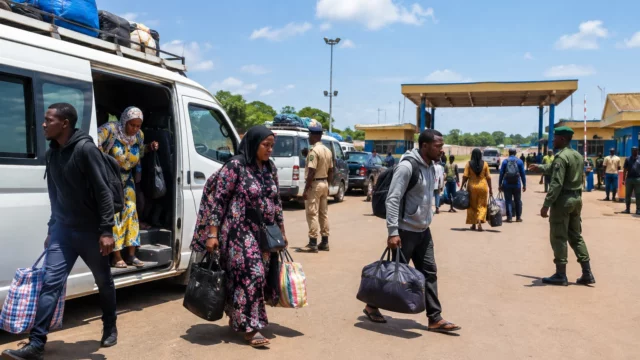
Available reports describe a significant movement of Burkinabè nationals leaving gold-mining areas and crossing the Malian border. The Guinean News Agency reports that the suspension of activities was extended across the region and that miners left the sites. Guinean media outlet Guinee360, for its part, reports that the Burkinabè authorities are organising the return of several thousand of their nationals. These accounts confirm a substantial movement, but do not make it possible to determine with certainty how many people were expelled or to establish that all were forced to leave.
Conflicting accounts of the conditions of departure
Burkina Faso’s Security Minister, Mahamadou Sana, said Ouagadougou had not been notified before the operation. He also spoke of injured people, some of whom were said to have been shot, and condemned what he described as cruel and degrading treatment. These are serious allegations. In the absence of accessible independent confirmation, they must remain attributed to the minister and cannot be presented as an established account.
Mali, through which some of the people are said to have travelled, reported an influx of nationals of various countries at the border with Guinea. According to information reported by regional media, the Malian authorities announced arrangements for reception and assistance. Burkina Faso, for its part, said it was preparing the return of its nationals, with buses and reception sites. The transport announcements do not, however, specify how many people were actually transported or provide details of their circumstances on arrival.
At the time the information was reviewed, the media cited had not reported any detailed Guinean communication on the situation of Burkinabè nationals. This leaves practical questions unanswered: did people have access to their personal belongings, healthcare and an individual procedure? Were workers with regular status distinguished from those whose stay was not? An independent investigation could help clarify the disputed facts.
Finding a balance between enforcement and protection
For the authorities in Conakry, the challenge is to regain control of mining activities and limit environmental damage in a region where gold mining plays a major role. But a sudden closure also affects workers who depended on the sites, families left behind and the small businesses that revolve around the mines. The consequences vary from person to person: an operator, a day labourer and a vendor do not have the same income or the same ability to leave.
The Burkinabè and Malian authorities are now involved in organising reception and returns. This cooperation addresses an immediate need, but does not resolve questions of responsibility for operations carried out in Guinea. Protecting the natural environment and respecting people’s rights are not mutually exclusive: enforcement of the regulations must also provide for clear procedures, verifiable checks and appropriate support.
The next steps will involve two things: independent verification of the conditions of departure and Guinea’s ability to regulate gold mining sustainably in Siguiri. For the three countries, the episode is a reminder that national mining decisions have direct consequences across borders. Monitoring the returns organised by Ouagadougou and the enforcement measures announced in Siguiri will help establish whether the operation leads to better-regulated mining or merely shifts the problem elsewhere.