Algeria
 Egypt
 Libya
 Morocco
 Sudan
 Tunisia
 Benin
 Cabo Verde
 Côte d'Ivoire
 Ghana
 Guinea
 Guinea-Bissau
 Liberia
 Mali
 Mauritania
 Niger
 Nigeria
 Senegal
 Sierra Leone
 The Gambia
 Togo
 Cameroon
 Central African Republic
 Chad
 DR Congo
 Equatorial Guinea
 Gabon
 Republic of the Congo
 São Tomé and Príncipe
 Burundi
 Comoros
 Djibouti
 Eritrea
 Ethiopia
 Kenya
 Madagascar
 Malawi
 Mauritius
 Mozambique
 Rwanda
 Seychelles
 Somalia
 South Sudan
 Tanzania
 Uganda
 Angola
 Botswana
 Eswatini
 Lesotho
 Namibia
 South Africa
 Zambia
 Zimbabwe
A sporting project that goes beyond the pitch
In the Sahel, football is never just about the ball. It is also about infrastructure, movement between capitals, crowd safety and the ability of states to project an image of stability. The joint bid by Burkina Faso, Mali and Niger to host the 2032 Africa Cup of Nations is part of this broader logic, going well beyond sporting ambition alone.
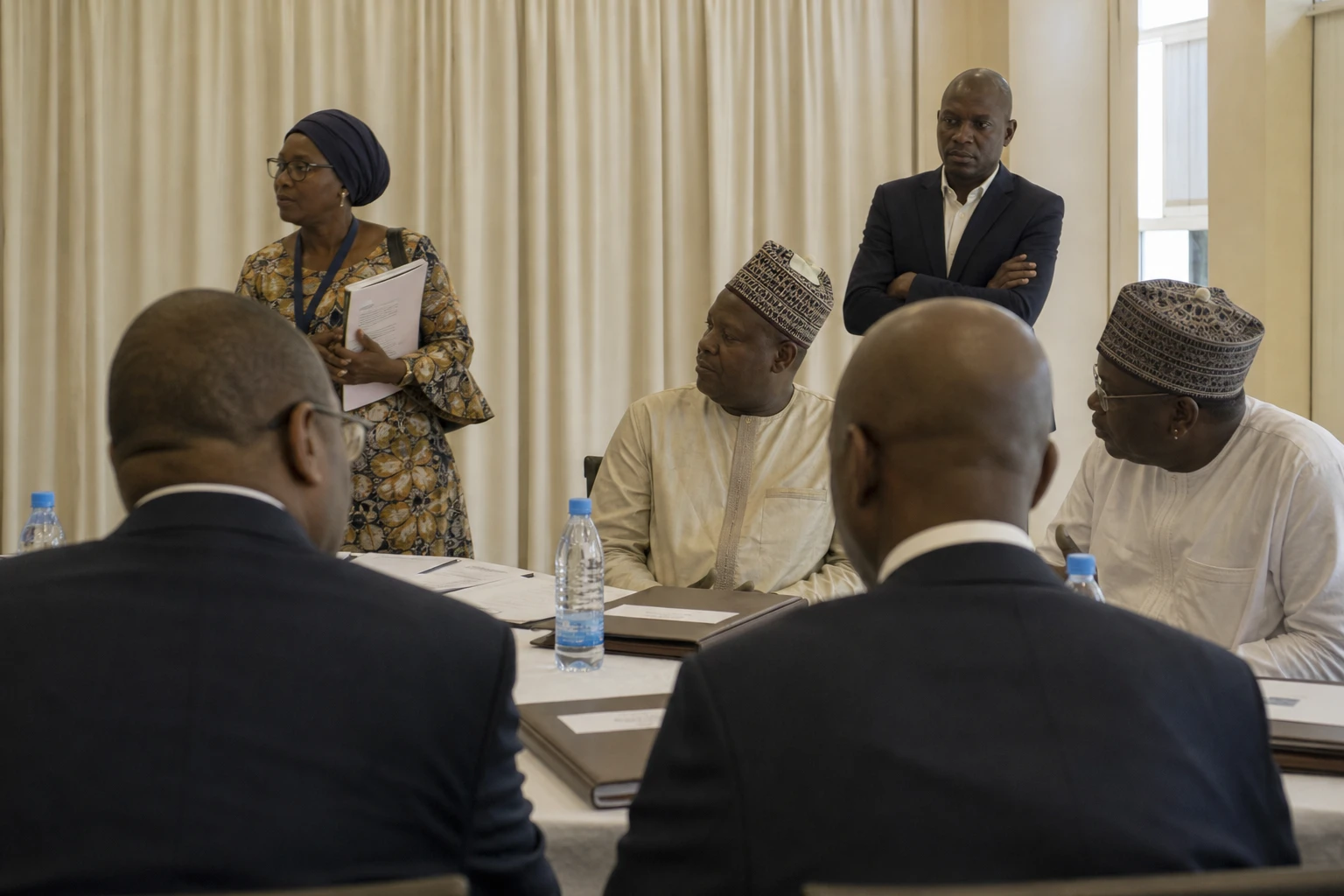
The bid comes at a time when these three countries are also seeking to show that they can act together, despite internal difficulties and tensions with several regional partners. For their sports officials, hosting a major continental competition would send a strong signal. For the public, it raises a very practical question: can roads, stadiums, hotels, transport and security meet the challenge?
The CAF has registered a joint expression of interest
On 21 July 2026, the Nigerien Football Federation said that the Confederation of African Football had formally taken note of the joint expression of interest by Burkina Faso, Mali and Niger in hosting the 2032 Africa Cup of Nations. Several African media outlets reported the same information, saying that a meeting had taken place in New York between CAF president Patrice Motsepe and officials from the three federations, on the sidelines of the 2026 World Cup.
At this stage, this is a first milestone, not a decision on the host. The CAF has merely registered the interest of the three federations, opening the way for the next steps in the process: an assessment of guarantees, stadiums, team accommodation, travel and security arrangements. On these points, the Sahel bid will be judged like all the others, but against a standard that will inevitably be high.
The trio can nevertheless point to some advantages. Burkina Faso hosted the Africa Cup of Nations in 1998, while Mali hosted the 2002 edition. The CAF’s archives also list both countries among the competition’s past hosts.
Experience, but gaps to close
The Sahelian federations know that the tournament’s history is not enough. Burkina Faso and Mali have a genuine footballing heritage, but a joint bid by three countries now requires much more than memories of a successful tournament. It needs approved stadiums, suitable hotels, reliable domestic transport links and coordination between states. Niger, meanwhile, has yet to host the Africa Cup of Nations, making the challenge even greater for the bid as a whole.
Comparisons with recent major joint bids also show that the CAF now looks as closely at logistical strength as at political symbolism. A joint bid can carry more weight than a single-country proposal, especially if it allows investment to be shared among several cities. But it also makes governance more complicated: standards, budgets and responsibilities must be harmonised across three separate countries.
Against this backdrop, the security situation remains decisive. Since 2024 and again in 2026, the United Nations has described the Sahel as a region where armed groups, transnational crime and violent extremism continue to threaten stability. UNHCR even warned in early July 2026 that the Lake Chad basin remained at a tipping point, with a marked increase in recorded incidents between January 2024 and April 2026.
Security, the key test for a continental tournament
This is where the project’s credibility will be decided. Mali, Burkina Faso and Niger have faced attacks by jihadist groups and population displacement for years, putting pressure on administrations, roads and public services. UN agencies and several recent analyses describe a Sahel region where the threat remains acute, with direct effects on markets, schools, mobility and mass gatherings.
A major tournament is not just about a main stadium. Airports, roads, fan zones, hotels, training venues and delegation travel all need to be secured. For governments, an Africa Cup of Nations can act as a catalyst for investment. For local people, it will only have meaning if it leaves behind facilities that can be used in everyday life, not just full stands for a few weeks.
The precedent most often recalled in African football remains the attack on the Togo team convoy in Cabinda, Angola, in January 2010, before the 2010 Africa Cup of Nations. The event left a lasting mark on the continent’s sporting memory. It is a reminder that a competition can be put at risk by a single weak link: a journey, a security perimeter or a failure of coordination.
A sporting bid and a political signal
The bid by Burkina Faso, Mali and Niger also has political significance. The three countries are linked through the Alliance of Sahel States, a partnership formed amid diplomatic ruptures and a search for strategic autonomy. Their joint bid for the 2032 Africa Cup of Nations extends this approach of presenting a united front, this time in a positive and popular arena.
At the continental level, the CAF faces a symbolic bid. If it decides that a Sahelian region can host a major competition, that will say something about its ability to support fragile states without lowering its standards. If, on the other hand, it finds the guarantees insufficient, it will send a clear message about the place of security risks in African sport. In either case, the issue will go beyond football.
The next steps will therefore depend less on slogans than on evidence. Until a final decision is made, attention will turn to announced construction projects, improvements to stadiums, budget commitments and the security trajectory in the three countries. For now, the 2032 Africa Cup of Nations is not yet in the Sahel. But the Sahel has already entered the race to host it.