Algeria
 Egypt
 Libya
 Morocco
 Sudan
 Tunisia
 Benin
 Cabo Verde
 Côte d'Ivoire
 Ghana
 Guinea
 Guinea-Bissau
 Liberia
 Mali
 Mauritania
 Niger
 Nigeria
 Senegal
 Sierra Leone
 The Gambia
 Togo
 Cameroon
 Central African Republic
 Chad
 DR Congo
 Equatorial Guinea
 Gabon
 Republic of the Congo
 São Tomé and Príncipe
 Burundi
 Comoros
 Djibouti
 Eritrea
 Ethiopia
 Kenya
 Madagascar
 Malawi
 Mauritius
 Mozambique
 Rwanda
 Seychelles
 Somalia
 South Sudan
 Tanzania
 Uganda
 Angola
 Botswana
 Eswatini
 Lesotho
 Namibia
 South Africa
 Zambia
 Zimbabwe
When two armed groups compete for the same tracks and areas of influence, local populations do not automatically become safer. For the authorities in Mali, Burkina Faso and Niger, the conflict between the Group for the Support of Islam and Muslims (JNIM), linked to al-Qaeda, and Islamic State in the Sahel may hamper a rival. But this rivalry is no substitute for a state presence or the protection of residents.
A rivalry that crosses borders
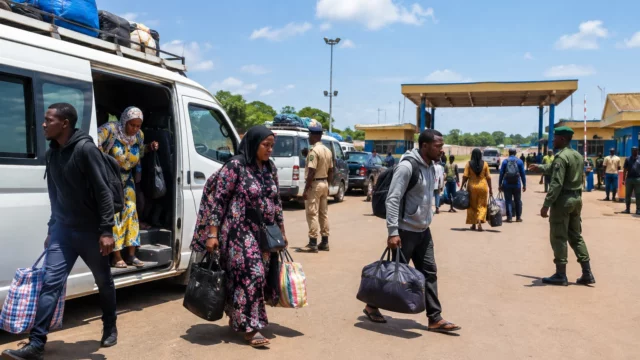
Mali, Burkina Faso and Niger share a vast border area where armed groups move, recruit and seek to control territory. Administrative borders are not enough to contain these movements. Military operations and local rivalries, however, can quickly shift the balance of power.
JNIM brings together several armed formations and is al-Qaeda’s Sahelian branch. Islamic State in the Sahel, often referred to by the acronym ISS, is its main competitor in the region. The two organisations do not form a united front: they are vying, in particular, for influence, resources and control of transit areas.
This competition is part of a broader trajectory. Mali experienced two coups in 2020 and 2021, then moved closer to Burkina Faso and Niger within the Alliance of Sahel States (AES), a political and military cooperation between the three countries. The break with the Economic Community of West African States (ECOWAS), which took effect in January 2025, also reshaped regional relations. These developments have not removed shared security challenges.
Fighting reported in northern Burkina Faso
On 9 October, JNIM and ISS fighters reportedly clashed near Ganadaouri, in Burkina Faso’s Oudalan province, in the north of the country. Several reports describe a large-scale battle. The available details are, however, difficult to verify independently.
ISS claimed to have inflicted heavy losses on its rival. This account comes from a party to the conflict and cannot be considered confirmed. The information consulted does not establish a reliable death toll. It is therefore important to distinguish the reality of the clashes, reported by several media outlets, from the figures cited by the groups themselves.
The battle is part of an intensification of clashes between the two organisations since September. Fighting has also been reported in other parts of the border area. Accounts of the events and their scale vary by source, making caution necessary before drawing a definitive regional assessment.
Reports by TV5MONDE on clashes in the Sahel and Le Monde’s coverage of the conflict also place the 9 October fighting near Ganadaouri. This convergence confirms the reported location and date, but does not validate the death tolls claimed by the combatants.
A tactical advantage does not guarantee political gains
On the ground, rivalry between groups can temporarily reduce their ability to concentrate their forces against national armies. It can also cause casualties, divert fighters to other fronts or weaken their local control. For the authorities, this may provide room for manoeuvre. It does not, on its own, amount to a lasting victory.
The same fighting can also worsen insecurity. Residents risk being caught between rival groups, displaced or cut off from markets and services. Cross-border routes are essential to daily trade, particularly for merchants and livestock breeders. An increase in clashes can therefore weigh on the local economy, well beyond the contested positions.
For Bamako, the outcome will depend less on the number of fighters the groups say they have lost than on the ability of public services to return to the affected areas. Security, justice, administration and access to resources are all part of the same picture. If one organisation retreats but no lasting civilian presence takes its place, another group may seek to fill the vacuum.
The situation in Mali is also a reminder that military gains can be reversed. In 2026, coordinated attacks struck several localities across the country and territorial setbacks put the authorities under pressure, according to press reports. In this context, a clash between rivals is not enough to establish that the state has regained control. Changes in presence and security must be assessed over time.
A rivalry to watch across the AES
The events in Oudalan primarily concern Burkina Faso, but they shed light on the regional balance where Burkinabe, Malian and Nigerien territories meet. They are a reminder that threats and the movement of armed groups cross borders, while responses remain largely organised by each state and through AES mechanisms.
The central question is therefore not simply whether rival groups are weakening one another. It is also necessary to monitor whether armies can secure affected areas without putting civilians at greater risk, and whether administrations can resume their functions there. For residents, any change will be measured in practical terms: being able to travel, trade and access services without local control shifting with every new offensive.
The next developments to watch are independent confirmation of casualty figures, changes in positions around Oudalan and any movement of the fighting towards the Malian and Nigerien borders. While these facts remain incomplete, it would be premature to conclude that rivalry benefits military governments. It may weaken an adversary in the short term; it guarantees neither stability nor the safety of local populations.