Algeria
 Egypt
 Libya
 Morocco
 Sudan
 Benin
 Burkina Faso
 Cabo Verde
 Côte d'Ivoire
 Ghana
 Guinea
 Guinea-Bissau
 Liberia
 Mali
 Mauritania
 Niger
 Nigeria
 Senegal
 Sierra Leone
 The Gambia
 Togo
 Cameroon
 Central African Republic
 Chad
 DR Congo
 Equatorial Guinea
 Gabon
 Republic of the Congo
 São Tomé and Príncipe
 Burundi
 Comoros
 Djibouti
 Eritrea
 Ethiopia
 Kenya
 Madagascar
 Malawi
 Mauritius
 Mozambique
 Rwanda
 Seychelles
 Somalia
 South Sudan
 Tanzania
 Uganda
 Angola
 Botswana
 Eswatini
 Lesotho
 Namibia
 South Africa
 Zambia
 Zimbabwe
In Radès, the sea first brings home an obvious truth: a coastal city cannot thrive if dirty water is allowed to flow offshore.
In the southern suburbs of Tunis, pollution is no longer an abstract issue. It can be seen in the Méliane river, in the odours around industrial zones and in the state of the beaches along Radès and neighbouring municipalities. The issue here is not only environmental. It also affects public health, port activity, industrial jobs and the image of a coastline that remains vital to thousands of Tunisian families.
This is a long-standing problem. It concerns a densely populated basin where industry, housing, sanitation and maritime traffic intersect. This mix puts constant pressure on wastewater systems and the coast. Scientific studies have already described Radès-Hammam Lif as an area exposed to several sources of pollution, with a high concentration of urban and industrial activity around the mouth of the Méliane river. Tunisia’s environment ministry, for its part, says industrial pollution must be monitored and regulated, while the National Environmental Protection Agency is responsible for controlling discharges and treatment facilities.
A long-standing issue, but a highly political one
Radès is in the governorate of Ben Arous, east of Tunis. The city is a strategic hub in the southern suburbs. It is home to a port, an industrial zone and residential neighbourhoods directly exposed to pollution. The Méliane river, which runs through the area before flowing into the Gulf of Tunis, carries some of the domestic and industrial discharges from the metropolitan area. University research and field studies have already reported metals and organic pollutants in the river and on the nearby coast.
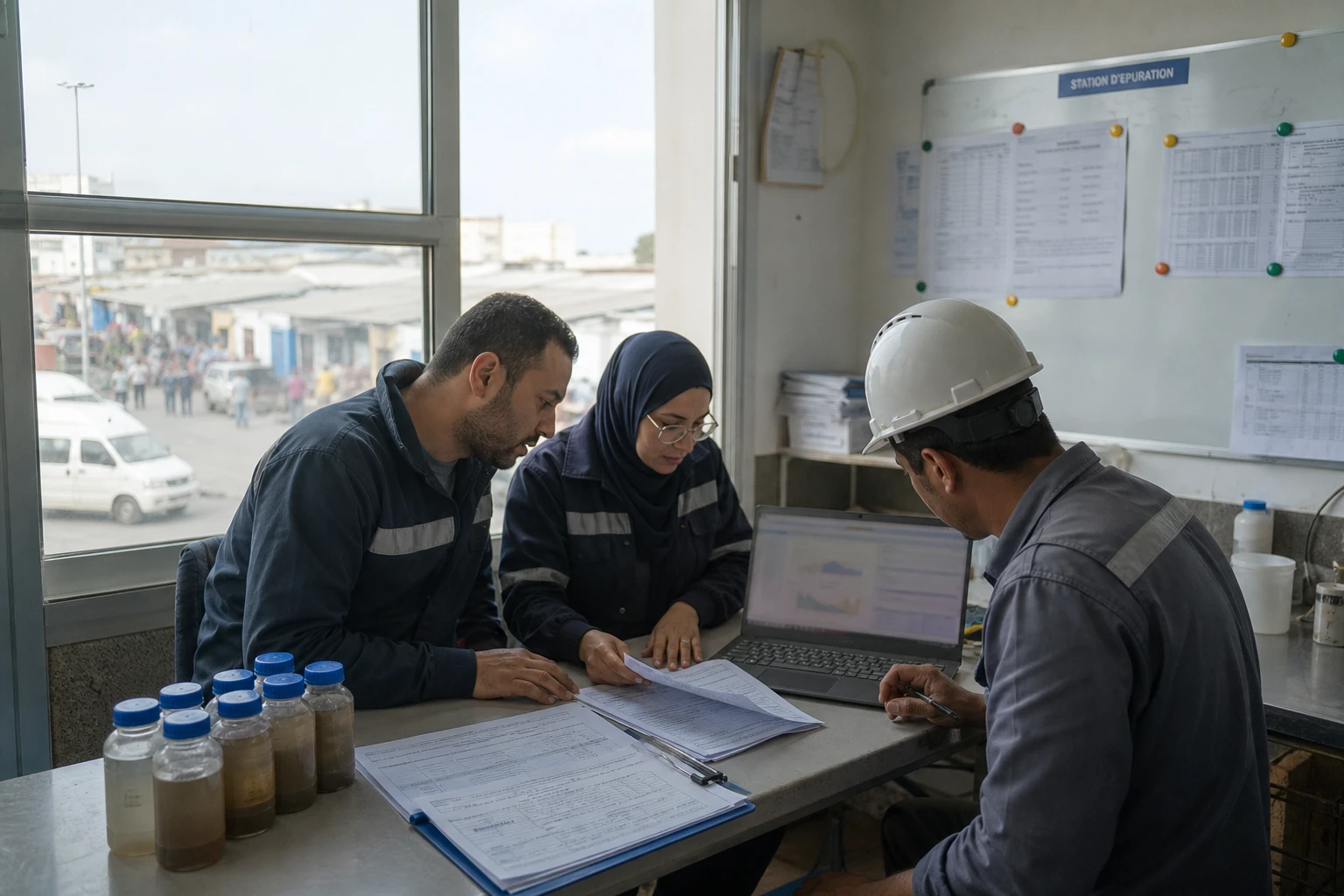
In this context, the public response cannot be limited to a symbolic visit. It involves several administrations: the National Sanitation Office, the National Environmental Protection Agency, the environment ministry and local authorities. ONAS is not merely a technical operator. Tunisia’s environment ministry describes it as a central player in protecting the aquatic environment and combating sources of pollution. But on the ground, residents have for years denounced a gap between the rules and their enforcement.
The recent sequence of events illustrates this tension. On 20 January 2026, Kaïs Saïed had already visited Radès during severe weather, according to the TAP news agency. In early August 2026, the head of state returned to the site to highlight pollution in the area, before a ministerial meeting devoted to the issue. The president’s repeated visits show that the matter has moved beyond the technical sphere to become a test of local and national governance.
What the South Méliane project actually funds
At the heart of the plan, the South Méliane wastewater treatment plant in Radès is to be rehabilitated and expanded. The DEPOLMED programme, co-financed by the French Development Agency, the European Investment Bank and the European Union, aims to reduce water pollution in several coastal areas of Tunisia. AFD describes it as a €140 million programme involving the renovation or expansion of four coastal wastewater treatment plants, including South Méliane, and the installation of about 540 kilometres of networks, 53 pumping stations and 29,000 connection boxes.
Work at South Méliane began in 2020, and several institutional and technical sources give the end of 2026 as the deadline for completion. Here again, the decisive issue is not just the investment. It is the ability to make the whole system work: collection, treatment, discharge monitoring and the effective connection of industrial facilities. Documents related to the project also note that the quality of effluent at the South Méliane plant has deteriorated and that there is a risk of direct discharge into the Méliane river when the infrastructure is overloaded.
Regulatory compliance remains the crux of the problem. In Tunisia, effluent discharges are governed by a 2018 decree setting limit values for receiving waters. But several analyses published in recent years show that the gap between the law and its implementation remains wide, especially when administrative monitoring lacks resources. In other words, modernising a treatment plant is not enough if the factories feeding into it do not treat their wastewater upstream.
Between local anger and a Mediterranean-wide issue
The southern suburbs of Tunis have already shown that pollution there is not solely a matter for technicians. In September 2021, residents of Radès, Ezzahra, Hammam Lif, Hammam Chatt and Borj Cédria formed a human chain along the coast to protest about the state of the beaches and discharges reaching the sea. The protest made a strong impression because it was organised by local residents, families and elected officials, not a partisan organisation. It also reflected exhaustion with an issue that was well known and widely discussed, but too often put off.
For residents, the stakes are immediate: swimming, health, quality of life, neighbourhood values, odours, nuisances and access to a clean coastline. For industrial firms, the message is even more direct: an era of poorly monitored discharges cannot continue without environmental, health and political costs. For the Tunisian state, the issue is ultimately a test of credibility. Modernising sanitation, monitoring discharges and enforcing standards say much about the authorities’ ability to address practical problems beyond making announcements.
At the regional level, the stakes extend beyond Radès. The Gulf of Tunis is part of the Mediterranean, an area already under heavy urban and industrial pressure along several southern shores. Tunisia is therefore on sensitive ground: protecting a densely populated coastline, preserving a basin of life around the capital, and showing that environmental policy can deliver visible results in an Arab and African country that, too, faces competition between social urgency and the ecological transition. That is where the significance of the issue lies: in the ability to turn local anger into a lasting public service.