Algeria
 Egypt
 Libya
 Morocco
 Tunisia
 Benin
 Burkina Faso
 Cabo Verde
 Côte d'Ivoire
 Ghana
 Guinea
 Guinea-Bissau
 Liberia
 Mali
 Mauritania
 Niger
 Nigeria
 Senegal
 Sierra Leone
 The Gambia
 Togo
 Cameroon
 Central African Republic
 Chad
 DR Congo
 Equatorial Guinea
 Gabon
 Republic of the Congo
 São Tomé and Príncipe
 Burundi
 Comoros
 Djibouti
 Eritrea
 Ethiopia
 Kenya
 Madagascar
 Malawi
 Mauritius
 Mozambique
 Rwanda
 Seychelles
 Somalia
 South Sudan
 Tanzania
 Uganda
 Angola
 Botswana
 Eswatini
 Lesotho
 Namibia
 South Africa
 Zambia
 Zimbabwe
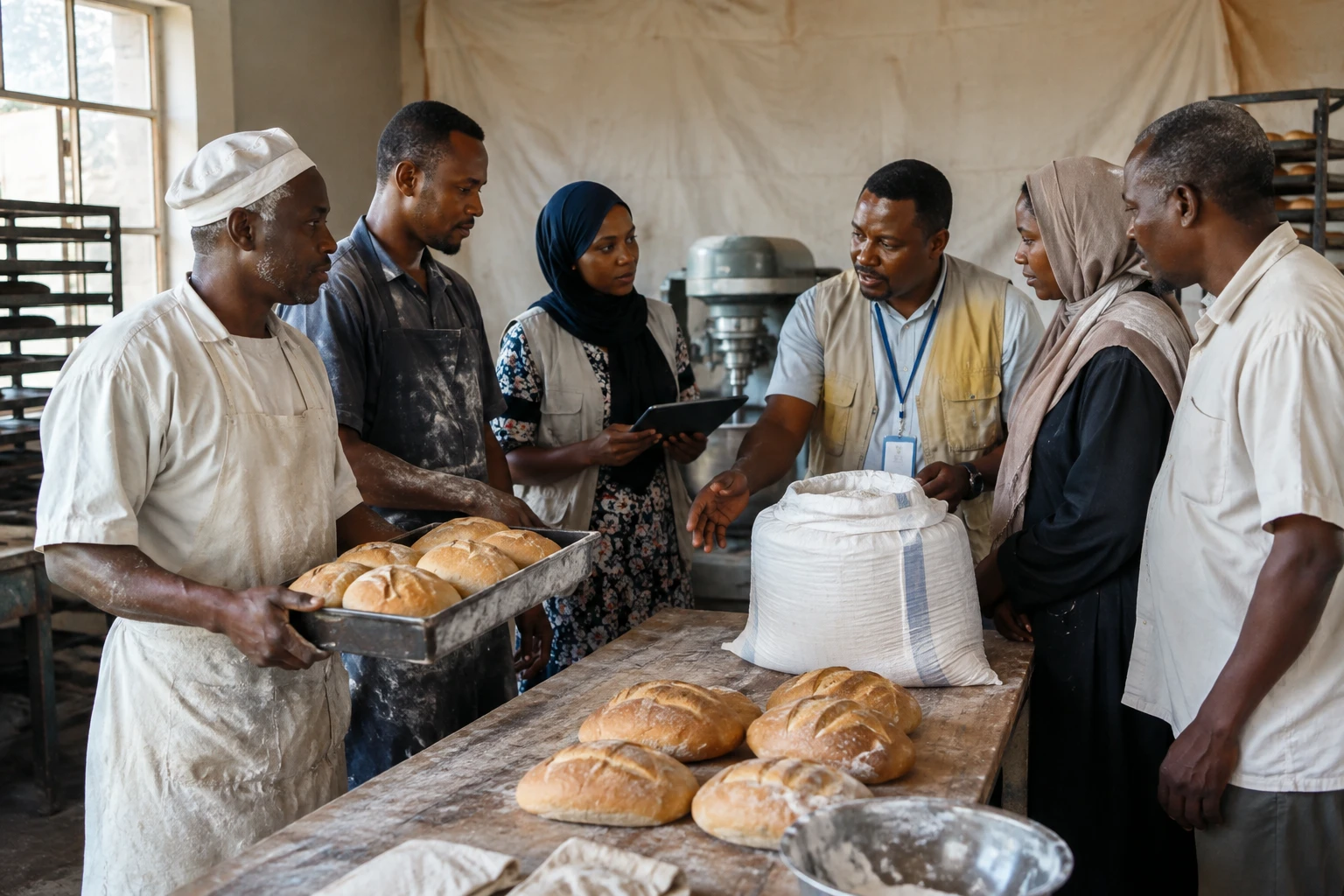
In Omdurman, buying bread increasingly means choosing between an essential food and other household expenses. The problem is not just the price on display: when flour is scarce, some bakeries cut production or close, while households have to buy smaller loaves or fewer of them.
A supply chain under pressure
The war that began on 15 April 2023 between the Sudanese army and the Rapid Support Forces has fragmented trade routes. Fighting, movement restrictions and transport costs are complicating the delivery of goods between regions. These disruptions are felt as far as urban markets, including areas where activity has resumed.
Sudan is a member of the Intergovernmental Authority on Development (IGAD), a regional organisation in the Horn of Africa involved in diplomatic efforts surrounding the conflict. But food-related challenges extend beyond national borders: population displacement, trade routes and aid needs also affect neighbouring countries. The African Union and IGAD remain among the frameworks through which the regional response is being shaped.
In this context, access to wheat and flour depends as much on the availability of stocks as on transport, fuel and traders’ ability to replenish their goods. Conditions vary from one state to another: a well-supplied market in the east does not guarantee that the same products will reach Omdurman or conflict zones.
In Omdurman, households and bakers bear the brunt
An Omdurman resident, Abeer Mohamed, says flour costs more and that both the size and quantity of bread have fallen. Families that relied on bread for several meals are now cutting back on purchases. Her account illustrates the tangible impact of inflation: the price alone does not tell the whole story, since the weight of a loaf may also have decreased.
Mohamed El Fateh, a bakery owner, says several establishments have suspended operations because flour is unavailable on the market. He says suppliers are not responding to orders, even after several days of waiting. When bakeries close, residents are left relying on those still open, which can mean longer waits to buy bread.
The reported figures for a 25-kilogram sack illustrate the scale of the increase: its price is said to have risen from 165,000 to 190,500 Sudanese pounds. This pushes up bakers’ costs even before baking begins. The available source also gives a conversion of these amounts into dollars, but the exchange rate varies sharply according to the market and date; the price in local currency is therefore best read without treating the conversion as an official rate.
Another report published on 26 October by Sudanese outlet Sudan Tribune gives a flour price of 191,500 pounds, citing an official from the Bakers’ Union. The difference from the 190,500 pounds reported in Omdurman may reflect different dates, suppliers or markets. It confirms a general upward trend, but does not establish a uniform price across the country. The newspaper also reports that fuel, yeast and oil are making production and transport more expensive.
Authorities in Blue Nile State are said to have authorised the sale of two loaves for 1,000 Sudanese pounds. This local decision does not automatically set the price in Omdurman, which is in Khartoum State. It nevertheless highlights the difficulty for administrations of balancing affordable prices against production costs, as industry professionals complain that some controls are not being enforced.
From bakery prices to purchasing power
The increase hits households that spend a large share of their income on food first. When bread becomes more expensive or harder to find, families may reduce portions, replace some foods or buy less often. Workers with irregular incomes and displaced people have less room to absorb these fluctuations. Sellers and bakers, however, are not all in the same position: those with stocks or direct access to flour can continue operating, while smaller establishments are more exposed to shortages.
The problem is not confined to Omdurman. Industry professionals report strains in Khartoum State, Gezira and North Kordofan. Nationally, FEWS NET data describe markets weakened by conflict, movement restrictions and declining purchasing power. Its analysis published in 2026 notes marked differences between regions: roads and supplies remain particularly disrupted in parts of Darfur and Kordofan. This variation makes it impossible to present a single price increase as representative of the situation facing all Sudanese people.
The bread crisis thus exposes several interconnected dependencies: wheat imports, domestic agricultural production, the exchange rate, fuel and road security. A disruption at any one point can reduce the quantity available or make delivery too costly. Authorities can announce price ceilings, but their enforcement depends on credible checks and a regular supply. Without affordable flour, a regulated price risks driving bakeries to close rather than sell at a loss.
An indicator to watch beyond the capital
The resumption of economic activity in some areas does not mean a uniform return to normal. Khartoum, of which Omdurman is part of the wider urban area, continues to feel the effects of the war, while other regions face different constraints on harvests and trade. The immediate challenge for Sudanese authorities is to maintain flows of flour and fuel without shifting the entire burden on to consumers or small bakeries.
At a regional level, volatility in Sudanese markets also matters to neighbouring countries, which host displaced people and are linked to Sudan by trade routes. The ability of IGAD and the African Union to support de-escalation and humanitarian access will affect these exchanges. In the coming months, the key indicators will be the opening of transport corridors, the availability of wheat and price movements across different states. In Omdurman, their impact will first be measured by one everyday question: how much bread can a family still afford to buy?
Reports of supply pressures and price movements have been published by Sudanese and African media. FEWS NET’s humanitarian estimates nevertheless emphasise that access to food and market conditions vary sharply from one region to another.