Algeria
 Egypt
 Libya
 Morocco
 Sudan
 Tunisia
 Benin
 Burkina Faso
 Cabo Verde
 Côte d'Ivoire
 Ghana
 Guinea
 Guinea-Bissau
 Liberia
 Mali
 Mauritania
 Niger
 Nigeria
 Senegal
 Sierra Leone
 The Gambia
 Togo
 Cameroon
 Central African Republic
 Chad
 DR Congo
 Equatorial Guinea
 Gabon
 Republic of the Congo
 São Tomé and Príncipe
 Burundi
 Comoros
 Djibouti
 Eritrea
 Ethiopia
 Kenya
 Madagascar
 Malawi
 Mauritius
 Mozambique
 Rwanda
 Seychelles
 Somalia
 South Sudan
 Tanzania
 Uganda
 Angola
 Botswana
 Eswatini
 Lesotho
 Namibia
 Zambia
 Zimbabwe
A cyberfraud case that reaches far beyond South Africa’s borders
At first glance, the episode looks like a conventional extradition proceeding. In reality, it tells a broader story about how digital fraud networks operate across several countries, exploit weaknesses in banking systems and target victims who are often far apart. For Nigeria, the country of origin of the people at the centre of the proceedings, the challenge is twofold: to protect its citizens from being tarred with the same brush while acknowledging that transnational cyberfraud remains a serious issue for judicial and financial security.
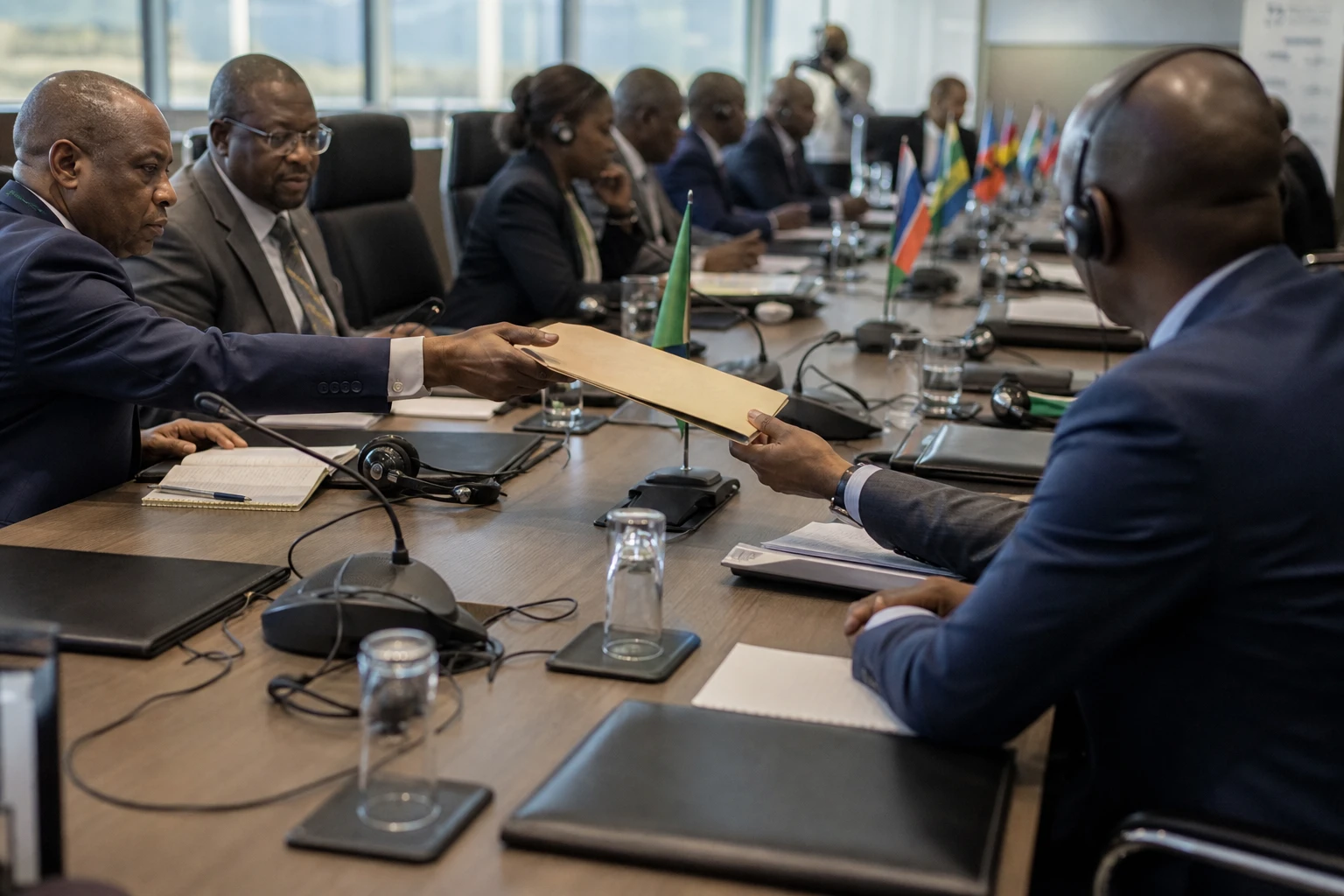
The case also fits a familiar regional pattern in southern and West Africa: when a case involves several jurisdictions, police forces, prosecutors and Interpol become central pieces of the puzzle. The South African Police Service confirmed on 11 September 2026 that it was facilitating the transfer of six Nigerian nationals to the United States, with the support of Interpol South Africa.
What the established facts say
According to the South African police, the six men were wanted by US authorities on fraud and money laundering charges linked to online romance scams. Investigators allege that they targeted more than 100 women in the United States and defrauded them of more than 100 million rand, or just over €5 million at the implicit exchange rate used in the initial statement.
The six suspects were arrested in South Africa in 2021 following a major police operation conducted with international partners. For several years, the US Department of Justice has described a wider case involving members or associates of Black Axe, also known as the Neo Black Movement of Africa, a criminal network founded in Benin City, Nigeria, with a presence in several countries. In the US indictment made public in 2021, authorities link the group to wire fraud and money laundering offences committed from Cape Town.
The case centres on a now familiar modus operandi: establish an online relationship, win the victim’s trust, then steer them towards requests for money, sometimes repeated, under the guise of a romantic emergency or personal hardship. Nigeria’s Economic and Financial Crimes Commission (EFCC) itself notes in its awareness materials that romance scams are among the most common forms of cybercrime targeting foreign victims.
Why the extradition matters to Pretoria, Abuja and Washington
For South Africa, the handover to US authorities is also a message at home: the country wants to show that it is not a grey zone where international networks can hide behind administrative borders. The Hawks, the specialised organised crime unit, see it as an example of effective cooperation with Interpol and US agencies. Such cooperation has a long history: other Nigerian nationals have already been extradited from South Africa to the United States in cyberfraud and trafficking cases.
For Nigeria, the impact is more sensitive. On the one hand, these cases reinforce an image of the country abroad that is sometimes distorted, as though nationality alone explained criminal activity. On the other, they are a reminder that some regional cyberfraud does have Nigerian roots, involving organised structures, overseas links and cross-border proceeds. The challenge for Abuja is therefore judicial, diplomatic and reputational all at once.
The implications extend beyond the three countries directly involved. In an African region where digital fraud, money laundering, fake accounts and romance scams spread quickly, institutions such as ECOWAS, SADC and the African Union are being watched for their ability to support police cooperation, information-sharing and harmonised responses. This case shows that an investigation begun in Cape Town can end up before a US federal court, but it also shows that no country can tackle alone a network spread across several continents.
A signal for future judicial cooperation
The next steps will now take place in US courts, where the six Nigerians will have to answer the charges against them. But the South African precedent will remain worth watching: it confirms that cybercrime cases are no longer resolved through local arrests alone. They involve warrants, extradition requests, cooperation agreements and political decisions between states.
Across the continent, the case is a reminder of a simple reality: judicial sovereignty is not enough when fraud networks move from the internet to several capitals and then into foreign jurisdictions. The test for African countries will be to uphold both the international cooperation that is necessary and the right to a fair assessment of their citizens, without allowing narratives about crime to reduce a country to its failings.