
 Algeria
 Egypt
 Libya
 Morocco
 Sudan
 Tunisia
 Benin
 Burkina Faso
 Cabo Verde
 Côte d'Ivoire
 Ghana
 Guinea
 Guinea-Bissau
 Liberia
 Mali
 Mauritania
 Niger
 Senegal
 Sierra Leone
 The Gambia
 Togo
 Cameroon
 Central African Republic
 Chad
 DR Congo
 Equatorial Guinea
 Gabon
 Republic of the Congo
 São Tomé and Príncipe
 Burundi
 Comoros
 Djibouti
 Eritrea
 Ethiopia
 Kenya
 Madagascar
 Malawi
 Mauritius
 Mozambique
 Rwanda
 Seychelles
 Somalia
 South Sudan
 Tanzania
 Uganda
 Angola
 Botswana
 Eswatini
 Lesotho
 Namibia
 South Africa
 Zambia
 Zimbabwe
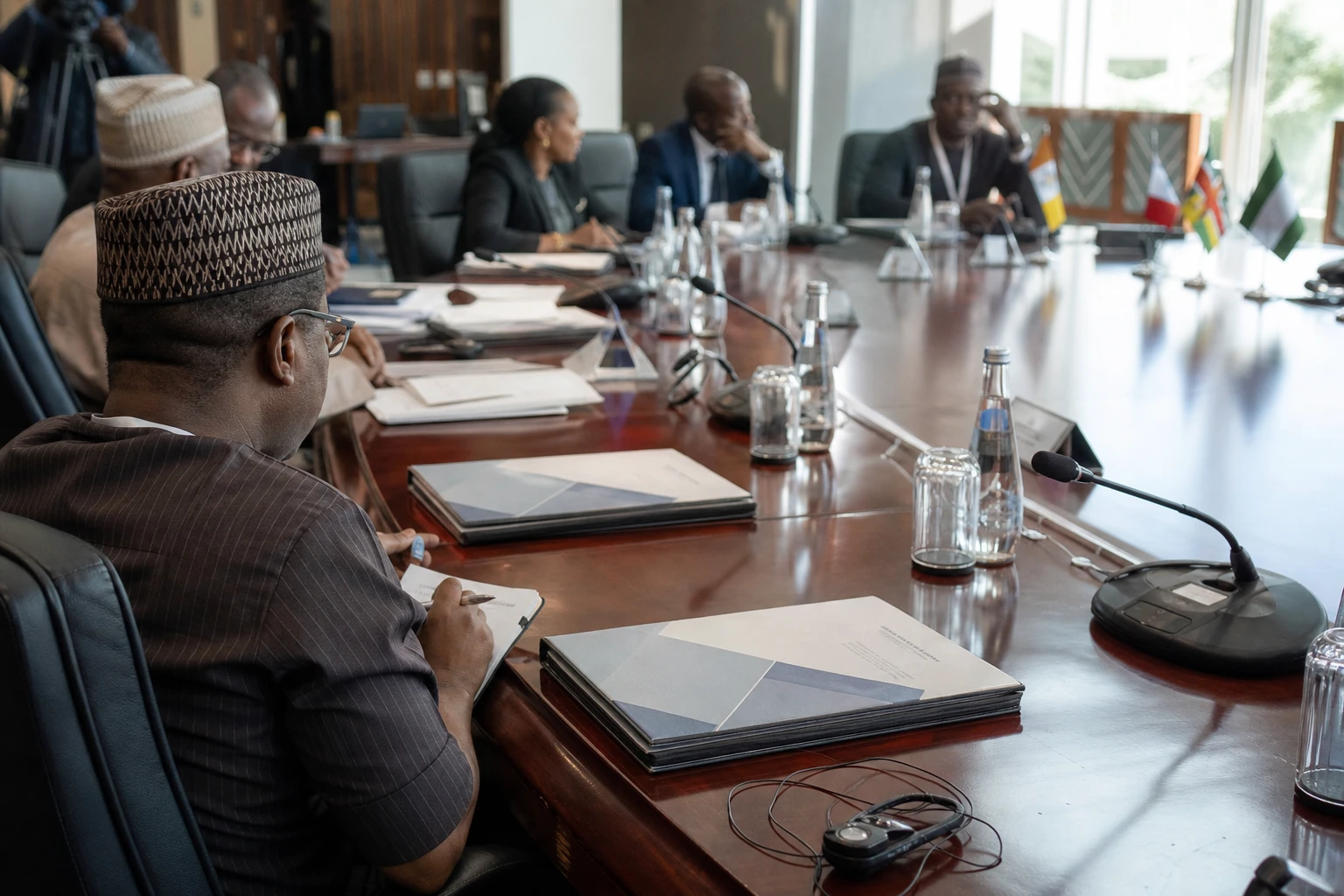
For Abuja, the challenge is no longer simply to extract more minerals. It is now to turn geological wealth into industrial activity, skilled jobs and sustainable revenue. The rapprochement with Washington opens up an opportunity. Above all, it requires Nigeria to define the practical terms of a balanced partnership.
A mining sector still marginal to Nigeria’s economy
Nigeria remains an oil power. Yet its subsoil also contains lithium, iron, bauxite, gold, limestone and other minerals sought by the energy and technology industries.
The government of Bola Ahmed Tinubu wants to reduce this dependence on hydrocarbons. Its strategy is based on developing “solid minerals”, the term used in Nigeria for mineral resources other than oil and gas. The sector, however, remains poorly structured and its contribution to the national economy is limited.
This situation is explained by several factors. Geological data are incomplete in some regions. Transport and electricity infrastructure remain inadequate. Artisanal mining also accounts for a significant share, particularly in gold and lithium, with persistent challenges around traceability, safety and formalisation.
The government is therefore seeking to move from scattered extraction towards an integrated approach. This shift requires a better understanding of deposits, secure mining titles and the attraction of capital able to fund processing locally.
Abuja and Washington prepare critical minerals agreement
On 13 September 2026, the Nigerian government announced its intention to sign a memorandum of understanding on mining cooperation with the United States. The signing is being considered on the sidelines of the 81st session of the United Nations General Assembly in New York.
Discussions cover the entire value chain: geological exploration, extraction, treatment, processing, refining and supply security. The draft agreement follows a meeting between Dele Alake, Nigeria’s Minister of Solid Minerals Development, and Keith Heffern, chargé d’affaires at the US embassy in Abuja. The details announced about the proposed Nigeria–US agreement show that the two countries are seeking to expand their cooperation beyond extraction alone.
The Nigerian minister also travelled to Washington with a delegation from the Nigeria Solid Minerals Company. The discussions focused in particular on supply chains considered strategic by the United States. For Washington, the aim is to diversify its suppliers of minerals needed for batteries, electrical equipment, defence and advanced technologies.
For Abuja, the interest is different, but complementary. Nigeria is seeking investment, equipment, technical expertise and commercial opportunities. The country also wants to prevent its minerals from leaving its territory in raw form, without processing or local value creation.
African first step before the US one
Nigeria’s initiative is part of a continental framework. On 22 September 2026, Dele Alake chaired a meeting of the Africa Minerals Strategy Group in New York, a platform bringing together African ministers responsible for mining and sector partners.
The discussions covered local processing, sovereignty over geological data, financing and supply-chain security. President Bola Ahmed Tinubu called on African countries to strengthen their coordination so that their role is no longer limited to supplying unprocessed minerals. The Africa Minerals Strategy Group’s discussions on value addition reflect a concern shared by several countries on the continent.
This position aligns with the ambitions of the African Continental Free Trade Area, AfCFTA, which aims to develop trade between African countries. It also aligns with the principles of the Africa Mining Vision: using natural resources to support industrialisation, economic transformation and skills development.
Within this framework, Nigeria wants to present itself as an industrial and financial market capable of playing a regional role. Its population, port infrastructure and manufacturing base are assets. However, electricity, logistics and security at mining sites remain decisive conditions.
African investment already offers an initial indication
The rapprochement with Washington follows an agreement reached in March 2026 between Nigeria and the Africa Finance Corporation, a pan-African financial institution specialising in infrastructure and industrial projects.
The partnership provides, among other things, for an alumina refinery valued at a reported $1.3bn. The facility is expected to produce up to one million tonnes of alumina a year. The agreement also includes a geoscientific mapping campaign and the creation of an investment vehicle to accelerate mining exploration.
According to projections released by the partners, the project could contribute $1.2bn a year to gross domestic product and generate more than $25bn in economic value over its lifetime. These figures remain forecasts. Their achievement will depend on final financing, the availability of bauxite and energy, and the refinery entering service as planned.
The agreement between the Nigerian government and the Africa Finance Corporation nevertheless provides a concrete example. It shows that mining diversification is not based solely on diplomatic declarations. It is also beginning with identifiable industrial projects backed by African institutions.
The roadmap will matter more than the signing
The future memorandum with the United States will not, on its own, guarantee investment. Its impact will depend on the commitments that accompany it: a timetable, priority projects, financing mechanisms, local-content rules and environmental safeguards.
Nigeria will also need to clarify how benefits are distributed. Major projects can increase public revenue and create jobs in mining regions. They can also exacerbate local tensions if communities do not benefit from the promised infrastructure, compensation and jobs.
Formalising artisanal mining will be another test. It can improve worker safety, mineral traceability and tax revenue. But it must take account of the incomes of thousands of people who currently depend on this economy, particularly in rural areas.
Finally, Abuja will need to preserve its negotiating room. The United States is not the only actor interested in Nigerian minerals. African, Chinese, European and Middle Eastern companies and investors are also tracking the country’s potential. This competition can strengthen Nigeria’s position, provided it is underpinned by transparent rules and a coherent industrial strategy.
A test for West Africa’s mining strategy
The issue therefore goes beyond the bilateral relationship between Abuja and Washington. It also concerns the ability of the Economic Community of West African States, ECOWAS, to foster regional value chains. Nigeria could supply its neighbours with minerals, services, port infrastructure or processing capacity.
The next step will be to examine the documents that follow any eventual signing. They will make it possible to distinguish general cooperation from a genuine industrial programme. For Nigeria and its African partners, the outcome will be measured less by the number of meetings than by the tonnes processed locally, the jobs created and the share of value retained on the continent.



