Algeria
 Egypt
 Libya
 Morocco
 Sudan
 Tunisia
 Benin
 Burkina Faso
 Cabo Verde
 Côte d'Ivoire
 Ghana
 Guinea
 Guinea-Bissau
 Liberia
 Mali
 Mauritania
 Niger
 Senegal
 Sierra Leone
 The Gambia
 Togo
 Cameroon
 Central African Republic
 Chad
 DR Congo
 Equatorial Guinea
 Gabon
 Republic of the Congo
 São Tomé and Príncipe
 Burundi
 Comoros
 Djibouti
 Eritrea
 Ethiopia
 Kenya
 Madagascar
 Malawi
 Mauritius
 Mozambique
 Rwanda
 Seychelles
 Somalia
 South Sudan
 Tanzania
 Uganda
 Angola
 Botswana
 Eswatini
 Lesotho
 Namibia
 South Africa
 Zambia
 Zimbabwe
When screens become evidence
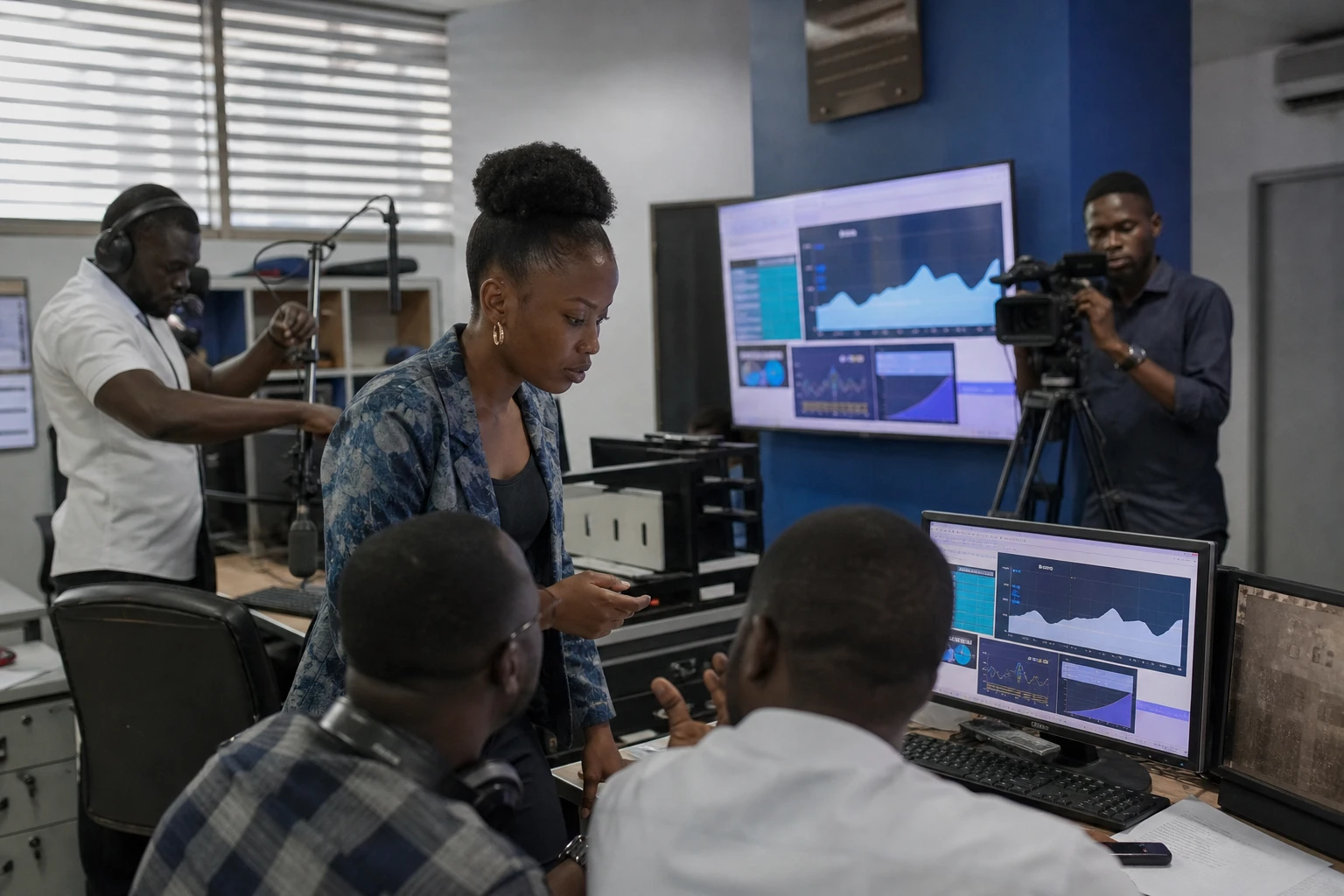
In Nigeria, television audiences are no longer measured by guesswork alone. They are now tracked using devices installed in selected households — a technical change whose impact extends far beyond the living room. In a market where advertising finances a large share of broadcasters, the quality of measurement can determine a programme’s value, the cost of a commercial and, ultimately, the economic health of Nigeria’s media.
This shift comes amid a landscape already transformed by the digital switch-over, or DSO, the transition from analogue to digital television. Nigerian authorities present the project as a driver of jobs, free-to-air channels and new advertising revenue. FreeTV, which is linked to the DSO, offers more than 100 free channels accessible via a set-top box or digital platform.
What the Lagos launch phase changes
The audience measurement system launched in Lagos is based on peoplemeters, devices that passively record television use in pilot households. The initiative is led by First Media and Entertainment Integrated Limited, with technical support from GARB, a Bulgarian audience measurement company. Nigerian media have reported that this first phase began on 1 September 2026 in the country’s economic hub.
The core issue is straightforward: replacing self-reported diaries with electronic data that advertisers, broadcasters and producers can trust. Under the old model, audience figures relied on manual declarations, which were easier to challenge and less useful for setting precise advertising rates. Automated measurement allows broadcasters to sell their inventory more effectively, while brands can invest with greater visibility over the expected returns.
Regulators also see it as a tool for building trust. Nigeria’s Advertising Regulatory Council, ARCON, believes reliable measurement can reassure investors, support the production of quality Nigerian content and create opportunities in the media and creative industries. This matters because Nigeria’s audiovisual market is one of the largest on the continent, and its strength depends as much on content creation as on the ability to prove what audiences are actually watching.
An advertising market looking for benchmarks
The sensitive issue is not the technology itself, but trust. Nigeria’s Minister of Information and National Orientation has acknowledged that the roll-out still faces difficulties, particularly in raising public awareness. This matters because audience measurement is only valuable if households agree to be monitored, broadcasters accept the results and advertisers consider the figures robust enough to guide their budgets.
Nigeria is also seeking to resolve a familiar contradiction in African media markets: heavy content consumption, but fragmented data. The country has a broader digital base since the DSO, with free channels and wider distribution, but the commercial value of this offering depends on the ability to turn audiences into verifiable statistics. This is precisely the missing link needed to move Nigerian television from a market of estimates to one based on evidence.
The government projects potential television advertising revenue of 605.2 billion naira in 2026, or about $457 million at the exchange rate cited by the authorities. This figure should be read as an official projection, not revenue already earned. But it clearly signals the ambition behind the initiative: to make audience measurement a tool for monetisation, not merely a symbol of modernisation.
For producers, the impact could be decisive. More credible data make it easier to sell programmes to broadcasters, platforms or sponsors. Broadcasters can use the figures to adjust schedules, identify what works and avoid programming blindly. Advertisers can reduce the risk of paying for overstated exposure. In a country where the creative economy has become a strategic sector, this transparency could improve the flow of money between content creation, broadcasting and advertising.
Abuja, Lagos and the West African reach
The choice of Lagos is no accident. The city accounts for a large share of Nigeria’s economic and advertising activity, while Abuja remains the centre of regulatory and political decision-making. This geography explains why the reform brings together several institutions: the National Broadcasting Commission, the advertising regulator and the Ministry of Information. In a federal country, success will depend on extending the system beyond the first urban phase.
The implications also extend beyond Nigeria’s borders. Across West Africa, where ECOWAS is seeking to make markets more integrated and cultural industries are growing, the question of audience measurement comes up repeatedly: how can advertisers be attracted, local content financed and broadcasters’ value protected against global platforms? If Nigeria manages to establish a stable system, it could offer a useful precedent for other markets on the continent seeking to professionalise television advertising without relying wholesale on imported standards.
The next test will be how the system performs over time: the reliability of its panels, the transparency of its methods, acceptance by industry players and geographical expansion. Only then can the country turn a regulatory innovation into an industrial advantage. For a market that aims to lead in Africa, the real question is no longer just how many Nigerians watch television, but who now controls the value of that attention.