
 Algeria
 Egypt
 Libya
 Morocco
 Sudan
 Tunisia
 Benin
 Burkina Faso
 Cabo Verde
 Côte d'Ivoire
 Ghana
 Guinea
 Guinea-Bissau
 Liberia
 Mali
 Mauritania
 Niger
 Senegal
 Sierra Leone
 The Gambia
 Togo
 Cameroon
 Central African Republic
 Chad
 DR Congo
 Equatorial Guinea
 Gabon
 Republic of the Congo
 São Tomé and Príncipe
 Burundi
 Comoros
 Djibouti
 Eritrea
 Ethiopia
 Kenya
 Madagascar
 Malawi
 Mauritius
 Mozambique
 Rwanda
 Seychelles
 Somalia
 South Sudan
 Tanzania
 Uganda
 Angola
 Botswana
 Eswatini
 Lesotho
 Namibia
 South Africa
 Zambia
 Zimbabwe
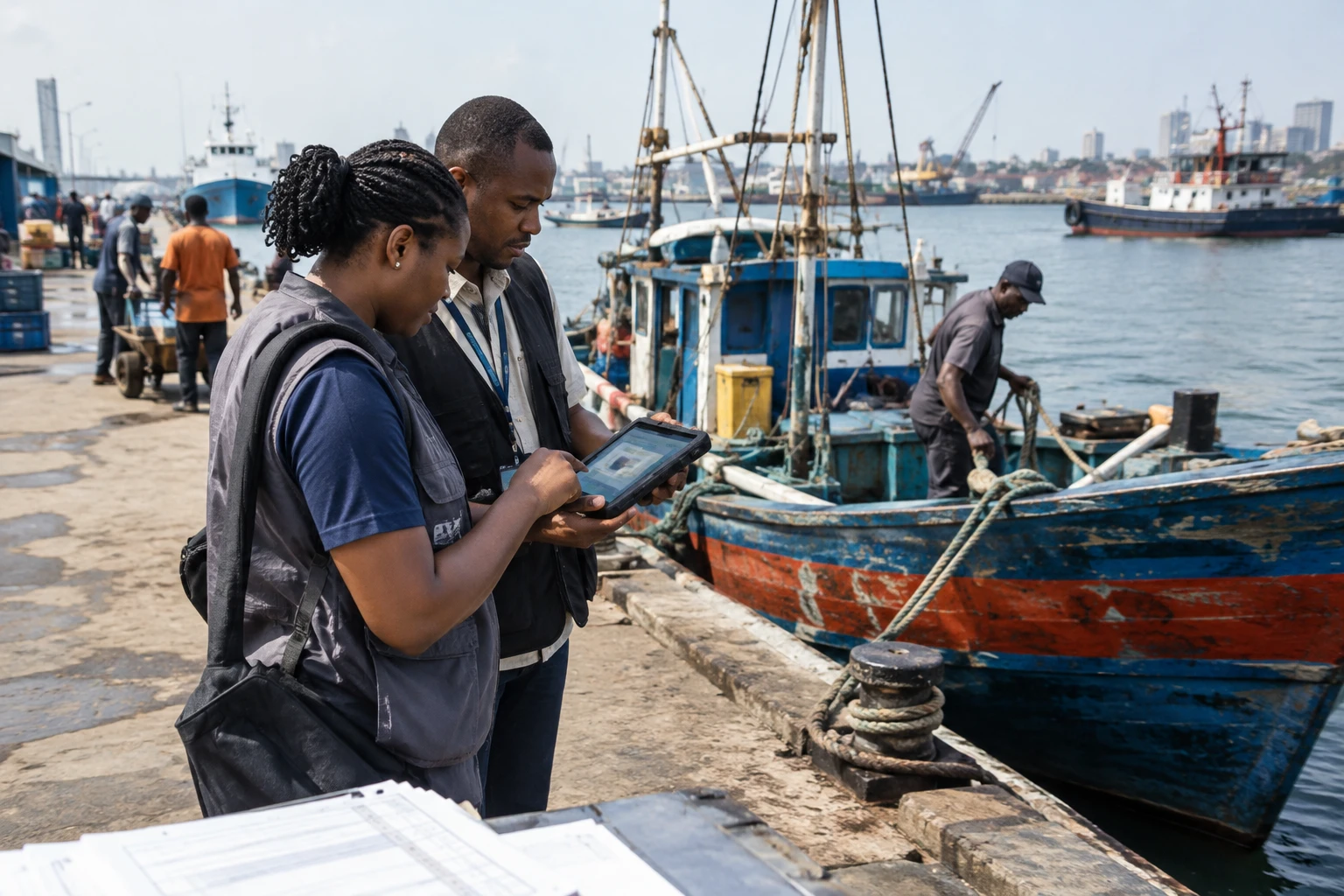
For fishers along Nigeria’s coast, an offence committed far from port can mean fewer fish in their nets and competition that is hard to control. In Abuja, the government is exploring a new tool to better monitor vessels at sea. But satellite data cannot replace inspections or effective sanctions.
A monitoring tool to complement checks at sea
On 12 October 2026, Nigeria’s Minister of Marine and Blue Economy, Adegboyega Oyetola, met Norway’s ambassador, Svein Baera, in Abuja. Norway presented the Blue Justice Ocean Surveillance programme, which provides participants with satellite-gathered vessel-tracking data. Nigeria is considering using its services, but the timetable and arrangements have not yet been specified.
The system relies in part on the automatic identification system, or AIS. It transmits the position and movements of equipped vessels. Combining these signals can help the authorities identify unusual routes and target their checks. Analysts at the Blue Justice International Centre can also provide technical support. However, AIS is not automatic proof of an offence: some vessels are not equipped, and a signal interruption must be interpreted with caution.
Blue Justice was launched by Norway in 2018. Its ocean surveillance programme was established with support from the United Nations Development Programme. Nigeria has already joined the Blue Justice Copenhagen Declaration, in 2022. The current move therefore concerns access to the operational satellite surveillance component, not a first-time membership of the initiative.
Pressure on incomes and resources
IUU fishing — illegal, unreported and unregulated fishing — encompasses practices that evade licensing, catch-reporting or conservation rules. For Nigeria, the issue goes beyond maritime policing. It affects fish supplies, public revenue and the livelihoods of fishing communities.
In 2023, the World Trade Organization estimated that Nigeria’s fisheries sector accounted for up to 5% of gross domestic product and supported the livelihoods of about 24 million people. It put annual losses linked to IUU fishing at nearly $70 million. These figures give a national-scale estimate; they do not break down the losses among artisanal fishing, businesses and government bodies.
The effects are not the same for everyone. Industrial crews and port authorities are affected by licensing and checks. But artisanal fishers, women traders and coastal communities depend directly on access to resources and consistent catches. More precise monitoring could help direct patrols more effectively. To have a tangible impact, it will need to be accompanied by investigations, legal proceedings and follow-up on sanctions.
Work already under way in the Gulf of Guinea
The satellite project adds to national and regional efforts. On 24 and 25 June 2026, Nigerian representatives reviewed and validated the draft national plan to combat IUU fishing at a workshop in Lagos organised with the Fisheries Committee for the West Central Gulf of Guinea (FCWC). The committee brings regional states together to coordinate fisheries management. Validation of the draft is a step in the process; it does not establish that the plan has been adopted or fully implemented.
The FCWC also documented a coordinated patrol between Nigeria and Liberia from 26 to 28 August 2026. According to the regional committee, Nigerian authorities detained three vessels for fishing-related offences. The operation shows the value of sharing intelligence across borders: a vessel can change its area of activity, while enforcement powers remain national.
At the same time, FCWC member states are working on a regional register of vessels authorised to fish. Such a tool would make it easier to verify licences and compare information between countries. It addresses a practical difficulty: incomplete or incompatible national data can complicate checks on fleets operating in several territorial waters.
Technology cannot replace the capacity to act
Nigeria also accepted the World Trade Organization’s Agreement on Fisheries Subsidies in June 2023. The agreement, which entered into force internationally in September 2025, prohibits certain subsidies that support IUU fishing. It complements surveillance measures, but forms part of a multilateral trade framework: its implementation also depends on national rules and available enforcement capacity.
For Abuja, the challenge will be to link satellite alerts with monitoring centres, the coastguard, fisheries services and the courts. It will also need to clarify who can access the data, how it will be stored and what procedures will allow it to be used as evidence in investigations. The human and material costs of patrols remain critical, particularly when checks must cover a vast maritime area.
Across West Africa, the challenge is to build cooperation that turns information into a coordinated response. The national plan, regional register and joint patrols are advancing on complementary fronts. The next steps to watch will be the formalisation of Nigeria’s access to the surveillance programme, followed by implementation of the national plan. These will be the points at which it can be judged whether the data genuinely improve resource protection and fairness among fisheries operators.



