Algeria
 Egypt
 Libya
 Morocco
 Sudan
 Tunisia
 Benin
 Burkina Faso
 Cabo Verde
 Côte d'Ivoire
 Ghana
 Guinea
 Guinea-Bissau
 Liberia
 Mali
 Mauritania
 Niger
 Senegal
 Sierra Leone
 The Gambia
 Togo
 Cameroon
 Central African Republic
 Chad
 DR Congo
 Equatorial Guinea
 Gabon
 Republic of the Congo
 São Tomé and Príncipe
 Burundi
 Comoros
 Djibouti
 Eritrea
 Ethiopia
 Kenya
 Madagascar
 Malawi
 Mauritius
 Mozambique
 Rwanda
 Seychelles
 Somalia
 South Sudan
 Tanzania
 Uganda
 Angola
 Botswana
 Eswatini
 Lesotho
 Namibia
 South Africa
 Zambia
 Zimbabwe
A vital network, but still too fragile
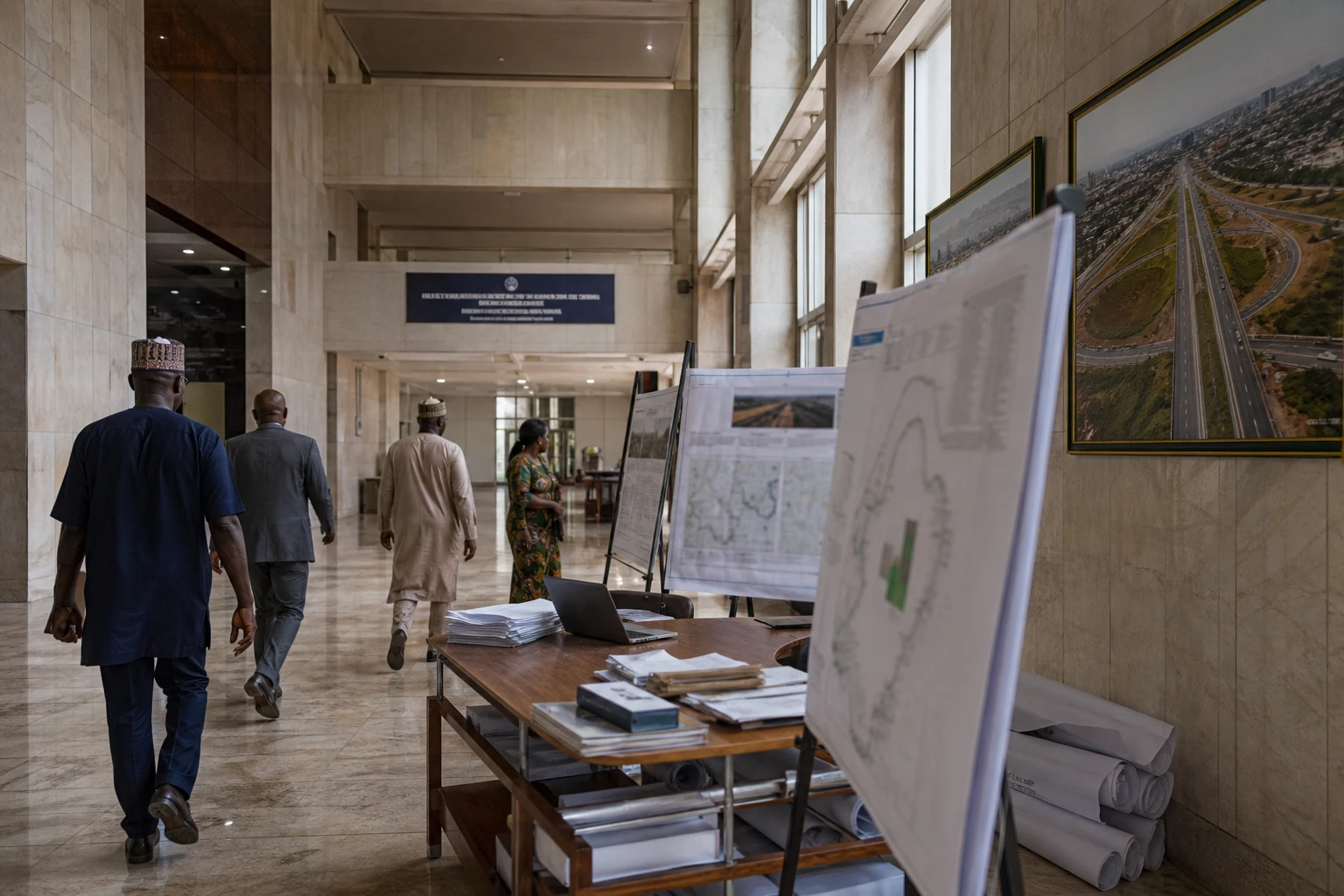
In Nigeria, a road is never just a strip of asphalt. It connects a market to a port, a farm to a city, a lorry to a refinery, and sometimes an entire community to its administrative centre. When maintenance is delayed, prices, journey times and safety risks all rise at once.
The federal government wants to take its efforts to a new scale. In Abuja, the Federal Executive Council approved, on Wednesday 20 August 2026, a package of road projects and truck park concessions worth about 438 billion naira. According to the Ministry of State for Works, the projects cover reconstruction, rehabilitation, maintenance and public-private partnership arrangements, including highway concessions.
What the new wave of investment covers
The announced package includes several strategic routes across the South-West, South-East, South-South and North-Central regions. Featured projects include reconstruction of the Ado-Ekiti–Iyin–Aramoko–Itawure–Ondo border road, rehabilitation of the Abeokuta–Iboro–Ilaro route, upgrades to a section of the East-West Road at Port Harcourt–Eleme–Onne, and work on the Dikko–Maje route in Niger State. The same package also includes operation and maintenance of the Lagos–Ibadan route, already crucial to national freight.
The choice of corridors is no accident. Lagos handles a huge share of port traffic. Port Harcourt serves the oil and industrial heartland of the south. The Abuja–Suleja–Minna route, meanwhile, structures trade towards the North-Central region. By targeting these roads, the federal government is seeking less to add kilometres than to ease the bottlenecks slowing domestic trade.
PPPs as a response to budget constraints
This strategy is part of a broader approach. Since 2019, Nigeria has used the Road Infrastructure Development and Refurbishment Investment Tax Credit Scheme, a mechanism that allows private companies to finance public roads in exchange for tax credits. The Ministry of Works says several groups, including NNPC Ltd, Dangote, NLNG, BUA, MTN Nigeria and others, have already joined the scheme.
The principle is simple: the state has little immediate budgetary room, but wants to keep projects moving. The private sector provides the money upfront. In return, it recoups its investment through tax relief or long-term concessions. For Abuja, this is a way to prevent projects from piling up without getting started. For companies, it is also a means of securing assets that are useful to their logistics and corporate image.
This is not a complete break with the past. Rather, it deepens a model already used on major corridors. The ministry recalled that NNPC had taken on 21 roads worth 621 billion naira in Phase I of the programme, while other companies had made additional investments under the same framework. The new decision of 20 August 2026 therefore extends an established arrangement in Abuja: bringing private capital into infrastructure that the federal budget can no longer fund alone.
Why road upgrades remain a major economic issue
The underlying problem is not new. The World Bank said in December 2024 that 80% of Nigeria’s road network was in poor condition. The institution said at the time that this reflected a combination of underfunding, weather-related wear and the difficulty of maintaining heavily used roads over the long term.
This deterioration affects everything else. Hauliers face more downtime. Agricultural producers see their costs rise before they even reach markets. Households pay more for imported goods because of logistical disruptions and higher distribution costs. In a country where the movement of goods still depends overwhelmingly on roads, a poorly maintained route quickly becomes an invisible tax on the everyday economy.
The scale of the problem is also territorial. Major cities feel the first effects of construction, but rural areas are most exposed to delays in access, seasonal isolation and the loss of value in their harvests. The RAAMP-SU programme, backed by the World Bank in December 2024, already targeted 6,500 kilometres of rural roads and around 4 million beneficiaries. This shows that in Nigeria the challenge is not confined to the highways visible from Abuja or Lagos: it also concerns the access roads linking communities to markets.
What this says about Nigeria and West Africa
Abuja’s decision is part of a broader regional trend: under pressure on public finances, several West African states are seeking to mobilise more PPPs, concessions and blended finance for infrastructure. Nigeria, the continent’s largest economy by population, is playing the role of a testing ground. Its choices therefore matter beyond its borders.
For ECOWAS, the stakes are direct. More reliable roads on Nigerian corridors facilitate trade with Niger, Benin, Cameroon and the rest of the sub-region. Conversely, deteriorating routes drive up costs, create truck queues, cause accidents and lead to lost goods. Nigeria’s roads are therefore a national issue, a matter of West African competitiveness and a test of the continent’s ability to finance its own mobility.
One decisive question remains: will a flurry of announcements be enough to reduce delays in implementation? The federal government says it has launched or restarted more than 2,700 kilometres of roads and highways in several parts of the country. But success will be judged on three very concrete points: the pace of construction, technical quality and maintenance after completion. That will determine whether PPPs become a lasting lever or merely a way to keep pace with urgent needs.