Algeria
 Egypt
 Libya
 Morocco
 Sudan
 Tunisia
 Benin
 Burkina Faso
 Cabo Verde
 Côte d'Ivoire
 Ghana
 Guinea
 Guinea-Bissau
 Liberia
 Mali
 Mauritania
 Niger
 Senegal
 Sierra Leone
 The Gambia
 Togo
 Cameroon
 Central African Republic
 Chad
 DR Congo
 Equatorial Guinea
 Gabon
 Republic of the Congo
 São Tomé and Príncipe
 Burundi
 Comoros
 Djibouti
 Eritrea
 Ethiopia
 Kenya
 Madagascar
 Malawi
 Mauritius
 Mozambique
 Rwanda
 Seychelles
 Somalia
 South Sudan
 Tanzania
 Uganda
 Angola
 Botswana
 Eswatini
 Lesotho
 Namibia
 South Africa
 Zambia
 Zimbabwe
A must-win match for Nigeria
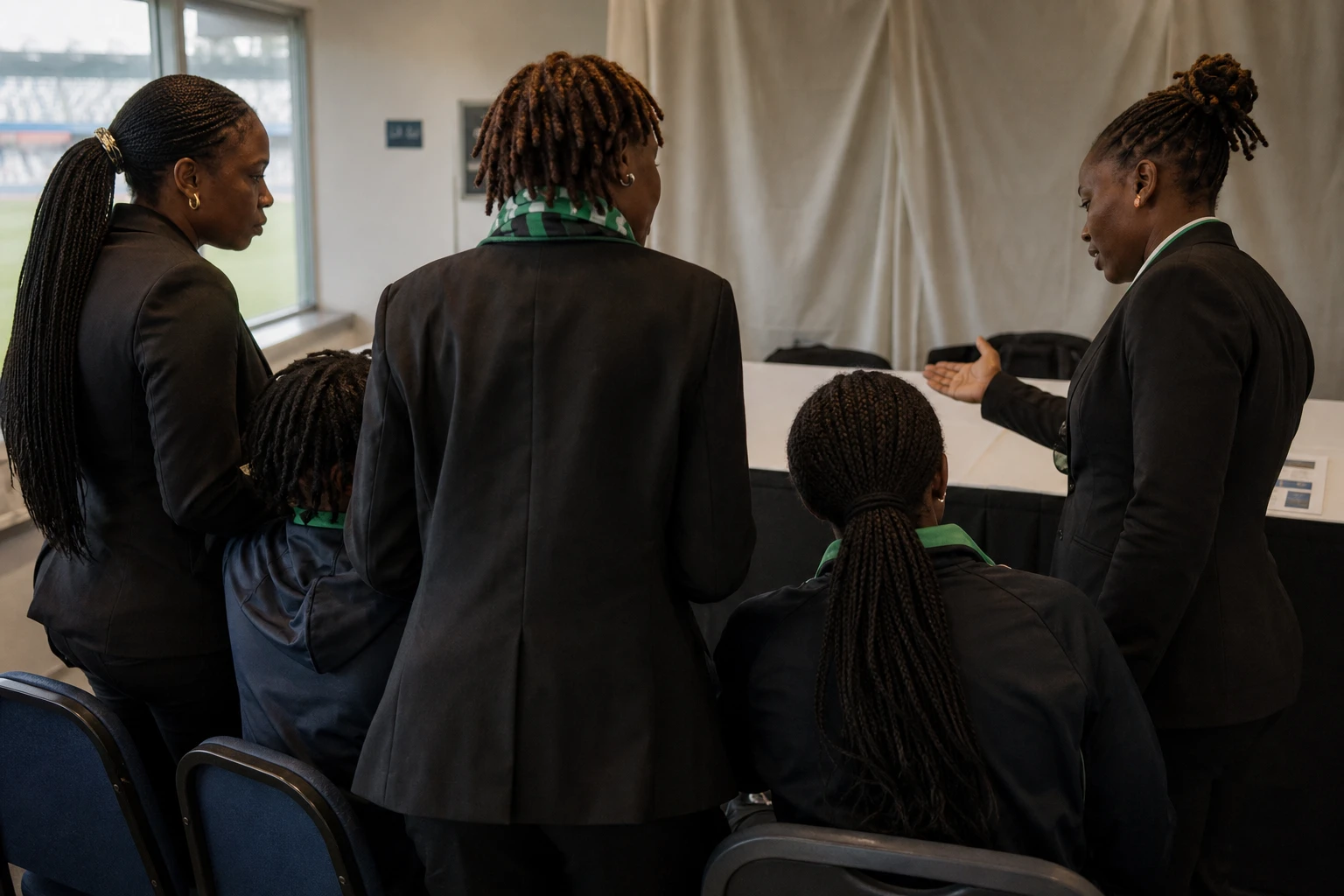
In Łódź, Nigeria are playing for more than just a match. They are playing for a place in the next stage of the tournament, but also to reaffirm a simple point: Nigerian women’s football is expected to compete at the highest level, including in youth categories. In a tough Group F, where Spain have already shown their command and China have held the Falconets to a draw, the team must deliver against New Caledonia to stay in contention. The context is clear: after two matchdays without a win, any slip-up could prove costly.
The tournament is being held in Poland from 5 to 27 September 2026, with the final scheduled for Łódź. The group stage brings together 24 teams, and Group F comprises Spain, China, Nigeria and New Caledonia. Nigeria qualified through the CAF African qualifiers, organised by the Confederation of African Football, which runs competitions across the continent.
An attacking line-up designed to break the deadlock
Nigeria’s approach looks set to be direct. The coach has named Christiana Uzoma in goal, with Onyedikachi Ekezie, Jumai Adebayo and Tumininu Adeshina in defence. In midfield, Favour Nkwocha, Kafayat Mafisere, Tosin Rafiu and Rebecca Adegbemile are tasked with setting the tempo and providing width. Up front, Queen Joseph leads the attack, supported by Ramotalahi Kareem and Janet Seimeyeha Akekoromowei. The tactical message is clear: control the ball, apply pressure and avoid a cagey match.
New Caledonia, by contrast, rely on a team still new to this level. Elizabeth Aben is in goal, with Leana Hmae, Kenza Kenon, Shirley Wenessia and Louane Pocoue in defence. Kheimera Gondou, Alesie Adjou and Deyanera Michel occupy the midfield, while Juila Honakoko, Joceline Kourevi and Joyce Angexetine lead the attack. The contrast is stark: on one side, a team used to major African and global tournaments; on the other, an Oceanian country making its debut in the competition.
Nigeria arrive with a modest record: a defeat by Spain, followed by a draw with China. In this kind of tournament, every goal carries extra weight, because qualification depends not only on points but also on goal difference. That changes the nature of the challenge. It is no longer just about winning, but about winning quickly, convincingly and by a margin. For the Falconets, managing time and the score matters as much as technical quality.
What this match says about Nigerian and African football
Nigerian women’s football remains a powerful symbol of African sport. The country has a long tradition in youth competitions, and the CAF Women’s Africa Cup of Nations and FIFA tournaments often serve as a springboard to the senior team. When the Falconets make progress, it is not just one team moving forward. An entire ecosystem also gains visibility: local clubs, training programmes, national leagues and talent scouting.
This fixture also has continental significance. At the tournament in Poland, several African teams have already had mixed starts, with difficult results for Benin, Tanzania and Ghana. Nigeria therefore carries part of the continent’s image in this competition. This is more than an abstract symbol. In West Africa, the development of women’s football still depends heavily on coaching resources, continuity in domestic competitions and players’ exposure to international football. A strong performance in Łódź could accelerate that momentum.
The Nigerian case also highlights a reality that is often underestimated: a youth team is prepared in an environment where expectations are high, but stability remains essential. For Abuja, the capital, the result in Łódź is more than just a score. It affects the country’s sporting reputation, confidence in women’s development and Nigeria’s standing in the African hierarchy. At regional level, ECOWAS views this kind of campaign as an indirect indicator of sporting and institutional development.
Qualification remains within reach, but time is short
What happens next depends on one simple factor: Nigeria’s ability to impose their tempo from the opening minutes. Against an opponent with less experience on the world stage, the Falconets have a chance to rediscover their efficiency, confidence and composure. But the match will not be won on the strength of the name on the shirt. They will need precision in the final touch, discipline in transition and clear thinking to the end.
Beyond this third matchday, the stakes go beyond qualification alone. A Nigerian place in the next rounds would raise the profile of African women’s football at a time when CAF is seeking to build out its competition pyramid, from U20 teams to senior sides. The result in Łódź will therefore say something broader: whether a major African football nation can turn its potential into a lasting presence on the world stage.