Algeria
 Egypt
 Libya
 Morocco
 Sudan
 Tunisia
 Benin
 Burkina Faso
 Cabo Verde
 Côte d'Ivoire
 Ghana
 Guinea
 Guinea-Bissau
 Liberia
 Mali
 Mauritania
 Niger
 Senegal
 Sierra Leone
 The Gambia
 Togo
 Cameroon
 Central African Republic
 Chad
 DR Congo
 Equatorial Guinea
 Gabon
 Republic of the Congo
 São Tomé and Príncipe
 Burundi
 Comoros
 Djibouti
 Eritrea
 Ethiopia
 Kenya
 Madagascar
 Malawi
 Mauritius
 Mozambique
 Rwanda
 Seychelles
 Somalia
 South Sudan
 Tanzania
 Uganda
 Angola
 Botswana
 Eswatini
 Lesotho
 Namibia
 South Africa
 Zambia
 Zimbabwe
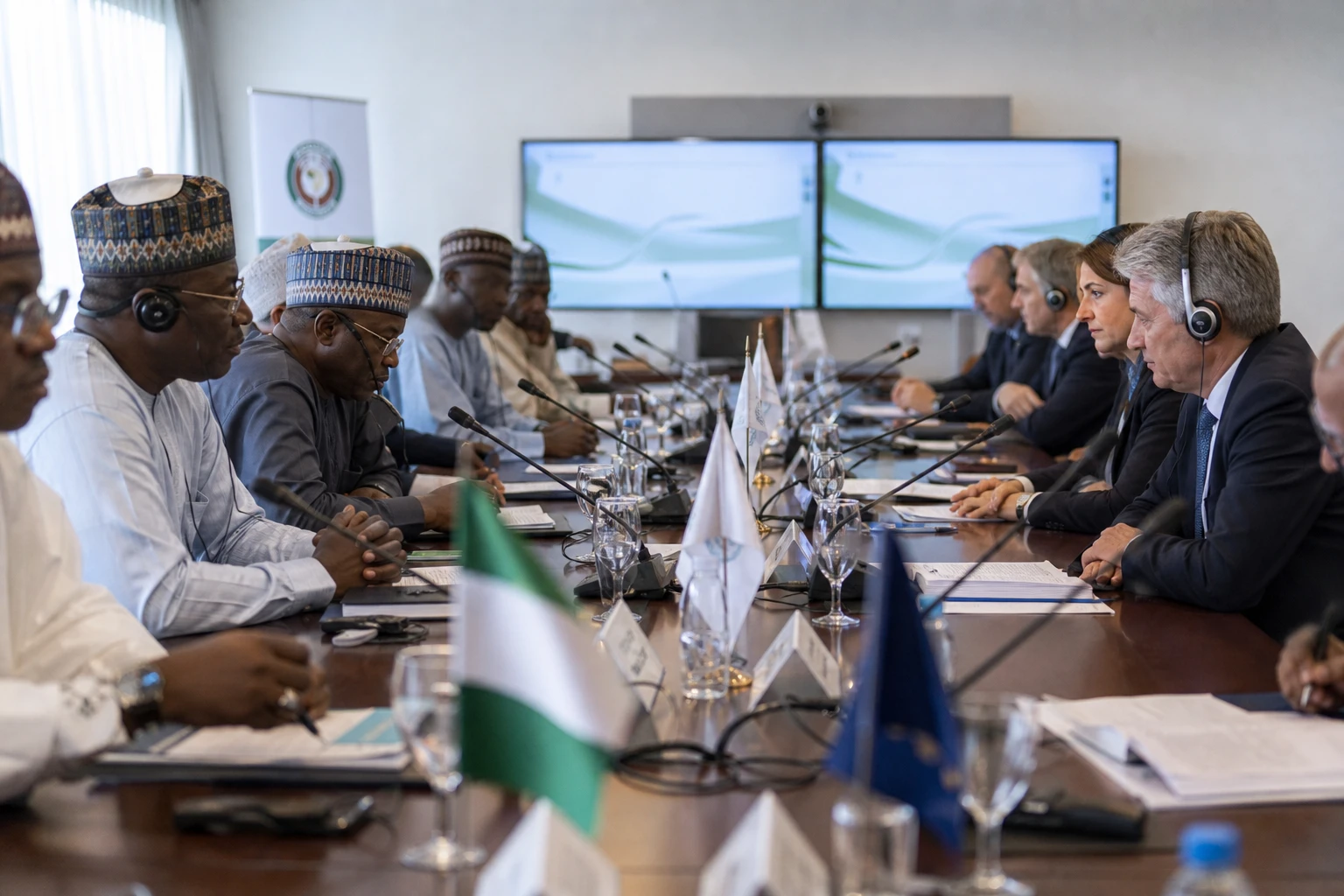
A partnership no longer confined to diplomatic circles
In Abuja, talks between Nigeria and Germany point to more than a simple diplomatic exchange. They show that in West Africa, security, energy and trade are now moving forward together, in a regional space where Sahel crises are spilling over into coastal countries. Nigeria, the region’s largest economy and a pillar of ECOWAS, remains at the centre of this equation.
In the Nigerian capital, German Foreign Minister Johann Wadephul concluded a two-day visit marked by a clear message: Berlin wants to consolidate its relationship with Abuja beyond security alone. For Nigeria, Foreign Minister Bianca Odumegwu-Ojukwu also stressed sectors capable of delivering tangible results for the real economy, from energy to skills.
The Sahel spills over as the West African coast reorganises
The context explains the acceleration. For several months, West African capitals have been warning of rising cross-border threats, whether terrorism, trafficking or forced displacement. ECOWAS, the Economic Community of West African States, has itself stressed the need for regional responses to these risks. In Abuja, Nigerian authorities often present the country as an anchor of this fragile stability.
Berlin shares this assessment, but brings its own strategic perspective. In its overview of bilateral relations, Germany’s Foreign Ministry says Nigeria plays a decisive role in regional stability and democracy, that it has security cooperation with Germany and that the bilateral energy partnership dates back to 2008. The same document also notes that Nigeria is Germany’s second-largest trading partner in sub-Saharan Africa.
Wadephul’s recent visit is part of this continuity. Before his departure, Berlin said Germany and Nigeria were working on shared interests ranging from fair trade to critical raw materials, as well as orderly migration, climate and the fight against extremism. The German minister also linked the situation in the Sahel to the security of coastal states, from Mauritania to Nigeria.
The facts: security, displaced people’s return and public funds
On security, Berlin announced €10 million to support the return and reintegration of people displaced by violence linked to Boko Haram and Islamic State-affiliated groups. The measure is aimed mainly at communities in north-east Nigeria, where forced displacement has left villages deserted, land abandoned and basic services weakened. The funding has been confirmed in several international media reports, while Germany has also reaffirmed its support for Nigerian forces in the fight against terrorism.
Nigeria is not seen solely as a recipient of assistance. It is also treated as a regional actor with influence. At the German-Nigerian Joint Commission in Berlin in November 2025, the two countries had already laid the foundations for broader cooperation on trade, energy, security, culture and migration. Germany’s Foreign Ministry later recalled in its July 2026 statement that the relationship was built on 65 years of diplomatic ties and a determination to intensify investment and skills exchanges.
The economic dimension remains central. German authorities describe Nigeria as Africa’s largest domestic market and one of their major partners on the continent. Official German sources point to rising bilateral trade and the presence of more than 90 German companies operating in Nigeria. Abuja officials, for their part, have highlighted bilateral trade of around €3 billion in 2025 and called for more investment in energy, manufacturing, infrastructure, digital technology and critical minerals.
What this relationship changes in practice
The first issue is energy. Nigeria wants to support its industrialisation with more reliable electricity and stronger infrastructure. Germany, meanwhile, has expertise sought after in energy efficiency, renewables, grid management and industrial technologies. This rapprochement is therefore more than diplomatic. It touches on Nigeria’s ability, as West Africa’s largest economy, to turn its potential into jobs, added value and non-oil revenue.
The second issue is skills. Abuja wants to draw on the German vocational training model to meet the needs of a young population and an economy that must move up the value chain. Berlin, for its part, sees this cooperation as a way to secure skilled workers and build stronger value chains, without reducing the dialogue to migration alone. The idea is simple: train, integrate, produce, then export more.
The third issue is security, with a direct impact on daily life. In north-east Nigeria, the reintegration of displaced people remains a delicate undertaking. Return is not simply a matter of putting families back on a map. It requires roads, schools, health centres, accessible land and a minimum level of security. Without these, returns remain precarious. This is precisely where the aid announced by Berlin carries political as well as humanitarian significance.
This African perspective on the issue matters. For Abuja, the question is not only how to contain Boko Haram or Islamic State-affiliated groups. It is also about protecting the economic fabric of the north-east, stabilising areas of return and preventing security pressures from the Sahel from spreading towards coastal trade corridors. For Berlin, by contrast, Nigeria is a middle-power partner capable of helping to contain an increasingly unstable regional neighbourhood. The two agendas converge, but they are not identical.
A reach extending beyond Abuja and Berlin
The July 2026 visit confirms a broader trend: African partnerships are increasingly viewed through the lens of intersecting interests. In West Africa, ECOWAS is seeking to strengthen its collective response mechanisms as political and security crises overlap. Nigeria, which is also home to the organisation’s headquarters in Abuja, retains a unique position within it. Its demographic, economic and diplomatic weight makes it an indispensable anchor.
At the continental level, this relationship also says something about the African Union and external partners: the defining issues are no longer dealt with separately. Security shapes investment. Energy determines industry. Skills determine competitiveness. And Sahel crises no longer remain confined to the Sahel. It is this shift, now openly acknowledged by European and Nigerian diplomats, that gives the visit its real significance.
What happens next will depend on the budgetary and technical follow-through on the commitments made in Abuja. The two countries’ authorities already have a bilateral roadmap. It remains to be seen whether the announcements on energy, training and the reintegration of displaced people will become measurable projects in a regional environment still marked by insecurity and economic pressure.