
 Algeria
 Egypt
 Libya
 Morocco
 Sudan
 Tunisia
 Benin
 Burkina Faso
 Cabo Verde
 Côte d'Ivoire
 Ghana
 Guinea
 Guinea-Bissau
 Liberia
 Mali
 Mauritania
 Niger
 Senegal
 Sierra Leone
 The Gambia
 Togo
 Cameroon
 Central African Republic
 Chad
 DR Congo
 Equatorial Guinea
 Gabon
 Republic of the Congo
 São Tomé and Príncipe
 Burundi
 Comoros
 Djibouti
 Eritrea
 Ethiopia
 Kenya
 Madagascar
 Malawi
 Mauritius
 Mozambique
 Rwanda
 Seychelles
 Somalia
 South Sudan
 Tanzania
 Uganda
 Angola
 Botswana
 Eswatini
 Lesotho
 Namibia
 South Africa
 Zambia
 Zimbabwe
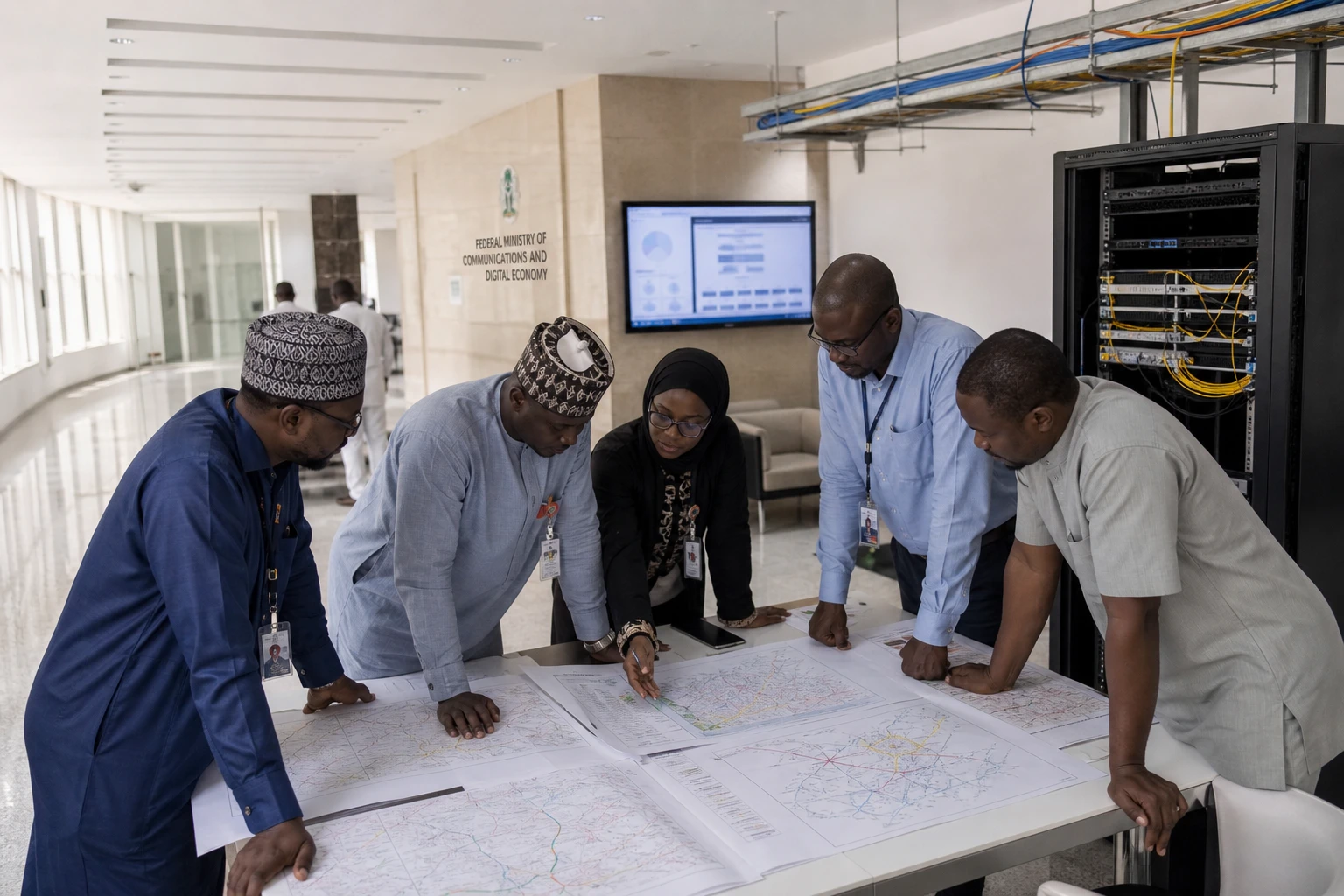
A country building its digital roads is already thinking about what to do with them
In Nigeria, the battle is no longer just about access to the internet. It is shifting towards control of the pipes, servers and data. In other words, the power to move, store and process information at home, in an African market where connectivity alone is no longer enough to create value.
This shift matters far beyond Abuja. Nigeria is at the heart of ECOWAS, which has spent years working towards a more integrated West African digital market. In this space, the ability to host services, reduce latency costs and secure data is becoming an economic, as well as a political, issue.
Fibre, financing and a tight schedule
The centrepiece of the plan is called Project BRIDGE. The programme aims to add at least 90,000 kilometres of fibre-optic cable across the country, with the goal of expanding the national network from about 35,000 to 125,000 kilometres. The Federal Ministry of Communications presents the project as foundational infrastructure for universal access to information and communication technologies.
Funding is already under way. The World Bank has approved $500 million for BRIDGE, as part of a wider $1.6 billion package. The African Development Agency, for its part, has approved $200 million for the same initiative, while the EBRD has announced a sovereign loan of up to $100 million.
On 31 August 2026, in Abuja, George Akume, Secretary to the Government of the Federation, reaffirmed this ambition at the GITEX Nigeria Government Leadership & AI Summit. The event runs from 31 August to 3 September 2026 between Abuja and Lagos, with a focus on public services, artificial intelligence and digital innovation.
The government is also seeking private capital. Its stated aim is to raise $750 million over 24 months for local cloud and data infrastructure. This target forms part of a public-private partnership approach, already central to BRIDGE’s financing structure.
A market reality that remains highly uneven
The contrast between mobile use and fixed access remains stark. Data reported by the Nigerian Communications Commission indicate 154.72 million active internet subscriptions in April 2026, but only about 265,000 FTTH subscriptions, meaning fibre-to-the-home connections. This gap shows that Nigeria has connected users on a massive scale, without yet building out enough fixed infrastructure.
The country therefore remains reliant on mobile networks for most of its traffic. Yet cloud services, enterprise applications and advanced AI uses require more stable connections, lower latency and data centres close to users. This is where the strategy changes in nature.
The ministry also says it wants to connect all 774 local government areas and deploy additional telecoms sites to reach underserved areas. The issue is not just technical. It is territorial, setting major urban centres that are already better served against rural and outlying areas, where private investment is less profitable.
Cost remains a barrier. Nigerian authorities point to vandalism, fibre cuts and operating costs, particularly when some sites still rely on diesel. The ITU generally sets an affordability threshold of about 2% of gross national income per capita for a basic package, while comparisons cited in Nigeria show a still very wide gap.
From data infrastructure to digital sovereignty
The next phase targets data centres, cloud and local processing capacity. Abuja’s message is clear: it is no longer enough to transport data; it must also be possible to keep it, use it and train AI models locally. This is the thinking behind the idea of digital sovereignty.
The government has strengthened this framework through reform of digital identity. The NIMC Act 2026 replaced the 2007 law and established the National Identity Management Commission as the authority of reference for digital identity architecture and electronic trust services. At the same time, Galaxy Backbone remains the central public operator for certain federal digital infrastructure.
This institutional architecture has a practical effect: it makes it possible to connect identity, public services and data within a single ecosystem. For businesses, this can reduce integration costs. For the state, it strengthens its ability to manage sensitive databases without relying entirely on foreign jurisdictions.
Nigeria is also investing in skills. The 3MTT programme reports 1.87 million registrations in the country, with more than 160,000 beneficiaries trained and coverage across all 36 states. Official data point to an effort to create a digital workforce able to support cloud, cybersecurity and AI.
What this strategy means for Nigeria and West Africa
Abuja’s bet is economic before it is symbolic. If fibre, cloud and data centres deliver, Nigeria can capture more value in its own digital market. This could also support employment, particularly in construction, maintenance, digital services and AI-related occupations. Official projections link BRIDGE to tens of thousands of direct and indirect jobs.
But the impact will not be even. Large companies, government agencies and start-ups in Lagos or Abuja will benefit more quickly from the new capacity. Households will feel the effects only if prices fall and last-mile networks follow. Without that, digital sovereignty will remain largely a matter for institutions and investors.
At the regional level, the issue goes beyond Nigeria. ECOWAS is pushing for deeper digital integration, in a West African market that will increasingly depend on interconnections, landing points, data centres and rules on data. A better-equipped Nigeria could become a regional provider of digital services, not just a major consumer of imported technology.
The next phase will be decisive. It will show whether Abuja can turn the announcements of 2026 into real capacity: deployment schedules, private capital attraction, the commissioning of the first infrastructure and the growth of local usage. That is when digital sovereignty will cease to be a slogan and become a value chain.



