
 Algeria
 Egypt
 Libya
 Morocco
 Sudan
 Tunisia
 Benin
 Burkina Faso
 Cabo Verde
 Côte d'Ivoire
 Ghana
 Guinea
 Guinea-Bissau
 Liberia
 Mali
 Mauritania
 Niger
 Senegal
 Sierra Leone
 The Gambia
 Togo
 Cameroon
 Central African Republic
 Chad
 DR Congo
 Equatorial Guinea
 Gabon
 Republic of the Congo
 São Tomé and Príncipe
 Burundi
 Comoros
 Djibouti
 Eritrea
 Ethiopia
 Kenya
 Madagascar
 Malawi
 Mauritius
 Mozambique
 Rwanda
 Seychelles
 Somalia
 South Sudan
 Tanzania
 Uganda
 Angola
 Botswana
 Eswatini
 Lesotho
 Namibia
 South Africa
 Zambia
 Zimbabwe
When a food root becomes an industrial issue
In Nigeria, cassava is no longer limited to gari, fufu or attiéké sold in markets. The tuber is now at the heart of a wider balancing act: feeding households while also supplying industrial value chains ranging from pharmaceuticals to energy. In a country that remains the world’s largest cassava producer, this shift raises a simple question: how can quality be secured without undermining food supplies?
The answer lies in an often-invisible link in the chain: vegetative seed, or cuttings. If they are weak, poorly controlled or carry diseases, declining yields quickly spread from one cycle to the next. In a system where cassava is propagated by stems rather than seeds, certification is no administrative formality. It is a condition for productivity and traceability.
Abuja steps up the control chain
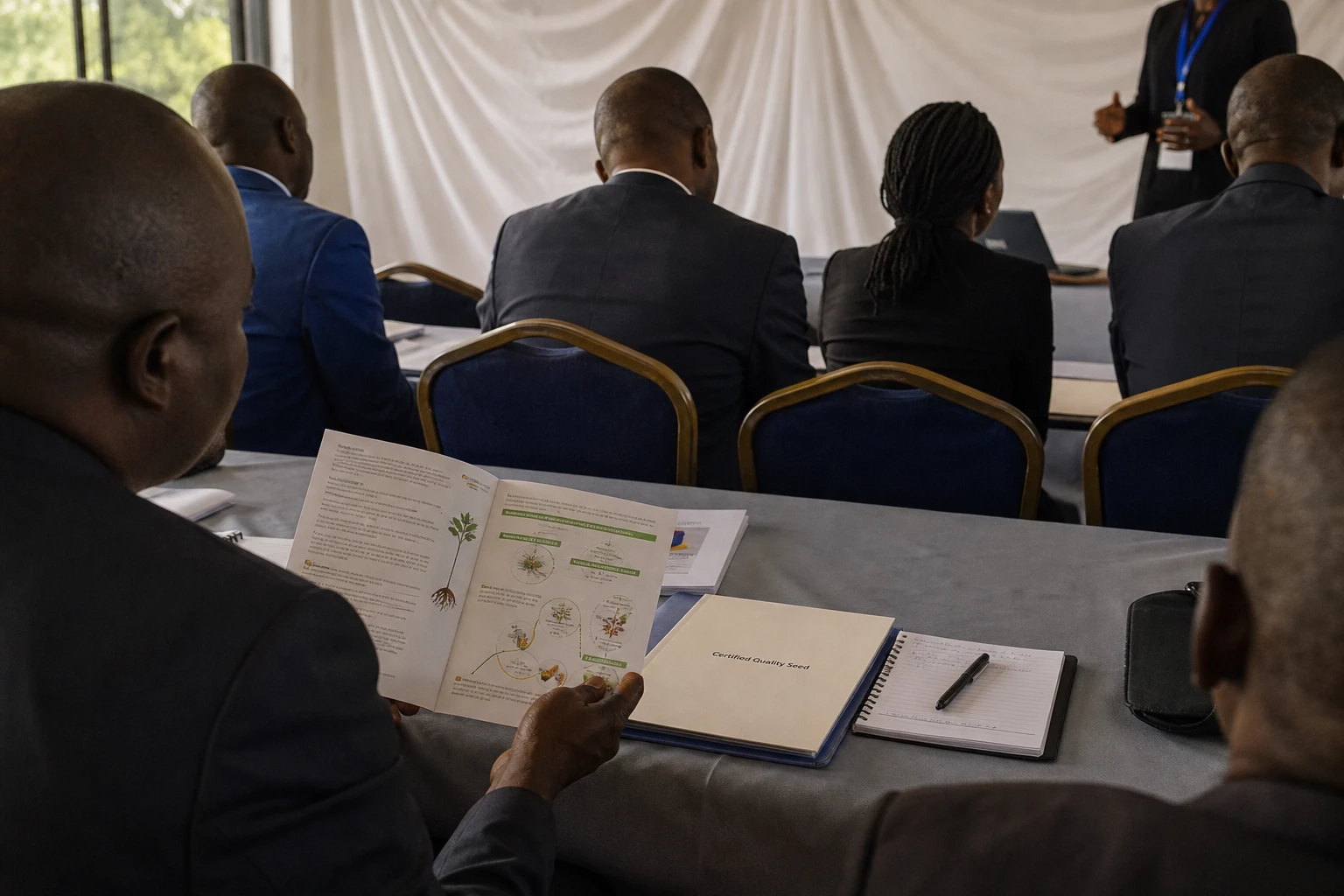
On 26 and 27 August 2026, the National Agricultural Seeds Council brought together seed inspectors, cutting producers and certification stakeholders in Abuja for training focused on cassava. The objective was clear: to improve implementation of the new rules governing the sector and strengthen quality control of planting materials, from production through to their supply to farmers. The regulator also recalled the existence of three texts published in 2025 to modernise the seed framework: harmonised regulations on variety registration and release, regulations on the production of “early generation seed”, and regulations on third-party certification.
This increase in capacity comes at the right time. Agricultural planning data published by Nigerian authorities project cassava production at 64.36 million tonnes in 2024, with an upward trend towards around 65.6 million tonnes. Nigeria thus retains a massive agricultural base, but yields remain below the potential seen in the best-performing major producer countries. In other words, the debate is no longer only about volumes, but about the quality of the means of production.
This work is also part of a broader institutional drive. Nigeria did not wait until 2026 to consider cassava a lever for diversification. The Energy Commission of Nigeria has already placed bioenergy at the heart of its strategy, while the ministry responsible for economic planning launched a project in January 2026 to integrate 14 million smallholders into the cassava-based bioethanol value chain.
One root is no longer enough for plates, pharmaceuticals and fuel
The clearest change is on the industrial demand side. Authorities and several industry players are seeking to make cassava a raw material for pharmaceutical starch, biofuels and other higher-value uses. In healthcare, the issue is immediate: a public body dedicated to natural medicines has said it is working on local production of pharmaceutical-grade starch to reduce an import bill estimated at $23 million a year. This figure has been cited by several independent sources and is consistent with foreign trade estimates for starch imports into Nigeria.
In energy, the logic is similar. Nigeria wants to strengthen domestic ethanol supplies and ultimately aims for a 10% blend in petrol, according to its national biofuels policy. The project is ambitious, but it requires steady volumes, uniform roots and logistics capable of meeting industrial demand that is far more demanding than that of local food markets.
For producers, this could open up new sources of income. For households, it could also create additional pressure on raw material prices if production does not keep pace. This is where the question of certified cuttings becomes central. Without healthy planting material, yield gains will remain too small to feed both food markets and new industrial segments. The priority, then, is not simply to increase the area under cultivation, but to improve productivity per hectare.
The private sector is well aware of this. Nigerian processors are already calling for more raw materials suited to starch, ethanol and pharmaceutical uses. But the value chain remains fragmented, with quality gaps between production zones and continued reliance on imports for certain specialised products. In south-western states as well as the country’s central region, the ability to produce healthy cuttings, certify them and distribute them quickly will determine the pace of industrialisation.
A Nigerian issue, but also a West African one
Nigeria is not alone on this path, but it plays a leading role in West Africa. In the ECOWAS area, where national farming systems remain closely tied to informal markets and cross-border trade, upgrading a value chain such as cassava could inspire other seed, processing and import substitution policies. It could also serve as a test of a broader continental ambition: turning Africa’s food crops into African industrial resources.
The Nigerian case nevertheless shows that successful agricultural industrialisation cannot simply be decreed. It is built in layers: regulation, certification, agronomic research, processing, financing and stable markets. Abuja has started with the foundations. That is often the right order. But what follows will depend on a very concrete point: the country’s ability to produce enough quality cassava without shifting the problem on to food markets. The coming months will show whether seed reform becomes a mere technical adjustment or the true foundation of a more robust value chain.



