Algeria
 Egypt
 Libya
 Morocco
 Sudan
 Tunisia
 Benin
 Burkina Faso
 Cabo Verde
 Côte d'Ivoire
 Ghana
 Guinea
 Guinea-Bissau
 Liberia
 Mali
 Mauritania
 Niger
 Nigeria
 Senegal
 Sierra Leone
 The Gambia
 Togo
 Cameroon
 Central African Republic
 Chad
 DR Congo
 Equatorial Guinea
 Gabon
 Republic of the Congo
 São Tomé and Príncipe
 Burundi
 Comoros
 Djibouti
 Eritrea
 Ethiopia
 Kenya
 Madagascar
 Malawi
 Mauritius
 Mozambique
 Rwanda
 Seychelles
 Somalia
 South Sudan
 Tanzania
 Uganda
 Angola
 Botswana
 Eswatini
 Lesotho
 South Africa
 Zambia
 Zimbabwe
In Windhoek, a mining recovery with implications beyond a single mine
In Namibia, uranium is more than a line on a balance sheet. It is a strategic resource, an export earner and a test of economic sovereignty. When a mine such as Langer Heinrich steps up production, the entire mining chain gets some breathing space, from Walvis Bay to public revenues in Windhoek.
The country remains one of the world’s three largest uranium producers, with 7,333 tonnes extracted in 2024, according to data compiled by the World Nuclear Association. Namibia is also Africa’s leading producer, explaining the attention paid to each asset in the country’s central basin.
In this landscape, Langer Heinrich mine matters for more than its return on investment. It is part of a sector in which volumes, sale prices and operational stability have an immediate bearing on the state, communities in the country’s central-western region and operators reliant on a precise regulatory environment.
Sales rise, but ramp-up remains incomplete
For the 2026 financial year ended on 30 June, Paladin Energy said uranium sales from Langer Heinrich had reached $304.3m. The group also said it had sold 4.35m pounds of uranium, against 2.71m a year earlier, an increase of 61%. The average realised price was $70 a pound, compared with $65.7 in the previous financial year.
The company presents this improvement as a direct result of the site’s gradual restart. In April 2026, it had already said it was raising its production guidance for the year, following gains in recovery rates and plant feed. In August, it confirmed annual production of 4.82m pounds, at the upper end of its revised targets.
The group’s gross profit also swung back into positive territory. Paladin reported gross profit of $52.2m, against a gross loss of $26.1m a year earlier. This reversal illustrates a simple reality: at a mine brought back into operation after several years on care and maintenance, the consolidation phase continues to weigh on margins, but the picture can change quickly if volumes follow.
For 2027, the group has not yet given a revenue figure, but is targeting sales of between 4.8m and 5.3m pounds. In other words, the trajectory remains upward, although the mine has yet to reach its nameplate capacity. This is key to interpreting the results: the performance is real, but it is still that of an asset ramping up.
What the Namibian state gains, and how operations affect the ground
In Namibia, uranium minerals are subject to a 3% royalty on the sale price. The ministry responsible for mines notes that its dedicated unit also monitors long-term uranium sales agreements to protect the national interest. This means that rising sales at Langer Heinrich automatically translate into additional state revenue, even before tax on profits.
The detail matters, because Namibia’s model is based on tightly regulated management of the extractive sector. Mining rights belong to the state, exports are controlled, and licences operate within a long-standing but still defining legal framework. Under this system, the performance of a single site can boost public revenues, support local contractors and strengthen logistics activity around the port of Walvis Bay.
Langer Heinrich is 75% owned by Paladin Energy, with the remainder held by CNNC Overseas Uranium Holdings Limited, a subsidiary of China National Nuclear Corporation. The site is in the Namibian desert, about 80 kilometres east of Walvis Bay and close to Rössing. This geography is no small matter: it places the mine at the heart of a mining corridor already integrated into the national economy and export flows.
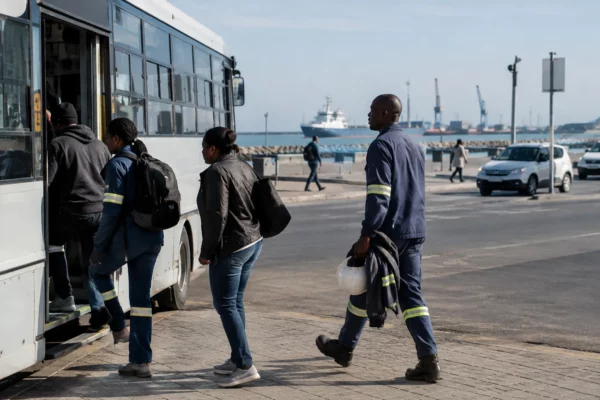
The restart of Langer Heinrich should also be viewed in social terms. During the consolidation phase, employment, transport contracts, industrial maintenance and local services expand faster than at a mature mine that is already stable. However, the lasting benefits for the population will depend on how long the recovery lasts, the stability of international prices and the state’s ability to capture a sufficient share of the value created.
A signal for southern Africa, and a reminder about value addition
The Namibian case resonates beyond the country’s borders. In southern Africa, where global demand for uranium remains strong, Namibia is consolidating its position as a major supplier of nuclear fuel. For the SADC, which brings together southern African countries, this confirms that an African state can retain a significant place in a global value chain even without processing the raw material locally.
But the debate does not end with tonnage. In Windhoek, one question keeps coming up: how much more value can the country capture before raw exports? Discussions about possible downstream development, or a greater role in the fuel cycle, carry particular weight in a country that already supplies a significant share of the world’s uranium but has no equivalent civil nuclear industry.
The next point to watch is therefore less about any single figure than about the durability of the pace. If Langer Heinrich sustains its production rate, the mine could become a more solid pillar of Namibia’s mining revenues. If prices soften or volumes slow, the positive effect will remain real, but more limited. In either case, Namibia is affirming an established position: that of a central African player in the global uranium market.