Algeria
 Egypt
 Libya
 Morocco
 Sudan
 Tunisia
 Benin
 Burkina Faso
 Cabo Verde
 Côte d'Ivoire
 Ghana
 Guinea
 Guinea-Bissau
 Liberia
 Mali
 Mauritania
 Niger
 Nigeria
 Senegal
 Sierra Leone
 The Gambia
 Togo
 Cameroon
 Central African Republic
 Chad
 DR Congo
 Equatorial Guinea
 Gabon
 Republic of the Congo
 São Tomé and Príncipe
 Burundi
 Comoros
 Djibouti
 Eritrea
 Ethiopia
 Kenya
 Madagascar
 Malawi
 Mauritius
 Mozambique
 Rwanda
 Seychelles
 Somalia
 South Sudan
 Tanzania
 Uganda
 Angola
 Botswana
 Eswatini
 Lesotho
 South Africa
 Zambia
 Zimbabwe
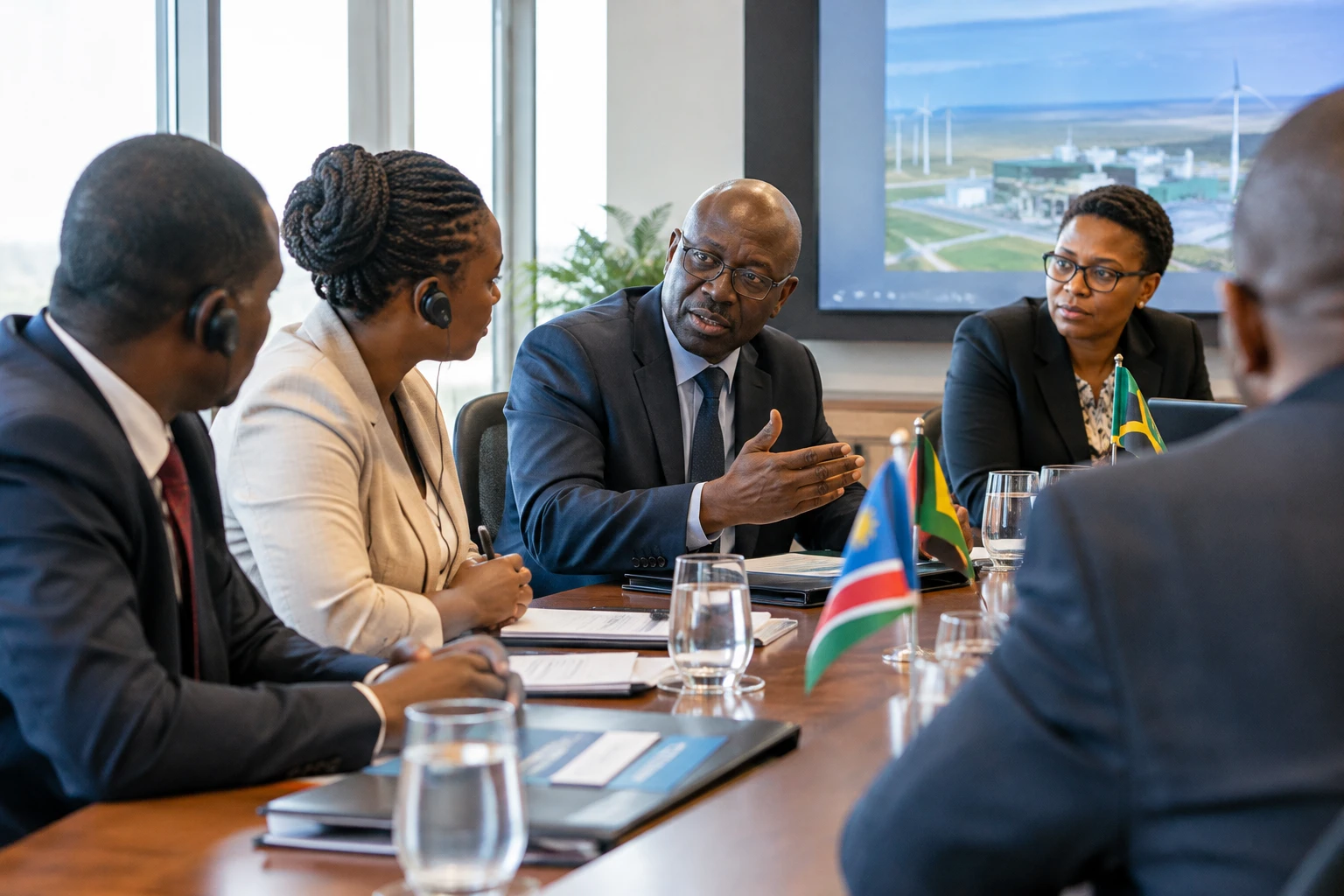
Turning sunshine and wind into steel for cars: in Namibia, this industrial ambition is beginning to take shape. But the road from an operational plant and memorandums of understanding to a profitable sector remains long.
A first industrial site in the Erongo region
Direct reduced iron, or DRI, is produced by removing oxygen from ore without using a traditional coal-fired blast furnace. When the hydrogen used is produced with renewable energy, the process can sharply reduce emissions. The result is not yet steel: DRI is a raw material that can then be processed.
The Oshivela site, operated by German-Namibian company HyIron near Arandis, in the Erongo region, was inaugurated on 11 April 2025. Its first unit is designed to produce 15,000 tonnes of DRI a year. The Namibian Press Agency, NAMPA, reported the inauguration and this initial capacity. The Namibian government and the European Union have also documented the site’s opening. NAMPA on the Oshivela plant ; European Union presentation of the project.
This initial capacity is modest by the standards of the global steel industry, but it gives the country a tangible production facility. The challenge is to move from an inaugurated plant to a regular supply, with clean energy available and suitable ore.
Talks with buyers, but no firm orders yet
On 10 November 2026, Mercedes-Benz and HyIron signed a memorandum of understanding to continue technical trials of iron produced in Namibia. The carmaker is assessing the possibility of incorporating this material into its steel supply chain. The announcement was reported by Namibian media outlet The Brief. So far, no firm purchase contract or supply volume has been made public. Namibian report on the Mercedes-Benz–HyIron agreement.
This memorandum follows earlier initiatives. In August 2025, Japanese trading and industrial investment group Toyota Tsusho signed an agreement with Namibia’s Ministry of Industry, Mines and Energy. The stated aim is to contribute to a green iron and steel production chain. In November 2024, HyIron also signed a commercial agreement with Germany’s Benteler, envisaging potential purchases of up to 200,000 tonnes of DRI. These agreements signal industrial interest, but should not be confused with sales already made. Toyota Tsusho on its agreement with the Namibian government.
HyIron plans to increase Oshivela’s output in stages. Targets of several hundred thousand tonnes, followed by higher volumes by 2030, remain development ambitions rather than current capacity. Their achievement will depend in particular on investment, technical studies and the conclusion of purchase contracts.
A global market still slow to commit
Namibia is moving ahead as the market for low-emissions iron and steel is still taking shape. According to the International Energy Agency, announced global capacity for near-zero-emissions steel production reached 115 million tonnes a year by the end of 2025. Yet fewer than 10% of announced projects fully met the criteria for near-zero production. Announced capacity is therefore neither a completed plant nor guaranteed output. IEA analysis of low-emissions steel capacity.
The IEA also notes that only a small share of projects has reached a final investment decision. The cost of technologies, the availability of clean hydrogen and buyers’ willingness to pay a potential premium remain obstacles. In this context, Namibia’s memorandums can help test the material’s quality and bring producers and customers closer together. They do not, however, guarantee financing or a market outlet.
Local value creation is decisive
For Namibia, the value of the sector is not limited to exports. Processing a resource locally could develop industrial skills, create logistics activities and broaden the economic benefits beyond energy projects. But the benefits will depend on the jobs actually created, the involvement of Namibian businesses and the revenue retained in the country. Investment announcements alone do not establish these benefits.
The constraints are tangible. Higher production requires securing iron ore, obtaining renewable electricity and hydrogen at a competitive cost, and then transporting the product to customers. The project will also have to demonstrate that its environmental credentials remain strong as it grows. Infrastructure, access to water and the distribution of benefits among the industrial site, neighbouring communities and major partners deserve particular attention.
The project forms part of Namibia’s strategy to develop green hydrogen and local processing. President Netumbo Nandi-Ndaitwah, who took office in March 2025, leads a country that is a member of the Southern African Development Community (SADC), a regional organisation for economic and political co-operation. A viable sector could thus strengthen industrial trade in southern Africa, provided infrastructure and contracts move beyond bilateral announcements.
The next step to watch is the shift from studies and memorandums to investment decisions and firm contracts. That is where the true significance of Namibia’s experiment will be measured: not only by its ability to produce lower-carbon iron, but also by its success in anchoring a lasting share of value creation in the national economy.