Algeria
 Egypt
 Libya
 Morocco
 Sudan
 Tunisia
 Benin
 Burkina Faso
 Cabo Verde
 Côte d'Ivoire
 Ghana
 Guinea
 Guinea-Bissau
 Liberia
 Mali
 Mauritania
 Niger
 Nigeria
 Senegal
 Sierra Leone
 The Gambia
 Togo
 Cameroon
 Central African Republic
 Chad
 DR Congo
 Equatorial Guinea
 Gabon
 Republic of the Congo
 São Tomé and Príncipe
 Burundi
 Comoros
 Djibouti
 Eritrea
 Ethiopia
 Kenya
 Madagascar
 Malawi
 Mozambique
 Rwanda
 Seychelles
 Somalia
 South Sudan
 Tanzania
 Uganda
 Angola
 Botswana
 Eswatini
 Lesotho
 Namibia
 South Africa
 Zambia
 Zimbabwe
In Port Louis, a private matter becomes public
In Mauritius, a political crisis can arise from a court case before a court has even ruled. When a relative of a public official is named in a drug investigation, the issue quickly extends beyond the family sphere: it affects the credibility of the executive, the image of a government promising a tougher response, and the confidence of a public already alert to the circulation of drugs on the island.
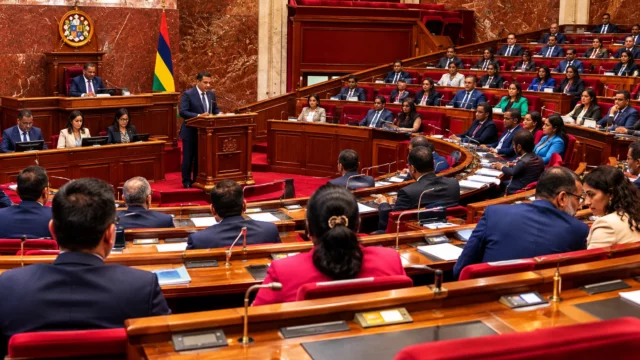
It was in this context that Véronique Leu-Govind, Minister Delegate for Arts and Culture, left the government on Monday 3 August 2026. The decision came after her husband, Gulshan Govind, was arrested in an investigation linked to the suspected importation of cannabis between Réunion and Mauritius. The Mauritian executive said it wanted to prevent “perceptions” from further undermining the team in office, while stressing that, at this stage, no evidence personally implicated the minister.
The case is a delicate one for Port Louis, the country’s political and administrative capital. In spring 2026, Mauritius adopted a new national plan to combat drugs, designed as a coordinated response based on information-sharing, maritime cooperation and digital tools. The case involving the Leu-Govind family has therefore emerged as the government seeks to project a hard line.
Drug investigation at the crossroads of Mauritius and Réunion
According to the information available, Gulshan Govind appeared before the court in Bambous, in the west of the island, on Monday 3 August, facing a provisional charge of drug trafficking. He had been arrested in Mauritius three days earlier. Investigators suspect he was linked to an attempt to import about 100 kilos of cannabis, with an estimated market value of €4.4 million. These figures come from details reported by the Mauritian press and have yet to be confirmed by the outcome of the investigation and the judicial proceedings.
The regional dimension is central. The suspected trafficking route between Réunion and Mauritius points to a reality well known in the south-western Indian Ocean: criminal networks do not respect maritime borders, and the islands share routes, ports, air links and common vulnerabilities. French authorities in Réunion have described stepped-up efforts against drugs in the area, while Port Louis has highlighted cooperation with regional and international partners against cross-border networks.
Bambous is not an incidental name in this type of investigation. Over the years, the locality has regularly featured in Mauritian police and court news. This is a reminder that trafficking is not confined to affluent neighbourhoods or major port routes. It also runs through residential areas and peri-urban pockets where surveillance is more difficult.
For the Mauritian government, the stakes are political as well as judicial
Véronique Leu-Govind’s resignation is first and foremost a matter of government management. In a Westminster-style parliamentary system, a minister or junior minister under the scrutiny of an investigation can become an image problem, even without being personally implicated. In Mauritius, where the governing coalition rests on fragile internal balances, every sensitive case can weigh on collective discipline and shape how voters view the executive’s coherence.
The issue is all the more sensitive because the government cites high figures in its fight against drugs. In July 2026, the head of government told Parliament that police had recorded 1,560 drug-related offences between January and 8 July, with seizures valued at about 1.3 billion rupees. The ADSU, meanwhile, reported 1,232 cases and 1,156 arrests by the end of the first half of the year, with drugs seized worth 1.9 billion rupees. These figures reflect the scale of the problem, but also the pressure on security services.
In this context, the minister delegate’s departure does not amount to a definitive political verdict. It is more a precautionary withdrawal, intended to protect the rest of the team and prevent public debate from focusing on a family matter. But the strategy comes at a cost: it is a reminder that Mauritius’s institutions must contend with a demanding public, which expects public officials to be beyond reproach, particularly when they oversee areas related to culture, young people and public life.
What the case says about Mauritius and the south-western Indian Ocean
For Mauritius, this episode goes beyond the individual case. It raises a broader question: how can judicial firmness, political transparency and regional cooperation be maintained together? The island is strengthening its tools, from port surveillance to information-sharing with foreign partners. It is also engaging with France, with Réunion remaining a strategic neighbour on security and judicial matters. But as long as maritime routes remain porous, networks will seek entry points, local links and low-profile operators.
The wider regional implications are real. In the Indian Ocean, as elsewhere in Africa, trafficking often thrives on three factors: rapid movement between islands and coastlines, the difficulty of monitoring every maritime route, and the interdependence of police, customs, the courts and regional cooperation. The Mauritian case is a reminder that an effective response cannot rely on arrests alone. It also requires stable institutions, robust chains of evidence and a clear separation between political and criminal responsibility. That is the fragile balance Port Louis must now preserve as the country seeks to present itself as a state governed by the rule of law, capable of standing up to criminal networks.