Algeria
 Egypt
 Libya
 Morocco
 Sudan
 Tunisia
 Benin
 Burkina Faso
 Cabo Verde
 Côte d'Ivoire
 Ghana
 Guinea
 Guinea-Bissau
 Liberia
 Mali
 Mauritania
 Niger
 Nigeria
 Senegal
 Sierra Leone
 The Gambia
 Togo
 Central African Republic
 Chad
 DR Congo
 Equatorial Guinea
 Gabon
 Republic of the Congo
 São Tomé and Príncipe
 Burundi
 Comoros
 Djibouti
 Eritrea
 Ethiopia
 Kenya
 Madagascar
 Malawi
 Mauritius
 Mozambique
 Rwanda
 Seychelles
 Somalia
 South Sudan
 Tanzania
 Uganda
 Angola
 Botswana
 Eswatini
 Lesotho
 Namibia
 South Africa
 Zambia
 Zimbabwe
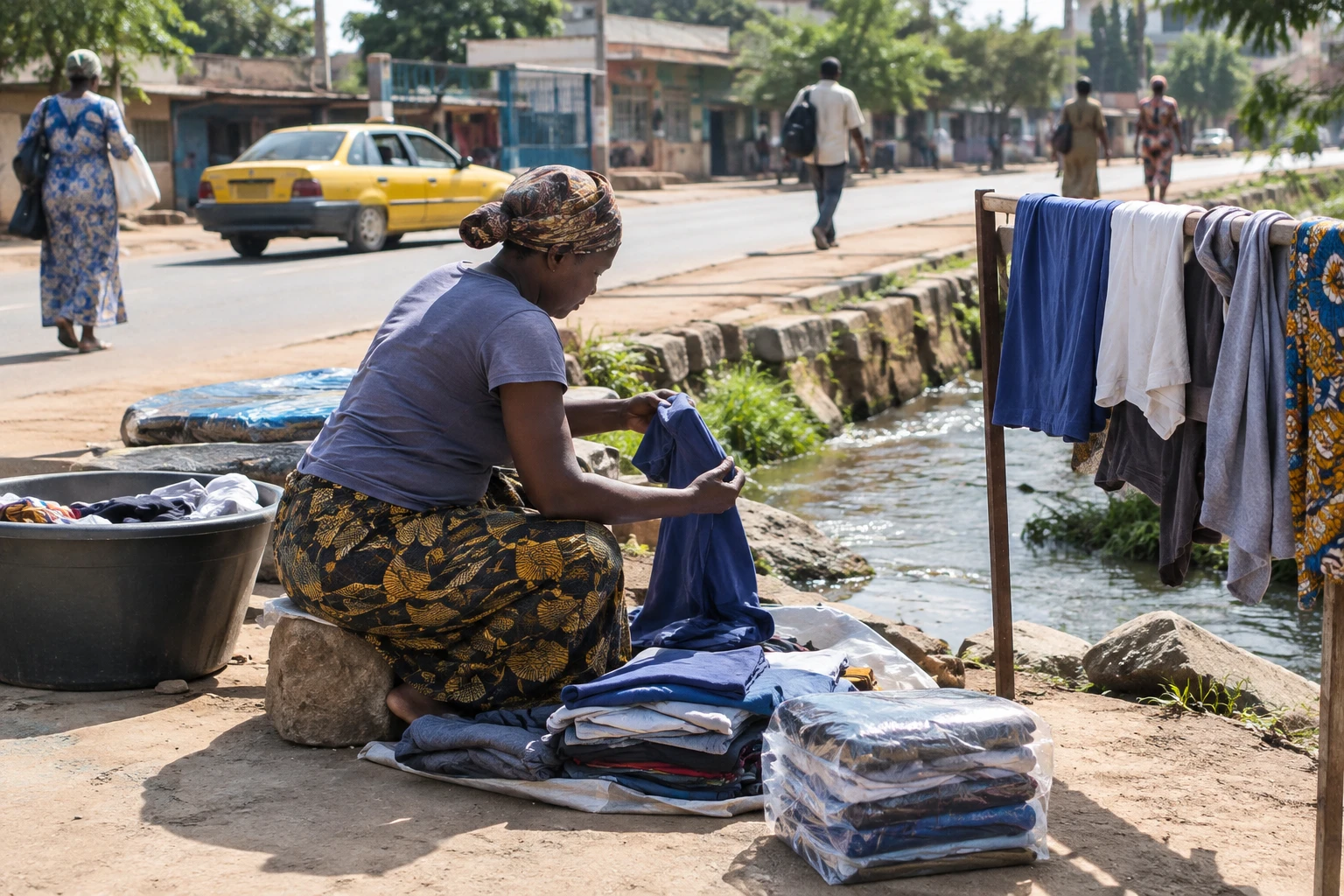
In Maroua, washing a garment can cost 100 or 200 CFA francs, with the item returned ironed the same day. For residents in a hurry or watching their spending, this service on the banks of the Mayo Kaliao meets a practical need. But it also exposes those who provide it to sudden floods and the loss of clothes.
A local service moving at the city’s pace
In the Baoliwol neighbourhood, laundry workers set up in the bed of the Mayo Kaliao, a seasonal watercourse that runs through Maroua, capital of the Far North region. They wash clothes by hand, hang them out to dry, then iron them. Some now return the clothes wrapped in plastic, a touch that brings their service closer to that of dry cleaners.
Kaïdama has been in the trade for around a decade. On a working day, he can have nearly a hundred garments in front of him and stay on site until evening. Customers come both to drop off their laundry and to use an individual service. This direct relationship, speed and affordable prices help build loyalty among a diverse clientele.
Prices reported in Maroua vary according to the service and the garment: around 200 CFA francs to wash and iron one item, while other laundry workers offer lower rates for washing alone. One young worker quoted in the report, for example, says she washes clothes in a basin for 500 CFA francs or charges 100 francs per garment. These are local accounts, not a general price list.
This activity is not just a last resort for low-income households. Customers with stable jobs also use it. One says he regularly entrusts his clothes to a laundry worker who can collect them from his home. The service’s growth is therefore due as much to its convenience and the trust built between customers and workers as to its price.
Income, but also exposure to floods
For young people who struggle to find work, laundry provides an income without requiring commercial premises or expensive equipment. One laundry worker interviewed estimates that he earns between 20,000 and 30,000 CFA francs a month. This amount depends on orders and cannot be extrapolated to the profession as a whole. Working days can be long, with trips back and forth between the watercourse and home.
The work carries an immediate risk: a rapid rise in water levels can sweep away people or clothes left to dry. One young laundry worker says he lost more than 50 items during a recent episode. If a customer demands replacement clothes, the loss can directly affect an income that is already limited.
The danger is linked to Maroua’s geography. An urban planning document from Cameroon’s ministry responsible for housing notes that mayos, or temporary watercourses, flow actively during the rainy season, generally from June to October. Heavy rain and flooding can affect nearby neighbourhoods. The Mayo Kaliao is thus both a seasonal resource and a place where work depends on conditions that are difficult to control.
A study of laundry workers in Maroua has also examined their working conditions and the health risks associated with using water from the Mayo Kaliao. It notes that the activity involves not only flood safety but also hygiene conditions. However, the available evidence does not allow conclusions here about a specific level of contamination or the workers’ overall health.
The informal economy at the heart of urban services
These laundry workers illustrate a broader reality of Cameroon’s economy. A survey of the informal sector by the National Institute of Statistics, published in 2023, indicates that services account for 35% of workers in the informal production units studied. It also finds that only six in every 100 workers in this sector are employees. Most therefore work for themselves or in small businesses, often without protections comparable to those in formal employment.
These national figures do not specifically describe laundry workers in Maroua. They nevertheless shed light on the conditions associated with their trade: starting an activity with few resources, variable earnings, long working hours and limited protection against accidents or losses. The growing presence of young women in this activity also makes their safety and access to suitable workspaces an important issue.
Competition with dry cleaners is not simply a matter of modernity versus precariousness. Laundry workers offer a different way of organising the service: proximity, flexibility, sometimes home collection and quick return. Dry cleaners, meanwhile, have different equipment and a different professional structure. The available evidence does not make it possible to measure the effect of this competition on their earnings or customer base.
A local issue in a shared regional space
Maroua is in the Far North, near Chad and Nigeria. Its location is a reminder that the region’s cities share trade flows and challenges, even though the activity described here remains primarily local. Cameroon belongs to CEMAC, the Central African Economic and Monetary Community, which organises some regional economic cooperation. Laundry workers’ day-to-day lives, however, depend on very practical decisions at municipal level: safe access to riverbanks, flood warnings and opportunities to work without unnecessary exposure to danger.
For local authorities, the issue is not simply to move these workers away from the watercourse. A lasting response should take into account the service they provide to residents, the price at which it is available and the risks borne by those who provide it. In Maroua, the trade’s growing value — careful ironing, packaging and delivery — shows an ability to adapt. It remains to be seen whether this development can be accompanied by safer working conditions without eliminating a source of income accessible to many young Cameroonians.