Algeria
 Egypt
 Libya
 Morocco
 Sudan
 Tunisia
 Benin
 Burkina Faso
 Cabo Verde
 Côte d'Ivoire
 Ghana
 Guinea
 Guinea-Bissau
 Liberia
 Mali
 Mauritania
 Niger
 Nigeria
 Senegal
 Sierra Leone
 The Gambia
 Togo
 Cameroon
 Central African Republic
 Chad
 DR Congo
 Equatorial Guinea
 Gabon
 Republic of the Congo
 São Tomé and Príncipe
 Burundi
 Comoros
 Djibouti
 Eritrea
 Ethiopia
 Madagascar
 Malawi
 Mauritius
 Mozambique
 Rwanda
 Seychelles
 Somalia
 South Sudan
 Tanzania
 Uganda
 Angola
 Botswana
 Eswatini
 Lesotho
 Namibia
 South Africa
 Zambia
 Zimbabwe

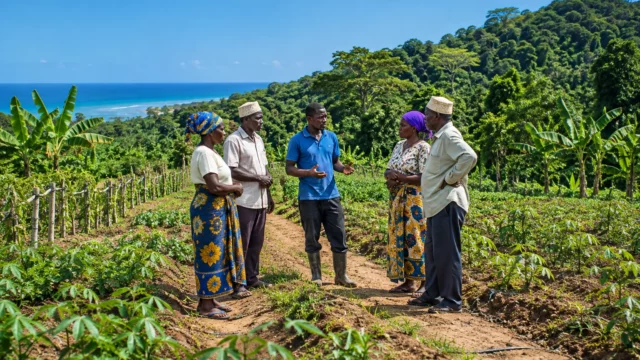
In Lamu, debate over the planned Dangote refinery is already about more than energy. It also touches on the decisive question of access to land. Two days before the official launch ceremony, 133 residents are asking the Kenyan courts to protect their rights to a plot earmarked for the project.
In Lamu, an industrial project at the centre of a contested territory
The site in question is in Chandavai, in Lamu County, on Kenya’s north-eastern coast. The area forms part of the LAPSSET corridor, a vast regional programme linking the port of Lamu to South Sudan and Ethiopia. The corridor includes roads, oil pipelines, port facilities and logistics infrastructure.
For Nairobi, Lamu is to become a major gateway to the landlocked markets of East Africa. The project is therefore part of a broader strategy than simply building a refinery. It is intended to strengthen Kenya’s role in regional energy supplies and support the economic transformation of the coast.
But Lamu is also a territory where major projects have repeatedly sparked land disputes. Residents say their families have occupied, farmed and used certain plots for generations, sometimes without formal title deeds. The absence of such documents does not necessarily mean there are no rights recognised under Kenya’s Constitution and laws.
Court maintains status quo ahead of 14 October hearing
On 28 September 2026, the Kenyan court responsible for land and environmental matters ordered that the status quo be maintained on plot LR No. 13061, at the centre of the dispute. The decision comes ahead of the launch ceremony scheduled for Wednesday 30 September, which President William Ruto is expected to attend.
Judge Jane Onyango did not declare the case urgent and did not explicitly prohibit the official ceremony. She did, however, order that the situation on the plot remain unchanged until the case has been heard with both sides present. The defendants must respond to the claimants before the hearing scheduled for 14 October 2026.
The 133 claimants, represented in the proceedings by several Chandavai residents, are seeking, among other things, a suspension of construction, excavation and land clearance. They say their homes, crops, trees and certain sites of cultural value could be affected by the project.
In their court documents, the residents also argue that site preparation work may have begun before compensation and resettlement issues were fully resolved. They refer to soil testing and work related to the development of nearby infrastructure.
These claims remain disputed and will have to be examined by the court. At this stage, no final ruling has determined whether the land acquisition was lawful or the amount of any compensation due.
The heart of the petition: compensation, consultation and the environment
The claimants do not necessarily present their action as a general opposition to investment. Their request is primarily for recognition of their land interests and for a process that complies with Kenyan law.
They say the state should have identified the actual occupants, assessed the property concerned and guaranteed compensation before taking possession. They also challenge the alleged absence of a resettlement plan for families who may be displaced.
The petition also raises an environmental issue. The residents are calling for impact assessment requirements and public participation obligations to be met before construction begins in earnest. For an oil and petrochemical complex of this scale, these procedures must cover soil, water, emissions, transport and effects on local livelihoods.
The issue is particularly sensitive in Lamu. The local economy depends on several activities, including farming, livestock, fishing, trade and tourism. The project’s effects will therefore differ for large companies, owners with title deeds, occupants without formal documents and households directly dependent on their land.
A refinery designed for East Africa
The project, led by the group of Nigerian businessman Aliko Dangote, is estimated at around $15 billion to $20 billion, according to estimates released in recent months. Planned capacity could reach 700,000 barrels of crude oil a day. If built at this scale, the facility would rank among Africa’s largest and become the biggest refinery in East Africa.
The complex is intended to produce fuels and petrochemical derivatives for Kenya and other regional markets. Its stated aim is to reduce several countries’ dependence on imports of refined products. Delivering on that promise, however, will depend on several factors: financing, crude supply, transport infrastructure and the ability of regional markets to absorb the output.
The refinery is also presented as an extension of Dangote’s continental footprint. After building a 650,000-barrel-a-day facility in Lekki, Nigeria, the group is seeking to strengthen its presence in another major African region. Lamu would give it access to East African markets and the landlocked countries connected by the LAPSSET corridor.
Project timetable now depends on court proceedings
The 30 September ceremony can still go ahead, as the order issued on 28 September did not explicitly prohibit it. The maintenance of the status quo, however, limits the promoters’ room for manoeuvre on the disputed plot until the next hearing.
The Kenyan government will therefore have to show that the land, environmental and administrative steps were carried out in accordance with the law. Dangote Industries, for its part, will need to clarify the operational timetable and the safeguards planned for the communities concerned.
The stakes extend beyond Lamu. In the East African Community, which includes Kenya, Uganda, Tanzania, Rwanda, Burundi, South Sudan, the Democratic Republic of the Congo and Somalia, major infrastructure projects are often presented as drivers of integration. Their acceptability, however, depends on how local communities are involved and compensated.
The next step will be the hearing on 14 October 2026. It could clarify the scope of the status quo, the role of the land authorities and the conditions required for the project to proceed. For Nairobi and Dangote alike, the refinery’s success will be measured as much by its industrial capacity as by the strength of its roots in the area.