Algeria
 Egypt
 Libya
 Morocco
 Sudan
 Tunisia
 Benin
 Burkina Faso
 Cabo Verde
 Côte d'Ivoire
 Ghana
 Guinea
 Guinea-Bissau
 Liberia
 Mali
 Mauritania
 Niger
 Nigeria
 Senegal
 Sierra Leone
 The Gambia
 Togo
 Cameroon
 Central African Republic
 Chad
 DR Congo
 Equatorial Guinea
 Gabon
 Republic of the Congo
 São Tomé and Príncipe
 Burundi
 Comoros
 Djibouti
 Eritrea
 Ethiopia
 Kenya
 Madagascar
 Malawi
 Mauritius
 Mozambique
 Rwanda
 Seychelles
 Somalia
 South Sudan
 Tanzania
 Uganda
 Angola
 Botswana
 Eswatini
 Lesotho
 Namibia
 South Africa
 Zimbabwe
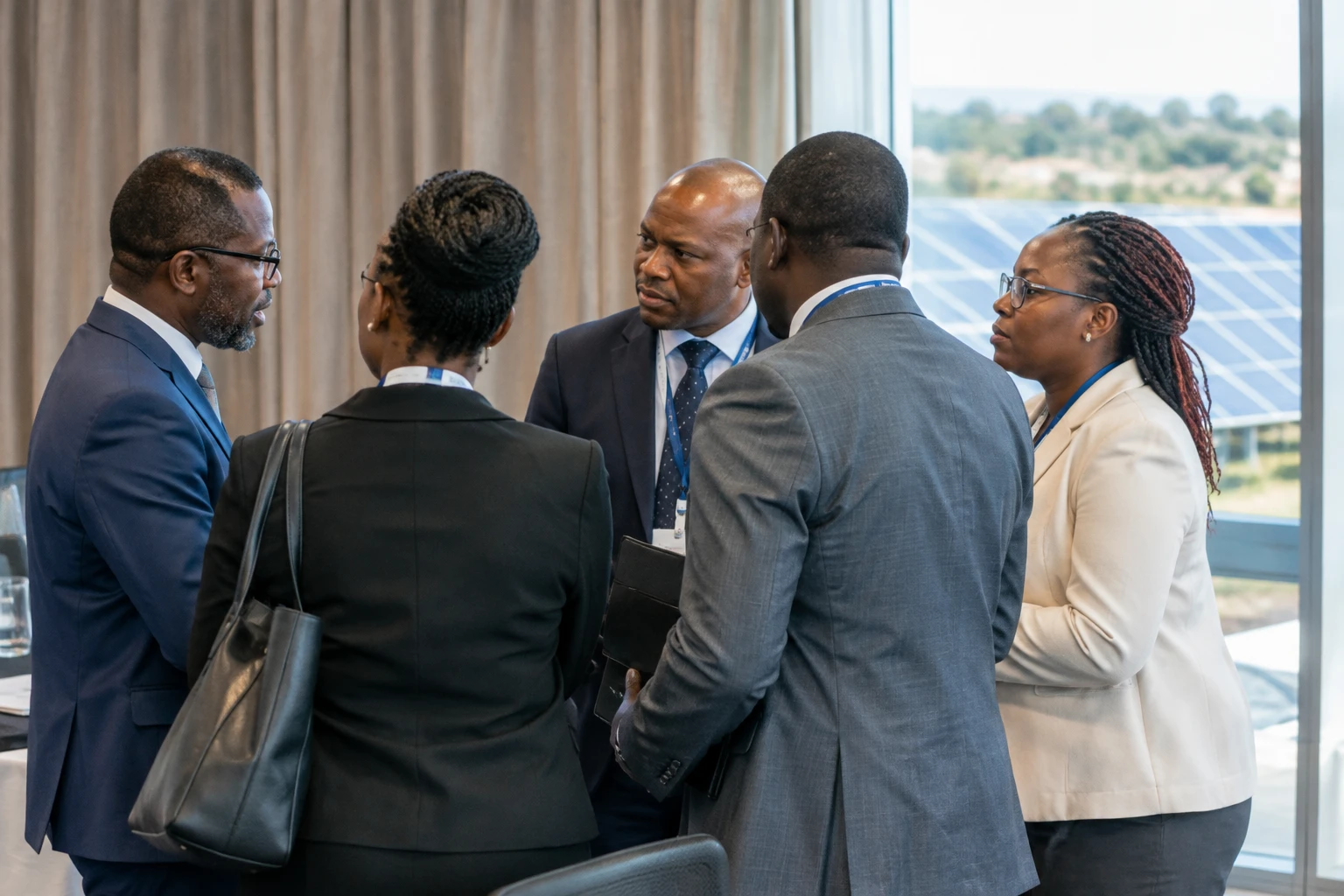
A solar power plant can generate electricity without finding a single buyer strong enough to reassure banks. In Zambia, the Kudu project is pursuing another route: selling its output to a trader that can distribute it among several clients across southern Africa.
A regional market to complement Zambia’s grid
The context gives this strategy practical significance. After the 2023-2024 drought reduced hydropower output and contributed to power cuts, Zambia is seeking to diversify its energy sources. Zambia’s Ministry of Energy says national outages ran from 8 March 2024 to November 2025. Solar provides supplementary generation, even if it cannot by itself replace dispatchable capacity or investment in the grid.
The country is also at the heart of the Southern African Power Pool (SAPP), the electricity trading market organised by members of the Southern African Development Community (SADC). Established in 1995, the system allows participating operators to trade electricity across borders. It opens up markets, but does not automatically guarantee that every megawatt generated can be transmitted and sold: transmission capacity and trading rules also matter. How the SAPP regional market works and its recent reports illustrate both trading activity and transmission constraints.
On 8 October 2026 in Lusaka, AXIAN Energy and Africa GreenCo signed a power purchase agreement (PPA) for Kudu. A PPA sets out the terms on which a producer will sell its future output. According to information provided by AXIAN and reported by pan-African media outlet Bankable, the agreement covers 200 MW of alternating-current capacity fed into the grid. The plant is planned to have a capacity of 240 MW in direct current and estimated annual output of about 530 GWh. Kudu project details corroborated by Bankable.
An intermediary between producers and buyers
GreenCo is to buy the electricity generated by Kudu and then market it to a portfolio of clients: utilities, mines, agricultural businesses and other economic players. The company thus acts as an intermediary buyer. Rather than depending on a single domestic client, the project will be able to target several buyers and access SAPP markets.
This diversification could make expected revenues more predictable. It could therefore help the developers persuade lenders, without eliminating the risks: Kudu’s financing has not been announced as finalised, and construction has not yet begun. Capital will still need to be raised, works completed and arrangements for evacuating the electricity secured. GreenCo’s model also relies on support mechanisms for its payment obligations; it does not mean that all commercial risk disappears. GreenCo’s role as an intermediary buyer and the guarantees associated with its model.
Previous projects in Zambia offer points of comparison. In May 2025, the 100 MW Chisamba solar project secured $71.5 million in commercial debt from Stanbic Bank Zambia. The financing was backed by a 13-year PPA with GreenCo. The project reached financial close in May and was commissioned on 30 June 2025, according to ZESCO, the state-owned electricity company. Financial details of Chisamba published by GreenCo.
Another precedent is Ilute, a 32 MWp plant near Sesheke in Western Province, which completed financing of $26.5 million in January 2026. Serengeti Energy says planned sales through GreenCo and the SAPP made it possible to structure the project without a sovereign guarantee. Ilute shows that financing based on access to a regional commercial market can be considered; it does not prove that Kudu will obtain the same terms. Ilute’s financing and access to the regional market.
Potential benefits, but no guarantees
For AXIAN Energy, the PPA marks a development milestone and sends a commercial signal to prospective financiers. The group expanded its presence in Zambia in October 2025 by acquiring an 85.6% majority stake in the Bangweulu plant, which is already operating. Kudu is therefore a new project, distinct from an existing asset: its output still has to be built and financed.
For businesses and mines, new volumes could widen supply options. For households, the impact will depend more on the system’s overall balance: line availability, sales contracts, prices, grid management and ZESCO’s capacity to serve different regions. A plant targeting commercial buyers does not, by itself, guarantee lower tariffs or an immediate improvement in residential access.
The regional dimension also matters. Electricity trading can connect the renewable resources of some areas with the needs of other countries, and provide new revenues for Zambian producers. But cross-border infrastructure and grid congestion determine how much power can actually be delivered. In its August 2026 report, the SAPP was still noting that transmission constraints were preventing some matched offers from being executed.
The next test, then, will be less the signing than what follows: financial close, the construction schedule, grid connection and contracts with end buyers. For Zambia and its SADC partners, Kudu highlights a central question in the energy transition: how to turn solar projects into reliable, financeable electricity that is actually distributed, both across borders and within the country.