Algeria
 Egypt
 Libya
 Morocco
 Sudan
 Tunisia
 Benin
 Burkina Faso
 Cabo Verde
 Côte d'Ivoire
 Ghana
 Guinea
 Guinea-Bissau
 Liberia
 Mali
 Mauritania
 Niger
 Nigeria
 Senegal
 Sierra Leone
 The Gambia
 Togo
 Cameroon
 Central African Republic
 Chad
 DR Congo
 Equatorial Guinea
 Gabon
 Republic of the Congo
 São Tomé and Príncipe
 Burundi
 Comoros
 Djibouti
 Eritrea
 Ethiopia
 Madagascar
 Malawi
 Mauritius
 Mozambique
 Rwanda
 Seychelles
 Somalia
 South Sudan
 Tanzania
 Uganda
 Angola
 Botswana
 Eswatini
 Lesotho
 Namibia
 South Africa
 Zambia
 Zimbabwe
When the rainy season becomes a test of governance
In Kenya, rain is never just a matter of the weather. It determines the fate of roads, schools, crops, neighbourhood markets and, often, families forced to leave at short notice. In a country where Nairobi is home to national institutions, while climate risks also hit rural areas, the warning of a new episode of intense rainfall has immediately taken on national significance. The question is not simply whether it will rain. It is whether the state, counties and communities will be able to act before water turns plains, roads and rivers into crisis zones.
A warning set against East Africa’s changing climate
Kenya is part of a region where climate shocks are recurring with greater intensity. The World Meteorological Organization said in May 2024 that the 2023/24 El Niño episode was coming to an end, with a gradual shift towards other conditions in the ENSO system, the ocean-atmosphere mechanism that strongly influences rainfall in East Africa. But its effects continue to be felt long after the phenomenon peaks.
Kenya’s meteorological service, for its part, documented above-average rainfall in several parts of the country in its 2023 report, including the coast, the central highlands and the Lake Victoria Basin. In May 2024, it also issued heavy-rain warnings covering a large part of the country, showing that Kenya remains exposed to highly irregular weather events. In this context, talking about El Niño in Kenya is less a matter of announcing an isolated event than describing a pattern of risk that has become structural.
What Kenya’s response plan entails
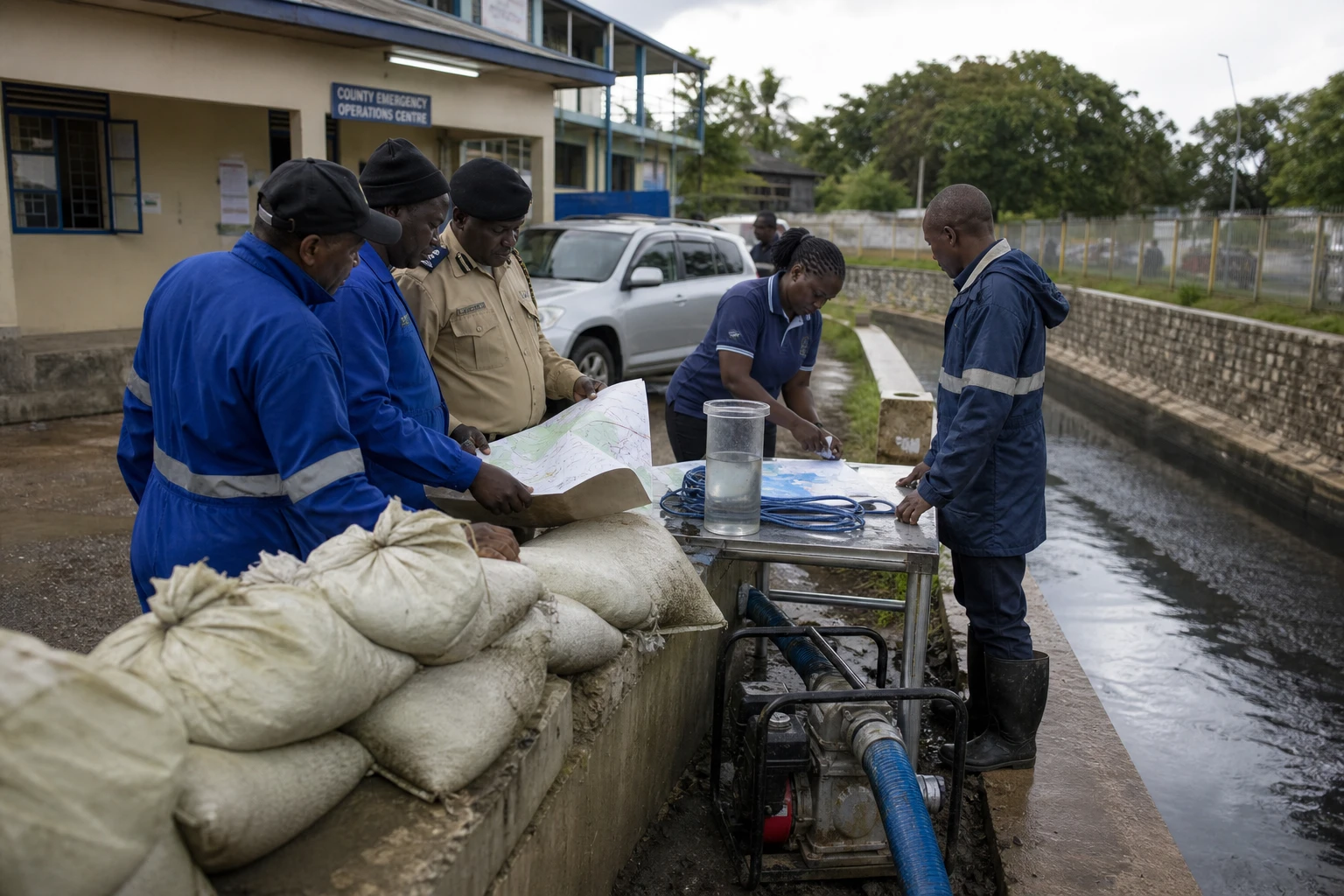
In response to the threat, Kenyan authorities have prepared an anticipatory plan based on four main measures: mapping risk areas, preparing to evacuate vulnerable people, strengthening community-level early warnings and placing rapid-response teams on alert. The aim is clear: to reduce the time between warning and action, particularly in counties where floods can affect roads, bridges, health centres and farmland.
The figure cited in the initial warning — 46 of the country’s 47 counties — reflects the national scale of the risk. Recent weather warnings have indeed covered a large number of counties, from Nairobi to the Rift Valley, as well as the coast and the north of the country. In other words, the threat is not confined to areas that are usually flooded. It also affects densely populated urban centres, where surface runoff gathers pace and evacuations become more complicated.
Heavy tolls, but figures that require caution
The consequences of El Niño-related rains have already been documented by several humanitarian organisations. A final report by the International Federation of Red Cross and Red Crescent Societies on flooding in Kenya cites 490 deaths between October 2023 and May 2024, as well as more than 729,000 people displaced. The same document confirms that the floods destroyed homes, disrupted essential services and created significant needs for shelter, healthcare and drinking water.
These figures should nevertheless be read carefully. The most detailed humanitarian source speaks of “more than 729,000” displaced people, while other assessments cite around 700,000 people affected across Africa or in Kenya. The sound journalistic approach is therefore to attribute the precise figure to its source and avoid presenting it as a single, unchanging and definitively settled truth.
What this means for Kenyans in practice
For urban households, the first shock is often logistical: traffic jams, closed roads, higher transport costs and difficulty accessing markets. For rural families, the stakes are even more immediate: crop losses, the destruction of homes built with lightweight materials, waterborne diseases and forced displacement. Counties near major river basins, such as the Tana River and Lake Victoria, remain particularly exposed, but low-income neighbourhoods in major cities are not spared.
There is also a political dimension to the institutional challenge. Kenya’s Constitution has strengthened the role of counties in managing local services. During a climate crisis, this system becomes decisive: if coordination between Nairobi and local governments is slow, warnings arrive too late; if it works, schools, clinics, secondary roads and evacuation points can be secured more quickly. This is where the credibility of the state is at stake, far more than in its announcements.
A Kenyan issue with continental implications
Kenya is not an isolated case. Across East Africa, the rise in climate extremes is forcing governments to move from reactive responses to forecast-based preparedness. The World Meteorological Organization is now stressing early-warning systems and anticipatory action. Kenya has also adopted an anticipatory action roadmap for 2024–2029, marking a shift towards responses triggered by measurable signals rather than by a disaster already under way.
Across Africa, the issue goes beyond the weather. It affects food security, public budgets, health systems and population movements. The coming months will show whether the country can turn its warnings into real protection. Observers will focus in particular on coordination between the meteorological service, disaster-risk management bodies, county authorities and humanitarian organisations, in a region where the climate now demands swift decisions as well as much finer-grained planning across the territory.