Algeria
 Egypt
 Libya
 Morocco
 Sudan
 Tunisia
 Benin
 Burkina Faso
 Cabo Verde
 Côte d'Ivoire
 Ghana
 Guinea
 Guinea-Bissau
 Liberia
 Mali
 Mauritania
 Niger
 Nigeria
 Senegal
 Sierra Leone
 The Gambia
 Togo
 Cameroon
 Central African Republic
 Chad
 DR Congo
 Equatorial Guinea
 Gabon
 Republic of the Congo
 São Tomé and Príncipe
 Burundi
 Comoros
 Djibouti
 Eritrea
 Ethiopia
 Kenya
 Madagascar
 Malawi
 Mauritius
 Mozambique
 Rwanda
 Seychelles
 Somalia
 South Sudan
 Tanzania
 Uganda
 Angola
 Botswana
 Eswatini
 Lesotho
 Namibia
 Zambia
 Zimbabwe
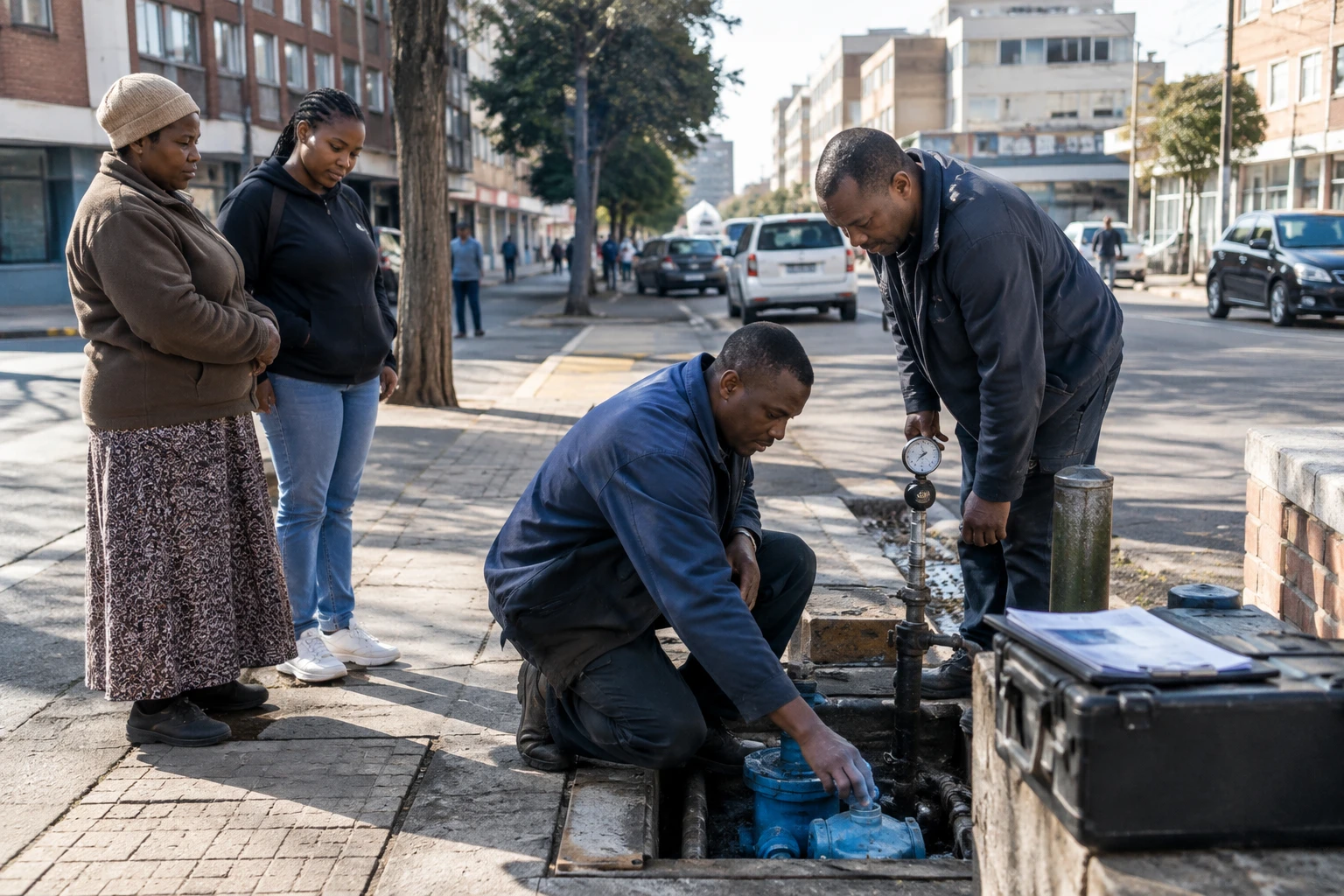
In Johannesburg, the quality of tap water has become a very tangible election issue. For affected residents, a promise that supplies will be restored is not enough: they need to know when the water will return and whether the network can remain reliable over time.
A local election at the heart of everyday life
South Africans will vote on Wednesday 4 November 2026 to renew their municipal councils. These elected representatives oversee essential services, including water supply, sanitation and waste collection. The election is organised by the Independent Electoral Commission. The date was officially set by the national authorities.
The vote comes amid a political landscape transformed since the 2024 national elections. The African National Congress (ANC), in power since the end of apartheid, lost its parliamentary majority and now governs in a government of national unity coalition with the Democratic Alliance and several smaller parties. The municipal election will therefore also measure the parties’ ability to retain or win control of major cities.
Johannesburg, the country’s main economic centre, is at the heart of some of these issues. Local councils do not resolve every problem with water networks on their own, but the municipality and public operators must respond to residents and organise work on the ground. For voters, institutional responsibility matters less than the outcome: having water at home.
Water cuts weigh on households and businesses
Since 19 October, several Johannesburg neighbourhoods have experienced supply interruptions or low pressure. Mayor Dada Morero acknowledged that some households had been without water for more than ten days. He said on Monday that overall storage in the municipal system had risen to 41%, from 37% the previous day, while warning that low pressure and temporary cuts could persist as the system was brought back online.
The announced improvement does not, therefore, mean an immediate return to normal in every neighbourhood. Reservoirs and pipes need to regain stable operation. Municipal teams are adjusting flows and pressure, and clearing air trapped in some pipes. The municipality says it is proceeding gradually to avoid draining supplies as they are replenished.
The disruption affects residents in different ways. A household with a reserve supply or able to buy water can cushion the impact of a cut. Other households must organise storage, travel and domestic tasks around an uncertain service. Small businesses and activities that depend on water also have to contend with interruptions that complicate their operations.
In accounts gathered on the ground, two Johannesburg residents explicitly link their service difficulties to the vote. Linda Mthembu says she wants to “vote for change” in response to water and electricity cuts. Sbonakaliso Sishi describes a deterioration in the country and calls for a political response. These accounts reflect individual experiences; on their own, they cannot measure the views of all voters.
The election puts local administrations to the test
Municipal elections are not a national referendum, but they can punish the teams responsible for local services. Waste collection, network maintenance and the continuity of electricity and water supply have a direct impact on daily life. In Johannesburg, candidates and parties will have to convince voters that their proposals can deliver verifiable change.
Responsibility is, however, divided among several levels of government and operators. This can make it difficult to identify the causes of an outage such as the one currently affecting the city. It does not absolve local authorities of the need to explain timelines, measures taken and the neighbourhoods affected. During an election period, transparency about this information becomes both a matter of trust and a management tool.
Amnesty International says that, for millions of South Africans, the promise of a dignified life remains unfulfilled, and calls on new administrations to make human rights and basic services a priority. Its position is a reminder that access to water is not just a campaign issue: it is also part of the public authorities’ obligations to the population.
A political indicator for southern Africa
The result will be watched beyond Johannesburg. The ANC’s electoral decline, already evident nationally in 2024, could be confirmed or slow in major municipalities. Municipal councils will then determine local coalitions and, through the way they operate, the parties’ ability to govern with sometimes fragmented majorities.
The regional significance does not lie in making a straightforward comparison between countries. Rather, it lies in a question shared by cities across southern Africa: how can reliable urban services be maintained when needs, networks and institutional responsibilities overlap? For South Africans, the answer will first be measured in their neighbourhood, after the vote.
In Johannesburg, the immediate focus is on the effective restoration of pressure and the continuity of supply, not just the aggregate level of reserves. At national level, the 4 November vote will show whether voters renew their confidence in the teams in office or favour other parties. In either case, the next test will be the same: turning commitments into accessible services.