Algeria
 Egypt
 Libya
 Morocco
 Sudan
 Tunisia
 Benin
 Burkina Faso
 Cabo Verde
 Côte d'Ivoire
 Ghana
 Guinea
 Guinea-Bissau
 Liberia
 Mali
 Mauritania
 Niger
 Senegal
 Sierra Leone
 The Gambia
 Togo
 Cameroon
 Central African Republic
 Chad
 DR Congo
 Equatorial Guinea
 Gabon
 Republic of the Congo
 São Tomé and Príncipe
 Burundi
 Comoros
 Djibouti
 Eritrea
 Ethiopia
 Kenya
 Madagascar
 Malawi
 Mauritius
 Mozambique
 Rwanda
 Seychelles
 Somalia
 South Sudan
 Tanzania
 Uganda
 Angola
 Botswana
 Eswatini
 Lesotho
 Namibia
 South Africa
 Zambia
 Zimbabwe
A strategic but still fragile sector
In Nigeria, rice is more than a staple food. It is also a test of economic sovereignty. The country remains Africa’s largest producer, but continues to buy a significant share of what it consumes, weighing on prices, foreign exchange reserves and the stability of the domestic market. The latest projections from the US Department of Agriculture show that the country’s rice imports remain high, at 3.2 million tonnes for 2025/2026, while production is set to decline slightly over the same period.
This dependence remains a major concern for Abuja, in a country where the rice market is one of the largest on the continent. Nigerian authorities have rolled out a range of support policies over several years, including restrictions on some imports, support for local processing and seed programmes. But progress remains slow in the face of population growth, logistics costs and productivity gaps between irrigated and rain-fed areas.
Japanese support focused on seeds
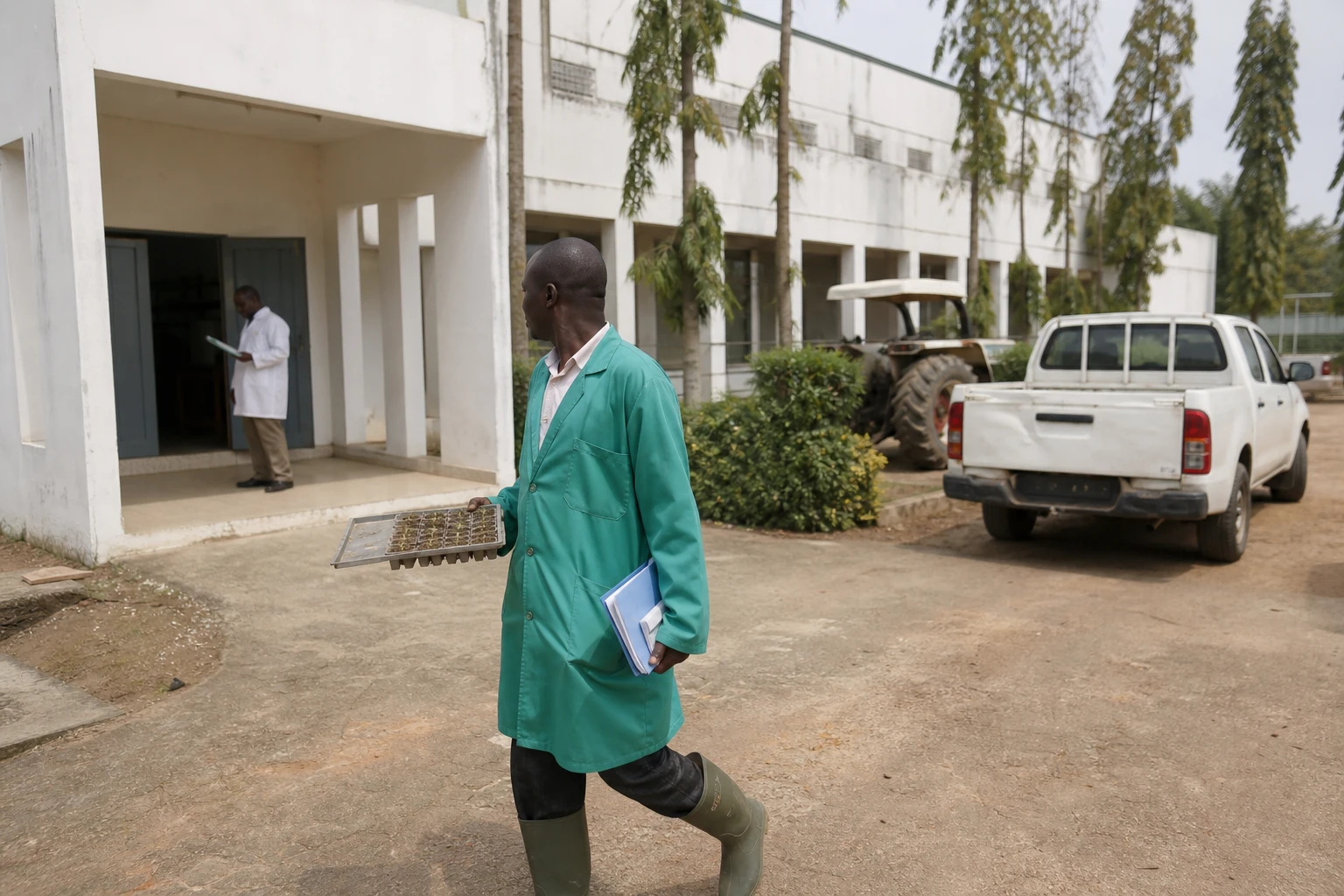
It is against this backdrop that Japan has decided to support a project to strengthen Nigeria’s rice seed system. The initiative, led by the Japan International Cooperation Agency, aims to improve rice seed multiplication at the National Cereals Research Institute, based in Badeggi, Niger State. The project runs from April 2025 to April 2029 and is focused on upgrading existing facilities and equipping the institute’s sites.
The funding announced by the Japanese authorities is estimated at about 587 million yen, or $3.7 million. It will be used to purchase tractors, transplanters, combine harvesters and excavators, as well as monitoring equipment such as germination testing devices, automatic weather observation systems and drying machines. The aim is straightforward: to produce more certified, higher-quality seeds for Nigerian farmers.
Nigeria’s Ministry of Agriculture and Food Security presents the project as a lever for modernising the sector. In its official communications, it stresses the strategic value of the NCRI in Badeggi for varietal research, disease resistance and adaptation to climate variability. The initiative is also intended to complement the work of the National Agricultural Seed Council, which is responsible for seed certification and oversight.
Why seeds matter as much as machinery
In the rice sector, seeds are the foundation of productivity. Poor-quality seeds reduce yields, weaken harvests and limit the return on investment in fertiliser, water and mechanisation. This is crucial in Nigeria, where yields remain low. Data compiled by the USDA put the average yield at around 2 tonnes per hectare in 2024/2025, well below levels seen in the most productive systems and still below the global average cited by the FAO.
The Nigerian government is nevertheless aiming to ramp up production. Its 2020-2030 National Rice Development Strategy seeks to double paddy production from the level recorded in 2020/2021. Yet USDA projections indicate that Nigeria’s paddy harvest is expected to reach 8.7 million tonnes in 2025/2026, just 7% higher than in 2020/2021. In other words, the current trajectory is too slow to meet the 2030 target.
This shortfall is not down to a single factor. Sector players also point to insecurity in some producing areas, low levels of irrigation, limited mechanisation and the weak distribution of certified seeds. Nigeria has considerable agricultural potential, but that potential does not automatically translate into stable production. This is where Japanese support comes in: it targets the first step in the supply chain, before the crop even reaches the field, at the stage when planting material is produced.
A Nigerian issue, but also a West African one
The issue extends beyond Nigeria’s borders. In ECOWAS, food security remains a major concern, as several urban markets in the region still depend on rice imports. When Nigeria produces more or, conversely, imports more, this has an immediate impact on trade flows, border prices and the strategies of neighbouring countries. The Nigerian case therefore has regional implications, from Benin to Niger and along West Africa’s trade corridors.
The project is also part of a broader series of initiatives involving international and African partners. The FAO, for example, recently launched a community-based rice seed production project with Nasarawa State, showing that seeds are becoming a shared focus of agricultural policy. This convergence shows that the challenge is no longer simply to grow more, but to better organise the upstream part of the sector, from research to quality control.
For farmers, the expected impact is tangible: more reliable seeds, more uniform plants and, ultimately, more consistent yields. For the federal government, the stakes are fiscal and political: reducing the import bill, better protecting consumers from price rises and lending credibility to food sovereignty commitments. For processors, meanwhile, better-quality paddy could reduce losses and improve supplies to local rice mills.
What happens next will depend on implementation. In Nigeria, agricultural projects often suffer less from a lack of announcements than from shortcomings in execution, coordination and follow-up. If equipment arrives on time, certification advances and seeds actually reach growers, Badeggi could become a pillar of the sector. Otherwise, the country will continue to produce a great deal, but not fast enough to reduce its dependence on imports.