Algeria
 Egypt
 Libya
 Morocco
 Sudan
 Tunisia
 Benin
 Burkina Faso
 Cabo Verde
 Ghana
 Guinea
 Guinea-Bissau
 Liberia
 Mali
 Mauritania
 Niger
 Nigeria
 Senegal
 Sierra Leone
 The Gambia
 Togo
 Cameroon
 Central African Republic
 Chad
 DR Congo
 Equatorial Guinea
 Gabon
 Republic of the Congo
 São Tomé and Príncipe
 Burundi
 Comoros
 Djibouti
 Eritrea
 Ethiopia
 Kenya
 Madagascar
 Malawi
 Mauritius
 Mozambique
 Rwanda
 Seychelles
 Somalia
 South Sudan
 Tanzania
 Uganda
 Angola
 Botswana
 Eswatini
 Lesotho
 Namibia
 South Africa
 Zambia
 Zimbabwe
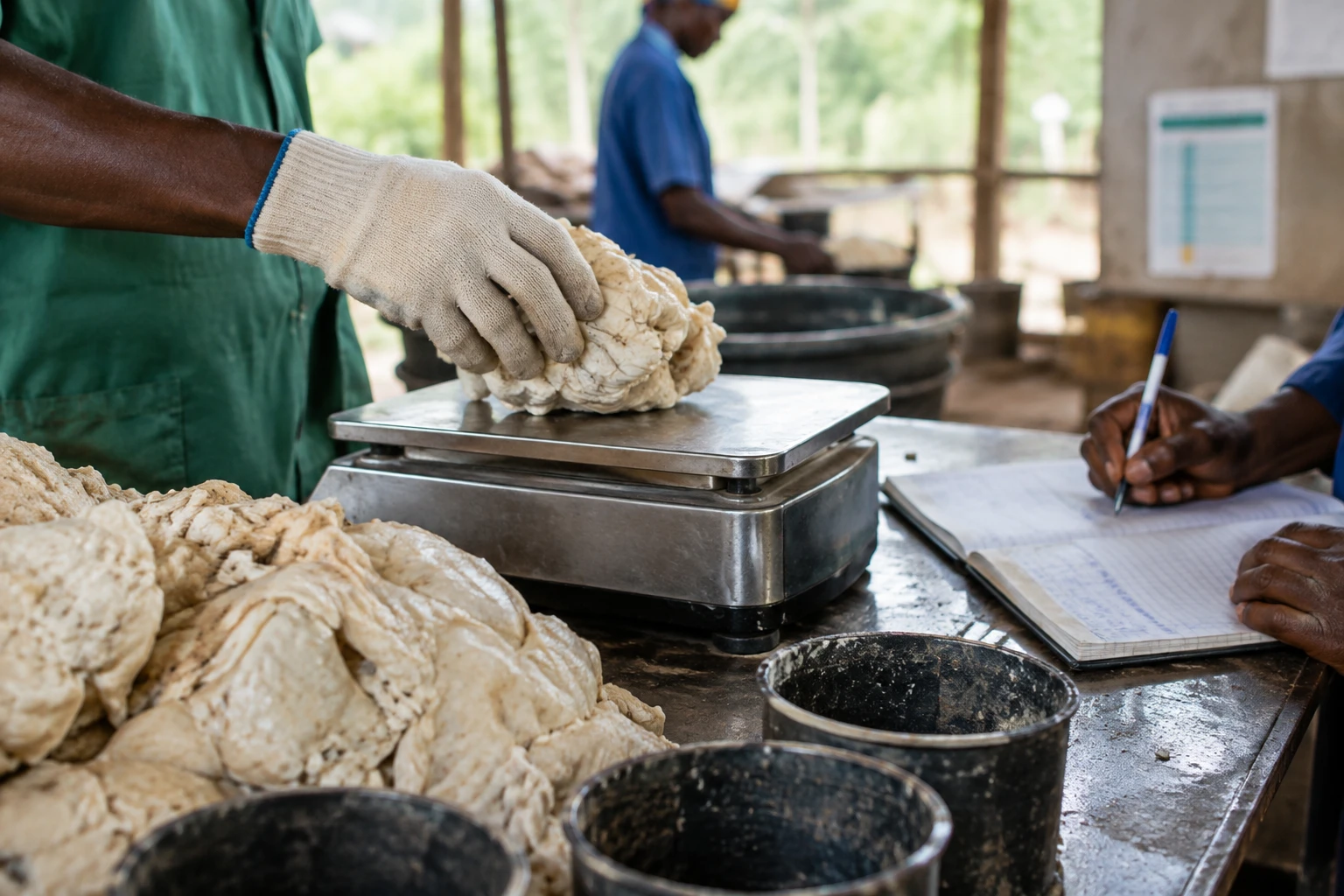
In Côte d’Ivoire’s plantations, rising volumes alone do not resolve the central question: how much of the value of rubber will stay in the country, and what income will reach growers? The rubber sector is moving fast. It must now turn its commercial weight into industrial jobs and more secure incomes.
A sector that has become indispensable
On 6 November 2026, in Abidjan, the government put this transformation at the heart of celebrations marking the 50th anniversary of the Association of Natural Rubber Professionals of Côte d’Ivoire (APROMAC). Agriculture Minister Bruno Nabagné Koné set out several priorities: developing local processing, increasing producers’ earnings, renewing plantations and improving the sustainability of production. The announcement comes as Côte d’Ivoire says it exported nearly two million tonnes of natural rubber in 2025, worth around 1,900 billion CFA francs.
The growth has been considerable. Production stood at about 164,000 tonnes in 2005. Industry data available for 2025 give a more precise figure of 1.93 million tonnes, rather than two million. The country has been Africa’s leading producer since 1990 and supplies more than 80% of the continent’s rubber, according to the 2025 annual report of SAPH, a major player in the sector. Estimates differ on its global ranking: Ivorian statements place it second, while the report ranks it third. It is therefore more prudent to describe it as one of the world’s leading producers.
By volume, natural rubber is now described as Côte d’Ivoire’s leading agricultural export, ahead of cocoa. That does not mean it surpasses cocoa in value: the figures announced place it second in terms of revenue. This distinction matters in an economy where cocoa remains a historic pillar of exports and rural incomes.
Producing more, capturing more value
The sector’s rise is underpinned by the expansion of plantations, the organisation of the industry and agronomic advances. It also relies on an extensive network of smallholder growers. The Ivorian Press Agency reports that more than 1.5 million people depend on this activity. The revenue figures announced for 2025 include more than 700 billion CFA francs attributed to small-scale producers. This figure gives an indication of the social stakes, but does not on its own show how income is distributed among growers, buyers, factories and exporters.
The next challenge is industrial. Some rubber is processed into semi-finished materials, but the manufacture of higher-value products — tyres, gloves, seals and technical components — remains largely based abroad. Côte d’Ivoire’s economic portal says the rapid increase in production has outstripped available processing capacity: the processing rate, previously close to 100%, has fallen to about 80%. The country has already adopted tax measures to encourage investment. The government now wants to attract more second- and third-stage processing activities.
This ambition is about more than building factories. It requires reliable supplies, equipment, technical skills and commercial outlets. If these conditions are met, industrial jobs could supplement income from latex sales. But processing alone does not guarantee better pay for growers: prices, production costs and marketing rules will also shape how value is shared.
An interprofessional agreement signed on 16 February 2026 introduced a new mechanism for setting the price of wet rubber, according to the authorities. The ministry is also calling for the productivity of trees and the quality of the product to be maintained. Tapping rubber trees that are too young or allowing the quality of delivered latex to deteriorate can undermine yields and the sector’s commercial reputation. In rural producing areas, these issues play out every day, when growers sell their harvest.
Traceability and regional markets
Access to markets will also depend on the ability to establish the origin of products. The European Union’s regulation on deforestation concerns rubber, among other products, and imposes due diligence obligations on operators placing these products on the EU market. After several postponements, the rules will apply from 30 December 2026 to medium-sized and large operators, and from 30 June 2027 to micro and small businesses. Producers and their organisations will, in particular, need to be able to geolocate plots and document their compliance.
For smallholder growers, this requirement may entail administrative and technical costs. Practical support at local level will therefore be crucial, as will the securing of land information. Traceability matters not only in Europe: it is becoming a competitiveness criterion in markets where buyers are demanding stronger guarantees about origin and production conditions.
Across West Africa, Côte d’Ivoire’s growth could strengthen the regional supply of rubber and attract investment in transport, storage and processing. The proximity of the ports of Abidjan and San Pedro is an asset for exports. But the region will fully benefit from this momentum only if links between producers, industrial facilities and neighbouring markets are strengthened, rather than limiting the sector to shipping raw materials.
The next stage will therefore be measured less by export volumes alone than by tangible results: installed industrial capacity, the share processed locally, income actually received by growers and the reach of traceability. For Côte d’Ivoire, whose political capital is Yamoussoukro, the challenge is to make an agricultural success a lasting driver of industrialisation, without leaving rural producers out of the value created.