Algeria
 Egypt
 Libya
 Morocco
 Sudan
 Tunisia
 Benin
 Burkina Faso
 Cabo Verde
 Côte d'Ivoire
 Ghana
 Guinea
 Guinea-Bissau
 Liberia
 Mali
 Mauritania
 Niger
 Senegal
 Sierra Leone
 The Gambia
 Togo
 Cameroon
 Central African Republic
 Chad
 DR Congo
 Equatorial Guinea
 Gabon
 Republic of the Congo
 São Tomé and Príncipe
 Burundi
 Comoros
 Djibouti
 Eritrea
 Ethiopia
 Kenya
 Madagascar
 Malawi
 Mauritius
 Mozambique
 Rwanda
 Seychelles
 Somalia
 South Sudan
 Tanzania
 Uganda
 Angola
 Botswana
 Eswatini
 Lesotho
 Namibia
 South Africa
 Zambia
 Zimbabwe
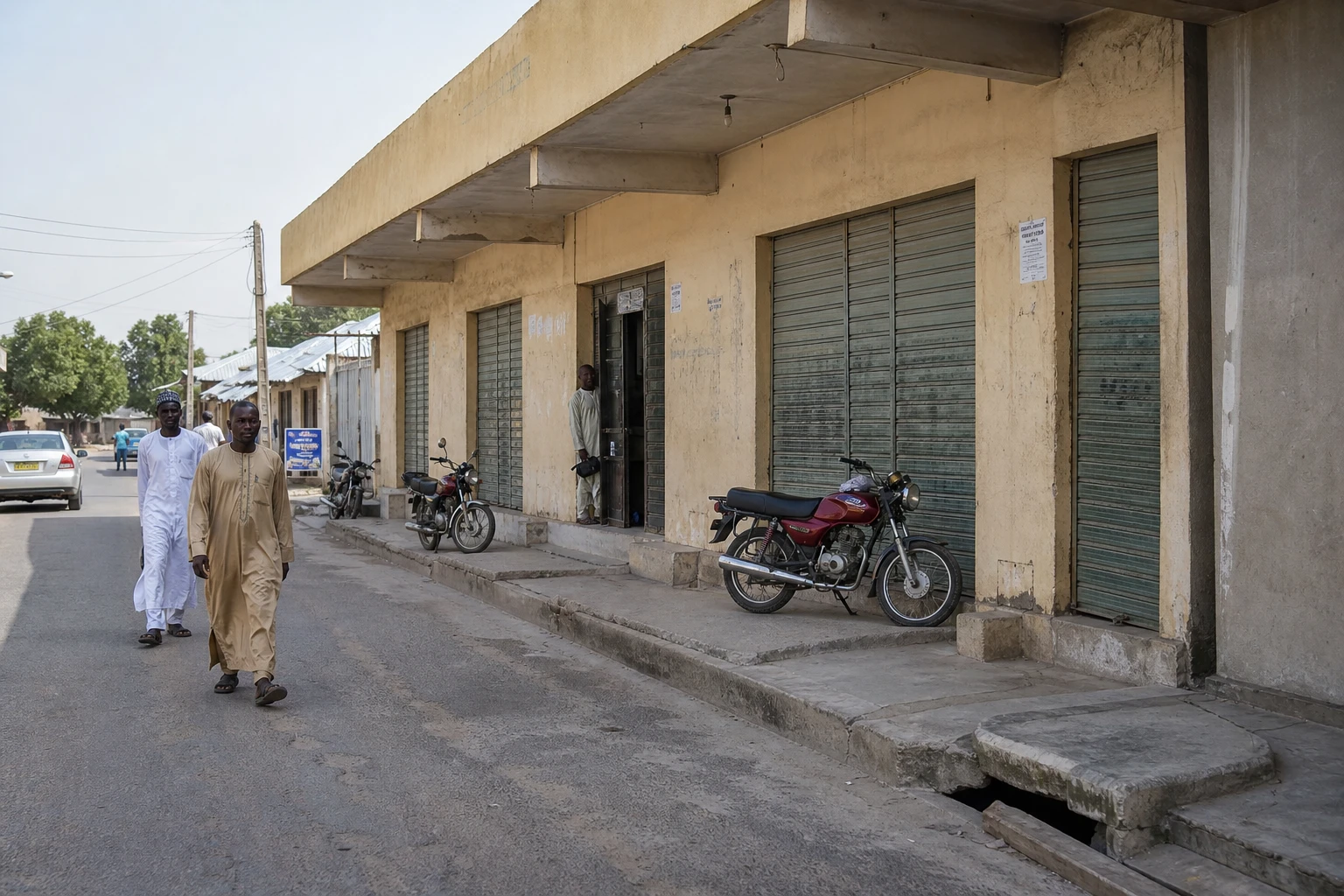
Geidam, a city under pressure since dawn
In north-east Nigeria, life can change in a matter of hours. In Geidam, in Yobe State, residents found themselves trapped at home after an attack attributed to ISWAP fighters, the West African branch of the Islamic State organisation, followed by a total curfew imposed by the army. The city, about 180 kilometres from Damaturu, the state capital, is now living in fear, amid checkpoints and a suspended economy.
This kind of sequence is not new in the area known as the BAY states, for Borno, Adamawa and Yobe. Since 2009, the insurgency first led by Boko Haram and later partly taken up by ISWAP has displaced millions of people and disrupted markets, schools and roads across Nigeria’s north-east. The military authorities continue to conduct Operation Hadin Kai, the counter-insurgency operation deployed in this part of the country.
What is known about the attack and siege
According to residents and military sources cited on Friday, ISWAP fighters attacked a military base on the outskirts of Geidam on Tuesday night into Wednesday. The exchange of fire reportedly lasted until dawn. After the attack, soldiers ordered a round-the-clock curfew, saying assailants remained around the city and further attacks were possible. Military personnel said access routes had been sealed and patrols were limited to inside the town.
A resident, Abubakar Musa, said residents had been ordered to stay indoors since Wednesday. Another resident, Usman Kabir, described shortages, with little food and almost no basic necessities. These accounts show the immediate impact of a total curfew in a city where many people live from day to day, relying on small-scale trade, local transport and informal work.
The tension involves more than the military and the attackers. The deputy head of the local district, Kaka Bukar Zanna, said he had been injured in the head during an incident involving soldiers after going out to assess the situation. The episode, reported by Nigerian media, illustrates the fragility of local command during an alert, when the lines between security control, civilian movement and administrative coordination become very blurred.
Why Geidam remains a repeated target
Geidam is not an isolated point on the map. The city has been attacked several times by ISWAP and Boko Haram. In 2021, fighters took control of it for several days before being pushed back, after looting and setting shops on fire. In November 2023, deadly attacks in Geidam district again highlighted the persistence of insecurity in this border area, which is semi-desert and close to the Lake Chad basin.
The regional context matters as much as the local scene. North-east Nigeria shares security dynamics with Niger, Chad and Cameroon through movement around Lake Chad. This is also why regional military cooperation remains a major issue, involving the Multinational Joint Task Force and coordinated efforts to combat armed groups. In Abuja, federal officials regularly describe security in the north-east as a national priority, while affected states call for a greater military presence as well as lasting civilian solutions.
The security response does not solve everything. In rural communities, residents often face both the threat from armed groups and restrictions imposed by security forces. Travel becomes difficult. Markets empty. Pupils miss school. Farmers give up on some fields. In a state such as Yobe, where security directly shapes trade with Damaturu and neighbouring localities, a prolonged curfew can quickly become a local economic shock.
A test for Abuja, Yobe and regional security
For Nigeria’s federal government, the Geidam case is a reminder that a temporary military advance is not enough to stabilise the north-east. The authorities may repel an assault, but they must also secure secondary cities in the long term, protect supply routes and prevent armed groups from returning to encircle towns. This is where the credibility of the state is at stake, not only in Abuja but also in state capitals such as Damaturu and in outlying local government areas where the administration remains under severe pressure.
The crisis also has continental significance. It is a reminder that in West Africa, jihadist groups exploit borderlands, weak state presence and fragile local economies. It also shows that the response cannot be purely military. Reconstruction, local justice, the movement of goods and civilian protection remain crucial issues. In the coming weeks, the key things to watch will be whether the curfew is eased, whether safe access to the city is restored, and whether the federal and Yobe authorities can regain the initiative beyond the logic of siege alone.