Algeria
 Egypt
 Libya
 Morocco
 Sudan
 Tunisia
 Benin
 Burkina Faso
 Cabo Verde
 Côte d'Ivoire
 Ghana
 Guinea
 Guinea-Bissau
 Liberia
 Mali
 Mauritania
 Niger
 Nigeria
 Senegal
 Sierra Leone
 The Gambia
 Togo
 Cameroon
 Central African Republic
 Chad
 DR Congo
 Equatorial Guinea
 Gabon
 Republic of the Congo
 São Tomé and Príncipe
 Burundi
 Comoros
 Djibouti
 Eritrea
 Kenya
 Madagascar
 Malawi
 Mauritius
 Mozambique
 Rwanda
 Seychelles
 Somalia
 South Sudan
 Tanzania
 Uganda
 Angola
 Botswana
 Eswatini
 Lesotho
 Namibia
 South Africa
 Zambia
 Zimbabwe
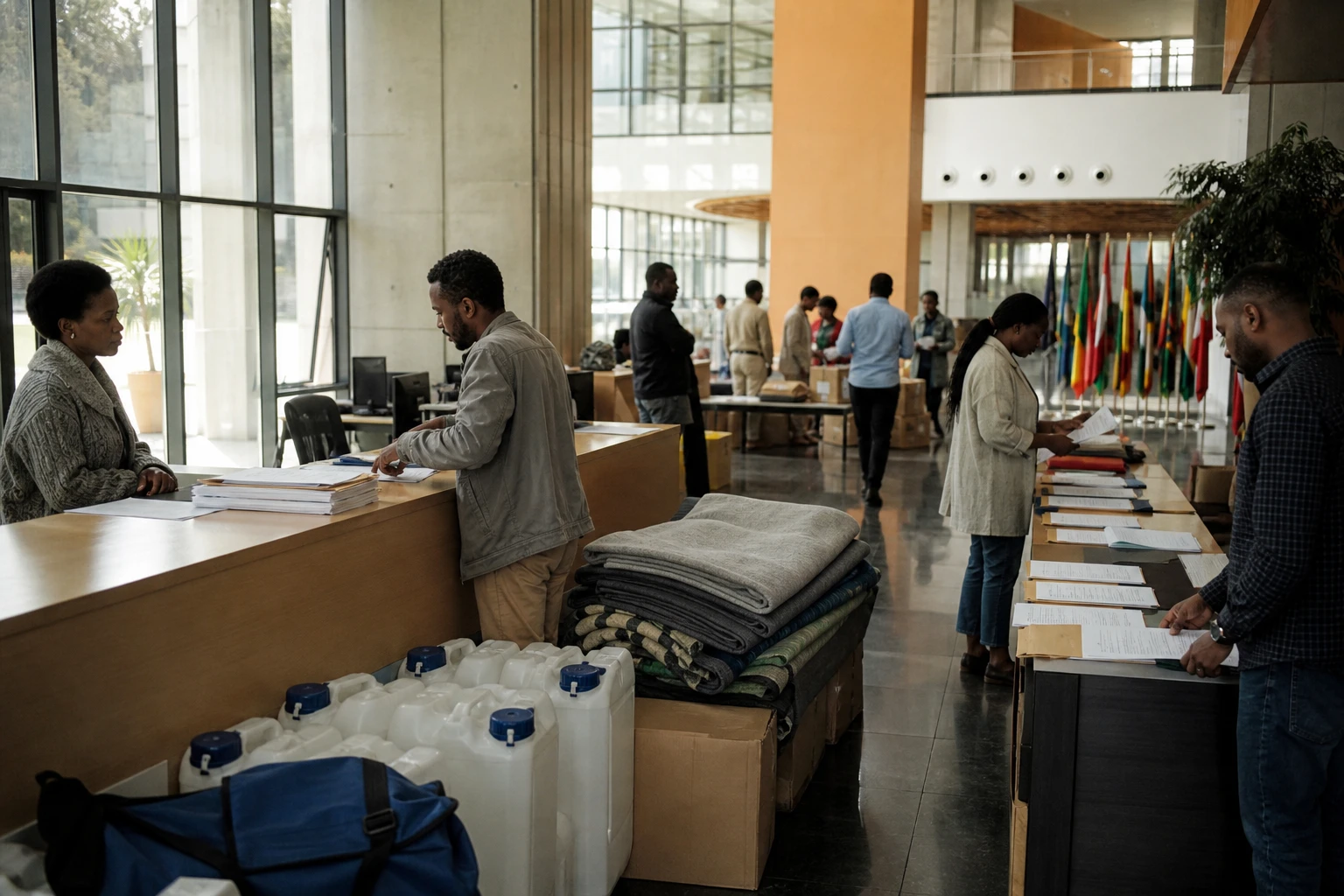
In Ethiopia, humanitarian aid is arriving just as access corridors are narrowing. In the north of the country, renewed tensions around Tigray are already complicating movement, trade and the delivery of relief. For displaced families, refugees and host communities, the issue goes beyond the announced sum: it concerns whether people in need can be reached at all.
New EU funding amid rising tensions
On 28 September 2026, the European Union announced an additional €18 million to meet humanitarian needs in Ethiopia. This contribution brings planned EU humanitarian aid for the country in 2026 to €61 million, or about $69 million.
The European Commission says the funds will target people affected by conflict, forced displacement, epidemics and climate shocks. The regions of Amhara, Benishangul-Gumuz, Oromia and Tigray are among those targeted.
The funding is intended to support food and nutrition assistance, healthcare, access to water and sanitation, and the provision of shelter and essential goods. It is also intended to strengthen protection services and organisations’ ability to respond rapidly after a crisis.
Particular attention will be paid to people recently displaced, refugees and the Ethiopian communities hosting them. This focus matters in a country that also hosts more than one million refugees from several neighbouring states.
The European Commission’s announcement of aid for Ethiopia is part of a broader package to support displaced people and populations affected by crises in several regions of the world. The overall package must still go through EU budgetary procedures.
Tigray at the heart of worsening insecurity
The decision comes as tensions have flared again in northern Ethiopia. On 23 September, the African Union reported that airports in Mekelle, Aksum and Shire had been occupied by forces linked to the Tigray People’s Liberation Front, or TPLF, the region’s main political and military movement.
The takeover of these facilities led Ethiopian Airlines to suspend flights to the three cities. Mekelle is the capital of Tigray. Aksum and Shire are also important for civilian travel and the organisation of aid.
The parties continue to give conflicting accounts. Tigray authorities say they acted defensively following federal operations. The Ethiopian government, in turn, accuses Tigrayan forces of contributing to the escalation. Drone strikes attributed to federal forces have also been reported in the north of the country.
This information should be treated with caution, as independent access to the affected areas remains limited. However, several details have been confirmed by separate sources, including the suspension of air links and the African Union’s warning about the military escalation.
The African Union’s call for restraint and de-escalation warns that the crisis could undermine the gains made under the Pretoria Agreement. Signed in November 2022, the agreement ended two years of war between federal forces and the TPLF.
A humanitarian crisis extending beyond armed conflict
The renewed fighting adds to a situation already weakened by droughts, floods, epidemics and prolonged displacement. Needs are therefore not concentrated solely in areas directly affected by combat.
According to UNICEF’s 2026 humanitarian appeal, 8.9 million people in Ethiopia will need assistance during the year. Among them are 6.3 million children. The organisation estimates that $401.5 million is needed to meet the most urgent needs.
These figures cover several sectors. Nutrition, health, education, child protection, water and sanitation remain essential. In rural areas, distances from healthcare centres and deteriorating roads can delay aid. In cities, rapid population movements put pressure on housing, markets and public services.
The consequences also vary between the groups affected. Displaced households have often lost their land, possessions and incomes. Host families must share resources that are already limited. Traders and informal-economy workers, meanwhile, are affected by road closures, supply disruptions and rising prices.
UNICEF’s data on humanitarian needs in Ethiopia in 2026 show that emergency aid cannot be separated from the challenges of recovery. Without functioning public services and regular access to markets, one-off distributions risk being insufficient.
A test for stability in the Horn of Africa
The crisis in Ethiopia has a regional dimension. Tigray shares a border with Eritrea, while tensions in the Amhara and Afar regions could affect routes linking the north of the country with the rest of Ethiopia. Any prolonged deterioration could therefore disrupt trade and movement in the Horn of Africa.
Ethiopia also plays a central role in the Intergovernmental Authority on Development, IGAD, a regional organisation working on peace, security and cooperation in the Horn of Africa. Addis Ababa is also home to the African Union headquarters. Another war in the north would weaken the country’s ability to influence crises in neighbouring areas.
The main concern now is protecting civilians and maintaining humanitarian access. The suspension of flights to Mekelle, Aksum and Shire reduces logistical options. Organisations will have to rely more heavily on roads, while the security of convoys remains uncertain.
The European response provides additional resources, but it does not solve the problem of access. For humanitarian agencies, the effectiveness of the €18 million will depend on whether they can operate in the areas concerned, obtain security guarantees and maintain dialogue with all parties.
The next steps will therefore be as much diplomatic as humanitarian. Verifiable de-escalation, the resumption of civilian air links and the protection of essential infrastructure will determine Ethiopia’s ability to prevent the crisis from worsening. The region, the African Union and international partners will also monitor implementation of the Pretoria Agreement, whose survival remains a key indicator of national stability.