Algeria
 Egypt
 Libya
 Morocco
 Sudan
 Tunisia
 Benin
 Burkina Faso
 Cabo Verde
 Côte d'Ivoire
 Ghana
 Guinea
 Guinea-Bissau
 Liberia
 Mali
 Mauritania
 Niger
 Nigeria
 Senegal
 Sierra Leone
 The Gambia
 Togo
 Cameroon
 Central African Republic
 Chad
 DR Congo
 Equatorial Guinea
 Gabon
 Republic of the Congo
 São Tomé and Príncipe
 Burundi
 Comoros
 Djibouti
 Eritrea
 Kenya
 Madagascar
 Malawi
 Mauritius
 Mozambique
 Rwanda
 Seychelles
 Somalia
 South Sudan
 Tanzania
 Uganda
 Angola
 Botswana
 Eswatini
 Lesotho
 Namibia
 South Africa
 Zambia
 Zimbabwe
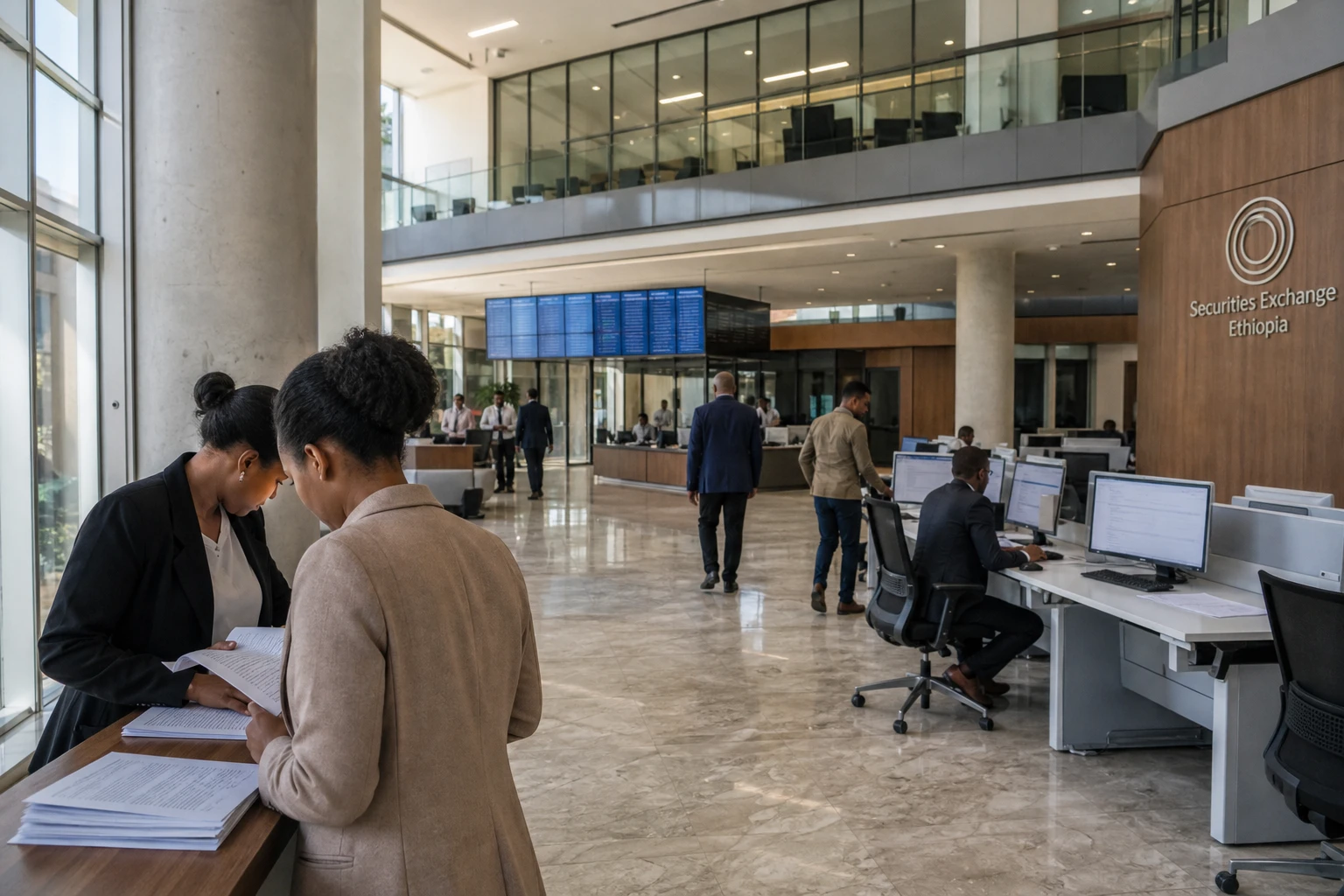
In Addis Ababa, Ethiopia’s young financial market is growing fast, but it still has to persuade investors to trade regularly. Sidama Bank’s arrival illustrates this dual trend: more companies are gaining access to the market, while trading remains concentrated in a limited number of shares.
A new bank joins a very young market
Sidama Bank began trading on the Ethiopian Securities Exchange, or ESX, on Monday 28 September 2026. The institution became the seventh company admitted to the Ethiopian exchange’s main market. Six of the seven listed companies are now banks.
The shares trade under the ticker SIDAX. The reference price set at launch is 1,300 Ethiopian birr per share. Trading was nevertheless very subdued on the first day: only nine shares changed hands, according to reports published by media outlets specialising in Ethiopia’s capital market.
The transaction covers 1,447,002 existing shares registered with the Ethiopian Capital Market Authority, the body responsible for supervising the capital market. It is therefore not a conventional fundraising exercise involving the mass issuance of new shares. The listing mainly makes shares already held by shareholders tradable.
Wegagen Capital Investment Bank advised on the transaction. The price of 1,300 birr represents a 30% premium to the share’s nominal value of 1,000 birr.
From rural microfinance to commercial banking
Sidama Bank’s history sets it apart from several other banks listed on the exchange. The company emerged in 2022 from the transformation of a microfinance institution based in the Sidama region of southern Ethiopia.
This background remains important to understanding its position. Microfinance institutions have long played a central role in serving households, small-scale producers and entrepreneurs far from traditional banking networks. Their conversion into commercial banks reflects a desire to widen access to credit, savings and payment services.
Sidama Bank closed the 2024–2025 financial year with total assets of close to 8 billion birr and reported revenue of 597.5 million birr. These figures give an indication of the institution’s size, but they are not enough to measure its stock-market value. That also depends on profitability, asset quality, the number of shares available and investors’ ability to trade them.
A dramatic acceleration in listings
The ESX began operations in January 2025. At the start of 2026, the exchange had only Wegagen Bank and Gadaa Bank. Since then, the pace of listings has accelerated sharply.
Awash Bank joined the market on 23 April 2026. Ethio Telecom, the former state telecommunications monopoly, was admitted on 26 May. Abay Bank followed on 25 June, then Bank of Abyssinia on 28 July. Sidama Bank completes this series in September.
This growth is gradually broadening the range of investments available to Ethiopian investors. It is also allowing companies to become familiar with the transparency, financial reporting and governance requirements associated with a listing.
The ESX aims to reach 50 listed companies by 2030. Its ambition therefore extends beyond the banking sector. The challenge will be to attract industrial, commercial, technology and service companies in order to reduce the current concentration in financial institutions.
The main challenge: turning listings into trading
The number of listed companies alone is not enough to create an active financial market. There also need to be enough buyers and sellers to enable regular transactions. This is precisely the ESX’s current weakness.
Sidama Bank’s debut demonstrated the point. A company can be officially listed without its shares being traded in significant volumes. In this context, a share price can move after only a few transactions. It does not necessarily reflect a solid market trend.
Liquidity — the ease of buying or selling a security without causing a sharp price movement — depends on several factors. These include the number of shareholders, the proportion genuinely available for trading, the presence of institutional investors and confidence in published information.
The first available figures show that activity remains irregular. In June 2026, however, the ESX announced that trading over one week had reached about 1 billion birr. This is an encouraging sign, but it should not be confused with sustainable daily liquidity. A financial market is built over time, through repeated and diversified transactions.
Reforms to attract companies and capital
Ethiopian authorities are seeking to accelerate this transformation as part of the economic reforms launched by Abiy Ahmed’s government in 2018. These reforms cover the foreign exchange market, telecommunications, banking and private investment.
In 2026, the Council of Ministers adopted a tax regime favourable to non-financial companies that go public. Eligible companies can benefit from a reduced corporate income tax rate of 25%, compared with the general rate of 30%, for three years from their admission.
The measure is intended to make listing more attractive. It will nevertheless need to be accompanied by a credible framework for investors. Regular publication of accounts, protection for minority shareholders and clarity over exit rules will be crucial.
Gradual opening to foreign investors is another workstream. It could bring capital and expertise. It also exposes the market to challenges related to foreign-exchange risk, the convertibility of the birr and the repatriation of income. Confidence will therefore depend as much on how announced rules are implemented as on the rules themselves.
A challenge for Ethiopia and East Africa
For Ethiopia, establishing an equity market addresses a structural need: diversifying corporate financing, which remains heavily dependent on bank lending and public resources. An active exchange could support the expansion of local businesses, finance infrastructure and offer households new savings opportunities.
The benefits will nevertheless be uneven. Large companies in Addis Ababa already have better access to legal advice, auditors and financial intermediaries. By contrast, companies based in the regions may find it harder to meet listing requirements. The market’s success will therefore also depend on its ability to include businesses from across the country.
At regional level, this development is of interest to IGAD, the Intergovernmental Authority on Development, which brings together several countries in the Horn of Africa and East Africa. The ESX will need to position itself alongside the established exchanges in Nairobi, Kampala and Dar es Salaam, while meeting the specific needs of the Ethiopian economy.
The next step will be less dramatic than announcing a new listing, but more decisive: expanding the investor base, increasing the number of shares genuinely available and fostering regular trading. The ESX’s challenge is no longer simply to list companies. It is now to bring the market to life.