Algeria
 Egypt
 Libya
 Morocco
 Sudan
 Tunisia
 Benin
 Burkina Faso
 Cabo Verde
 Côte d'Ivoire
 Ghana
 Guinea
 Guinea-Bissau
 Liberia
 Mali
 Mauritania
 Niger
 Nigeria
 Senegal
 Sierra Leone
 The Gambia
 Togo
 Cameroon
 Central African Republic
 Chad
 DR Congo
 Equatorial Guinea
 Gabon
 Republic of the Congo
 São Tomé and Príncipe
 Burundi
 Comoros
 Djibouti
 Eritrea
 Ethiopia
 Kenya
 Madagascar
 Malawi
 Mauritius
 Mozambique
 Rwanda
 Seychelles
 Somalia
 South Sudan
 Tanzania
 Uganda
 Angola
 Botswana
 Eswatini
 Lesotho
 South Africa
 Zambia
 Zimbabwe
Windhoek sees uranium as an industrial lever, not just a raw material
In Namibia, uranium is no longer just a line in export accounts. It also influences choices on industrialisation, employment and strategic positioning. In Windhoek, the issue therefore extends beyond mining: it touches on the country’s place in southern Africa and its ability to turn a mineral resource into sustainable revenue.
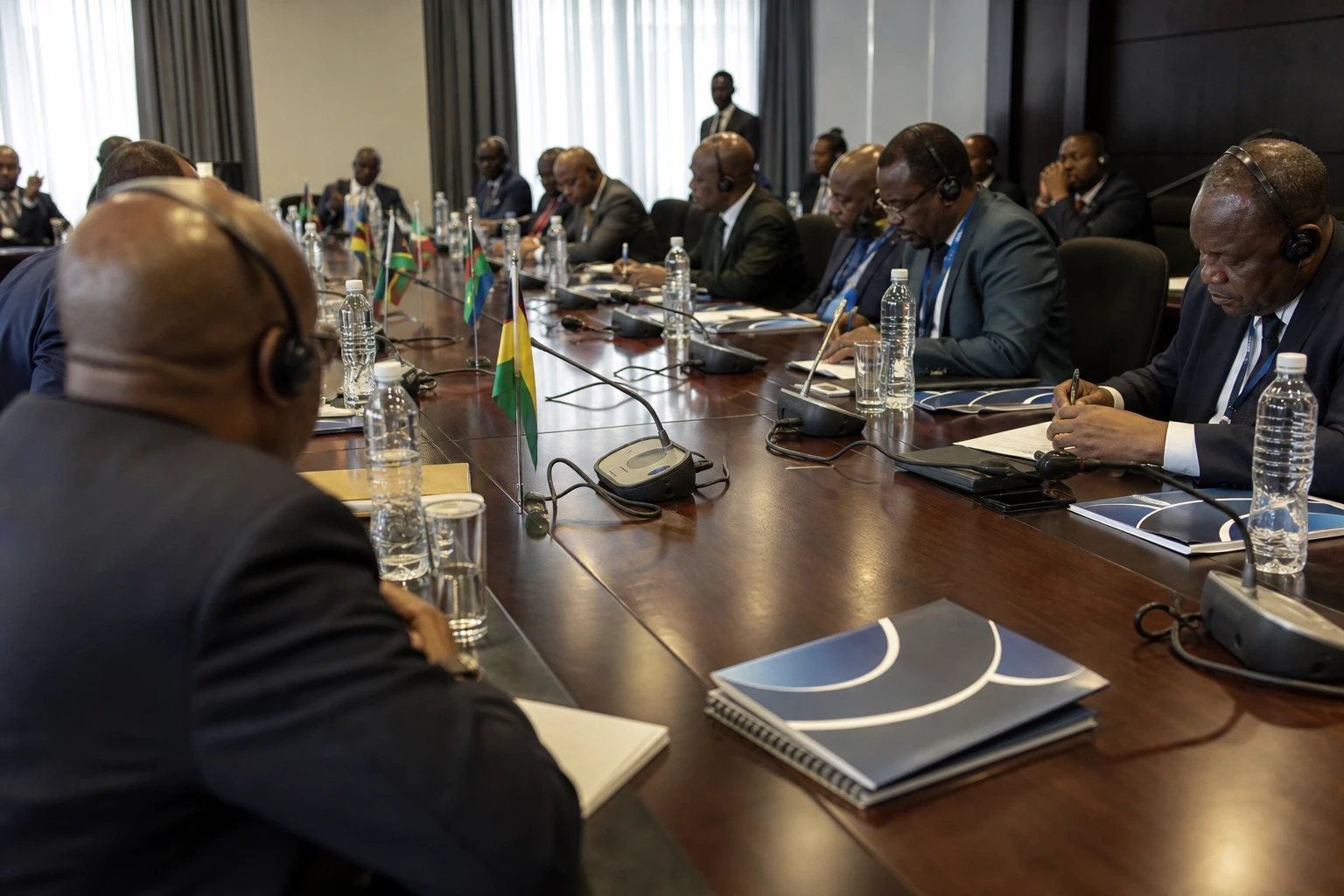
The regional context matters. Namibia belongs to SADC, the Southern African Development Community, where major mining and energy projects are scrutinised for their local benefits as much as for their export earnings. The country also remains one of the world’s uranium heavyweights, with a sector already structured around Rössing, Langer Heinrich and Husab.
Etango moves forward with a broader and more political financing structure than it may seem
Bannerman Energy has confirmed stronger financing for Etango, its uranium project in Namibia. The arrangement rests on an equity raising, a future share purchase plan reserved for shareholders, the group’s existing cash and the expected contribution of CNNC Overseas Limited, a subsidiary of Chinese nuclear giant CNNC. The company says this package will cover the construction phase through to completion.
In detail, the agreement signed in February 2026 provides for CNOL to take a 45% stake in the joint venture that will own the project, while Bannerman will retain 55% of the vehicle and 52.25% of Etango’s underlying economics. The Chinese partner is also to buy 60% of future production on market terms, with no floor or ceiling. The transaction remains subject to several conditions, including approval from the Namibian Competition Commission.
The timetable remains tight. Bannerman is targeting completion of the transaction in mid-2026, followed shortly afterwards by a final investment decision, or FID. In mining, the FID marks the real shift from study to construction. In June 2026, the company had already said preparatory work was progressing on schedule, with more than 560 people on site, 92% of earthworks completed and a permanent water agreement signed with NamWater.
The project is no minor undertaking. Bannerman says Etango is one of the world’s largest undeveloped uranium deposits and is expected to produce 3.5 million pounds of U3O8 a year for 15 years in its first phase. The company also cites total production of 52.6 million pounds over the deposit’s initial life.
What the project means for Namibia, and why China is a key player
For Namibia, the stakes are twofold. On the one hand, the country is consolidating its position among the world’s major uranium producers. On the other, it is seeking to capture more local value. In 2025, Rössing recorded its highest uranium oxide production in more than a decade, a sign that Namibia’s sector has regained momentum. The Namibian noted in June 2026 that the country now ranks among the world’s leading primary producers.
This expansion is taking place in a market that has become more favourable again. Uranium prices have risen after several difficult years, giving long-frozen projects fresh impetus. For companies, this improves margins and makes it easier to raise capital. For the Namibian state, it could mean more tax revenue, more subcontracting contracts and greater pressure to create skilled jobs locally, particularly around Windhoek, Swakopmund and the central-western mining corridor.
CNNC’s presence gives the deal a clear geoeconomic dimension. China remains one of the driving forces in global civil nuclear power, and CNNC says it has long-standing experience in Namibia’s sector. For Bamerman, this partner reduces financing risk. For Windhoek, it strengthens the place of a major mining project in an international value chain in which Asia carries significant weight. But this relative dependence on external buyers also underscores a simple reality: Namibia mainly exports a resource, not yet a processed product.
Governance therefore remains the sensitive point. The Namibian government and regulators will have to balance speed of execution, competition safeguards and national benefits. In such a capital-intensive sector, the quality of contracts matters as much as the volume extracted. The fact that the project is already fully permitted, with a mining licence and environmental approvals, shows that the regulatory groundwork is advanced. But the move to final financing will reveal whether the industrial ambition finally becomes a concrete construction project.
A signal to watch in southern Africa, beyond Namibia alone
Etango sends a message that extends beyond Namibia’s borders. Across the SADC region, several economies are seeking to negotiate better with mining groups to capture more value without deterring investment. The outcome will show whether a uranium project can still be financed with a foreign strategic partner while retaining a significant share of local control.
What happens next depends on three specific milestones: closing the agreement with CNOL, the final investment decision and the continuation of infrastructure work on site. If these steps are confirmed, Etango could join the short list of major African mining projects capable of entering production in a more favourable market cycle. For Namibia, the challenge is not simply to extract more uranium from the ground. It is to turn this resource into more stable economic strength for the benefit of the whole country.