Algeria
 Egypt
 Libya
 Morocco
 Sudan
 Tunisia
 Benin
 Burkina Faso
 Cabo Verde
 Côte d'Ivoire
 Ghana
 Guinea
 Guinea-Bissau
 Liberia
 Mali
 Mauritania
 Niger
 Nigeria
 Senegal
 Sierra Leone
 The Gambia
 Togo
 Cameroon
 Central African Republic
 Chad
 DR Congo
 Gabon
 Republic of the Congo
 São Tomé and Príncipe
 Burundi
 Comoros
 Djibouti
 Eritrea
 Ethiopia
 Kenya
 Madagascar
 Malawi
 Mauritius
 Mozambique
 Rwanda
 Seychelles
 Somalia
 South Sudan
 Tanzania
 Uganda
 Angola
 Botswana
 Eswatini
 Lesotho
 Namibia
 South Africa
 Zambia
 Zimbabwe
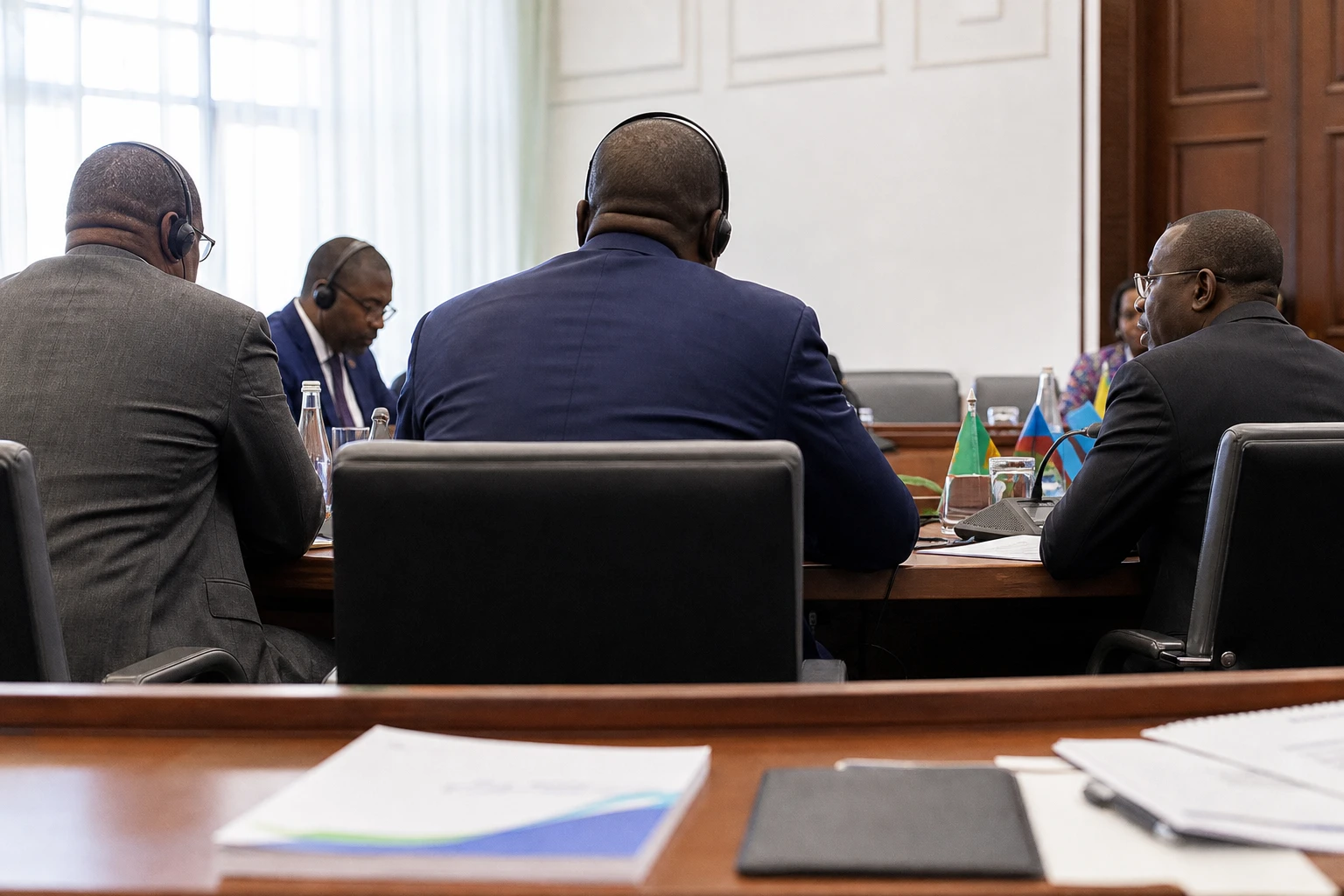
Malabo wants to move beyond oil
In Malabo, the question is no longer just how to find investors. It is also how to convince them that a country long defined by its oil revenues can offer a broader, more stable and more predictable framework. In Equatorial Guinea, this shift is crucial for businesses, but also for a population waiting for national wealth to finally flow into the real economy.
The context matters. Equatorial Guinea belongs to CEMAC, the Economic and Monetary Community of Central Africa, where budgetary room for manoeuvre is shrinking as hydrocarbons decline. The International Monetary Fund notes that hydrocarbon production continues to fall and governance reforms are moving too slowly. It also points out that the authorities have stopped publishing asset declarations by public officials, despite longstanding commitments.
Against this backdrop, Malabo is promoting a message of diversification. Gas, local processing of raw materials, agriculture, tourism and logistics. The idea is simple: no longer depend on a single sector, or solely on raw exports. This strategy also resonates across Central Africa, where several states are seeking to capture more value locally rather than let margins flow abroad.
An economic drive led by a high-profile figure
The campaign has gathered pace since Davos in January 2026, where the Equatorial Guinean delegation held a series of meetings with health and digital-sector players, while making the case for greater visibility in international business circles. Without adopting the official pageantry, the message was clear: Equatorial Guinea wants to be seen as a regional gateway, not just a crude oil producer.
The problem is that the main public face of this effort remains Teodoro Nguema Obiang Mangue, the vice-president and son of the head of state. His name weighs heavily in the equation. On 22 July 2021, London added him to its anti-corruption sanctions list, then clarified and strengthened the regime in 2025 with asset freezes, travel restrictions and a ban on serving as a company director. The British measures target the designated individual, but also complicate matters for banks, insurers and advisers subject to compliance obligations.
At the same time, the legal cases remain fresh in the memory in Europe and the United States. In France, the Court of Cassation brought a lengthy case linked to “ill-gotten gains” to a close in 2021. In the United States, a civil settlement reached in 2014 led Teodoro Nguema Obiang Mangue to forfeit more than $30 million in assets, including a villa in Malibu, a Ferrari and items linked to Michael Jackson. The US Department of Justice said at the time that the assets had been bought with the proceeds of corruption.
The Avenue Foch case remains a political symbol
The most sensitive case remains that of the building at 42 Avenue Foch in Paris. Equatorial Guinea wanted to use it as its embassy and brought a case before the International Court of Justice to challenge the French proceedings. The Court has already ruled on several aspects of the dispute, and the request for provisional measures was rejected in 2022 in the case concerning the property’s resale. The dispute has not gone away, however: it continues to embody the tension between claims of sovereignty and anti-corruption prosecutions abroad.
For Malabo, the stakes are as much diplomatic as economic. On paper, the British sanctions do not target the Equatorial Guinean state. In practice, they add reputational risk to any business relationship involving figures in the regime. Investors therefore assess more than geological or port potential: they look at legal certainty, tax predictability, dispute resolution, profit repatriation and the reliability of contracts.
This caution is all the stronger because social indicators remain under strain. The World Bank estimates that 50.7% of the population lived below the national poverty line in 2022, and 58.1% below the $8.30-a-day threshold. The contrast is stark in a country often presented as rich in hydrocarbons. Above all, it shows that the issue is not just producing more, but redistributing better, investing better and governing better.
What markets are watching, and what Central Africa is looking at
Malabo’s message to investors is therefore twofold. On the one hand, the country is seeking capital to finance diversification. On the other, it must contend with a legal legacy that continues to weigh on the credibility of some of its interlocutors. International groups, for their part, look beyond growth potential. They also assess the cost of risk, the strength of public-private partnerships and the state’s ability to honour its commitments.
Across the sub-region, the issue extends well beyond Equatorial Guinea. CEMAC still depends heavily on commodity exports, and weak governance reforms undermine the bloc’s collective credibility. If Malabo manages to build a genuine industrial and logistics shift, the knock-on effect could be significant. If it fails, the country will remain trapped in a familiar Central African paradox: substantial export revenues, but too little local processing and too few visible benefits for households.
The next milestone is the budget. Equatorial Guinea’s Ministry of Finance has already begun preparing the draft 2027 finance law, as official projections point to a continued decline in oil. This is where the reality of diversification will be measured: in budget choices, investment priorities and the actual place given to non-oil sectors.