
 Algeria
 Egypt
 Libya
 Morocco
 Sudan
 Tunisia
 Benin
 Burkina Faso
 Cabo Verde
 Côte d'Ivoire
 Ghana
 Guinea
 Guinea-Bissau
 Liberia
 Mali
 Mauritania
 Niger
 Nigeria
 Senegal
 Sierra Leone
 The Gambia
 Togo
 Central African Republic
 Chad
 DR Congo
 Equatorial Guinea
 Gabon
 Republic of the Congo
 São Tomé and Príncipe
 Burundi
 Comoros
 Djibouti
 Eritrea
 Ethiopia
 Kenya
 Madagascar
 Malawi
 Mauritius
 Mozambique
 Rwanda
 Seychelles
 Somalia
 South Sudan
 Tanzania
 Uganda
 Angola
 Botswana
 Eswatini
 Lesotho
 Namibia
 South Africa
 Zambia
 Zimbabwe
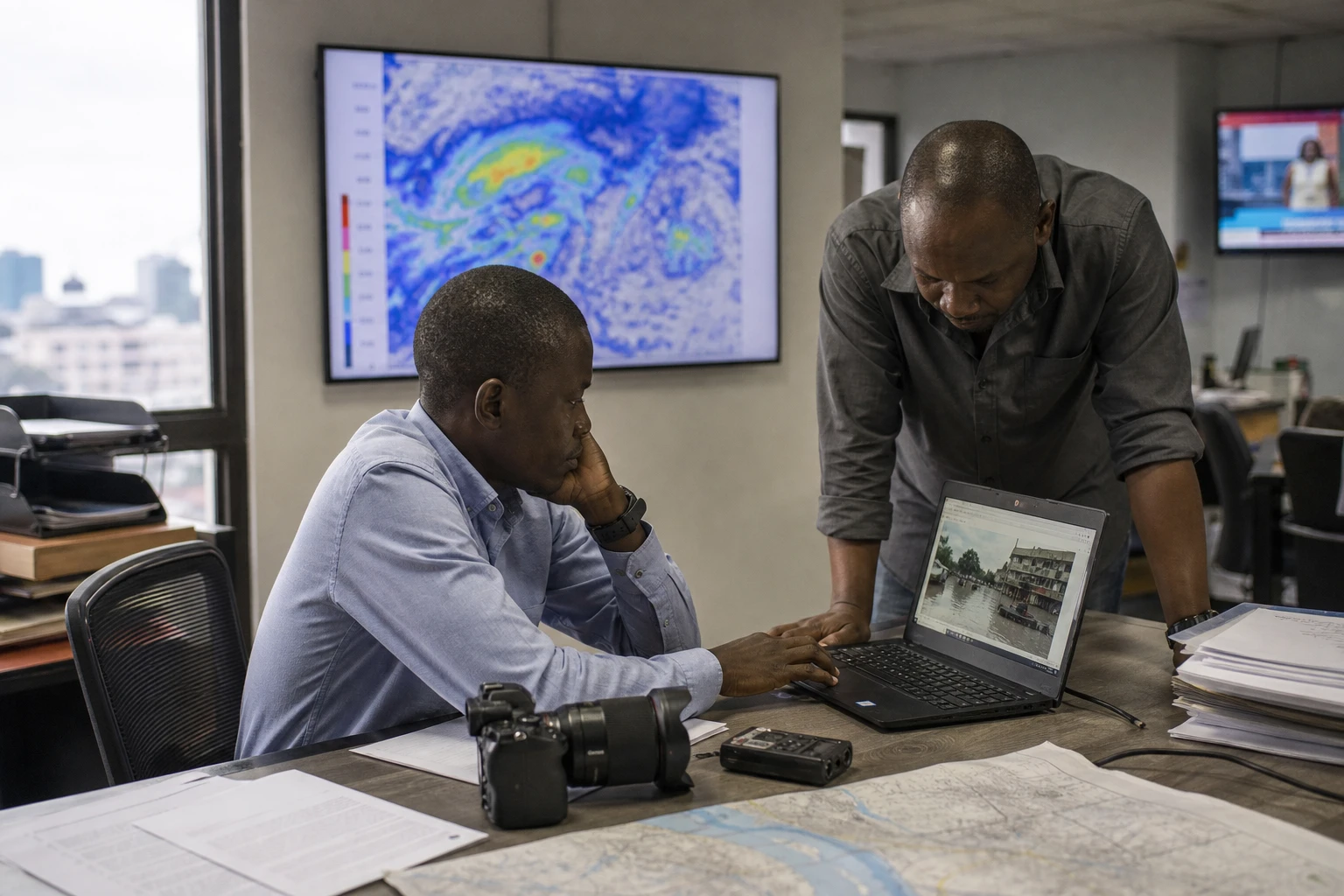
In Douala, the rain no longer stops at the doorstep
In Cameroon’s economic capital, a downpour is now enough to slow the entire city. Closed roads, blocked businesses, homes flooded with water: in Douala, the rainy season is no longer just a matter of comfort, but of everyday safety. Recent episodes have once again highlighted the city’s vulnerability: built on an estuary at low altitude, it has drains that often struggle to cope with very large volumes of water.
Douala’s case goes beyond a simple urban news story. For several years, Cameroon’s authorities, meteorological services and international lenders have described the Littoral metropolis as a flood-risk hotspot. Cameroon’s national meteorological office publishes ten-day monitoring and warning bulletins, while World Bank analyses highlight the city’s growing exposure to extreme rainfall, rapid urbanisation and obstructed drains.
A night of heavy rain, a morning of devastation
Heavy rain caused flooding in several neighbourhoods of Douala on the night of Thursday 10 to Friday 11 September 2026. Information gathered at the scene indicates that a pregnant woman died, apparently electrocuted, and was found at her home on Friday morning before the fire brigade arrived. This death toll should remain attributed to initial accounts until it is confirmed in a separate official statement.
The fifth arrondissement was among the worst-hit areas. Water rose very quickly in homes, leaving residents only a few minutes to move their belongings, protect children or seek shelter on higher ground. Elsewhere in the city, roads and bridges were submerged, forcing motorists to turn back and pedestrians to wait for long hours before continuing their journeys.
This paralysis is nothing unusual. For at least a decade, Douala has experienced recurring urban floods, often made worse by brief but intense rainfall, neighbourhoods built in low-lying areas and inadequate drainage. A World Bank document even notes that the share of built-up areas exposed to flood risk rose sharply between 1975 and 2014.
Why Douala remains so vulnerable
Geography explains part of the problem. Douala lies on the Wouri delta, in an area where waterways, tides and urban runoff converge. But geography does not explain everything. Rapid urbanisation, building over natural drainage areas and irregular maintenance of drainage infrastructure worsen the effects of every downpour. The city also accounts for a large share of the country’s economic activity, making every flood immediately costly for households, markets, transport and small businesses.
The problem is also structural. The Douala City Council has launched drainage works and prevention operations during the rainy season, while programmes funded by external partners aim to strengthen infrastructure resilience. But public announcements have yet to make up for decades of urban growth outpacing the provision of infrastructure. In June 2026, the DCC also assessed targeted sanitation infrastructure in several drains in Douala III, underscoring that efforts to manage rainwater remain fragmented and ongoing.
The contrast is stark between the business centre, residential neighbourhoods and poorer areas. In districts where informal activity dominates, a flood often means lost goods, interrupted income and families temporarily forced to leave their homes. On formal roads, it means traffic jams, logistical delays and higher transport costs. In other words, the same rain does not cause the same damage depending on where people live and work.
Beyond the day’s flooding, a test of urban governance
Douala’s floods are not just a local issue. They raise questions about how Cameroon plans its cities, protects its networks and prepares for climate events that have become more frequent and intense. National meteorological services published monitoring and warning bulletins in early September 2026, confirming that vigilance remained necessary across the country as atmospheric disturbances multiplied.
The issue also has regional significance. Douala is a hub for the Economic and Monetary Community of Central Africa, CEMAC, and a major gateway on the Douala-Bangui corridor. When the city is brought to a standstill, trade with the Central African Republic and parts of Central Africa slows. In June 2026, the World Bank confirmed a programme to modernise the Douala-Bangui corridor, aiming to improve traffic flows, transport costs and logistical efficiency across the region.
In Central Africa, as elsewhere on the continent, coastal cities and economic capitals face the same equation: rapid urban growth, sealed surfaces, inadequate drainage networks and extreme rainfall that is harder to absorb. Douala offers a vivid example. The next step will not take place only in flooded neighbourhoods, but will depend on the ability of Cameroonian and regional institutions to make prevention a continuous urban policy, rather than an improvised response after every storm.



