Algeria
 Egypt
 Libya
 Morocco
 Sudan
 Tunisia
 Benin
 Burkina Faso
 Cabo Verde
 Côte d'Ivoire
 Ghana
 Guinea
 Guinea-Bissau
 Liberia
 Mali
 Mauritania
 Niger
 Nigeria
 Senegal
 Sierra Leone
 The Gambia
 Togo
 Cameroon
 Central African Republic
 Chad
 DR Congo
 Equatorial Guinea
 Gabon
 Republic of the Congo
 São Tomé and Príncipe
 Burundi
 Comoros
 Eritrea
 Ethiopia
 Kenya
 Madagascar
 Malawi
 Mauritius
 Mozambique
 Rwanda
 Seychelles
 Somalia
 South Sudan
 Tanzania
 Uganda
 Angola
 Botswana
 Eswatini
 Lesotho
 Namibia
 South Africa
 Zambia
 Zimbabwe
In Obock, a maritime border becomes a humanitarian landing point
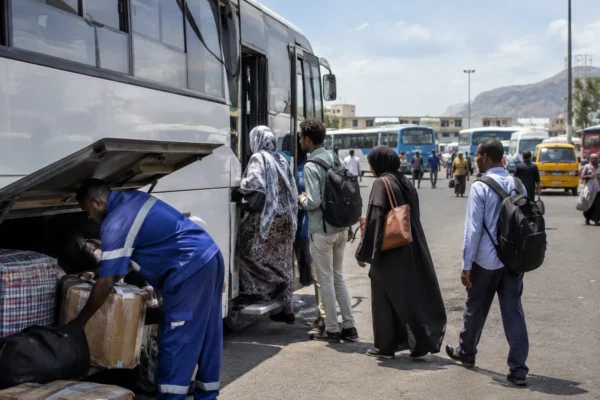
In Djibouti, the Bab el-Mandeb Strait is not only a strategic corridor between the Red Sea and the Gulf of Aden. For years, it has also been a passage for lives shattered by conflicts on the opposite shore. In just a few days, this reality has intensified further: thousands of people have landed on the Djiboutian coast from Yemen, with immediate needs for water, shelter, healthcare and registration.
The shock is not only humanitarian. It is also territorial. Arrivals are concentrated in the Obock region, in the north of the country, before people are transferred to the Markazi site, near Obock, which was established to host Yemeni refugees in 2015. In a small country with limited logistical capacity, every new influx immediately puts pressure on accommodation, sanitation and access to basic services.
Yemen slides deeper into crisis as Djibouti absorbs the pressure
The regional context is clear. Hostilities on Yemen’s west coast have intensified, prompting more families to leave the country by sea. UN agencies have reported more than 100,000 internally displaced people in Yemen and an increase in crossings to Djibouti. Meanwhile, the Red Sea remains an area of tension, where maritime security, local conflicts and humanitarian shocks feed into one another.
Djibouti is not a peripheral actor in this theatre. The country already hosts refugee populations fleeing several crises in the Horn of Africa, while also providing port and military infrastructure that strengthen its position in the Red Sea littoral’s balance of power. This geographical position gives the country a role as a transit point, but also leaves it particularly exposed to the domino effects of neighbouring crises.
To understand the scale of the phenomenon, it is necessary to look at events over the past few days. UNICEF said on 13 September that about 1,400 people, including many women and children, had arrived on the Djiboutian coast in 24 hours. Two days earlier, the authorities and humanitarian partners had already reported much smaller arrivals, showing how quickly the numbers were rising. UNHCR subsequently confirmed that about 2,935 people had reached Djibouti in eight days, up to 17 September.
What the figures reveal: a reception system under strain
UNHCR estimates that its operation in Djibouti is only 15% funded. The agency is seeking about $5.1 million to meet the most urgent needs of new arrivals. This funding shortfall is not a technical detail. It determines the capacity to register people, identify the most vulnerable, provide temporary shelter and maintain minimum services in places such as Markazi.
The Djiboutian government has also responded. On 20 September, the Prime Minister’s Office brought together the relevant departments to review the reception of Yemeni refugees in the Obock region. The official statement cited the need to strengthen accommodation and sanitation capacity, and provide tents, essential kits, clothing and electricity at the site. It also highlighted co-ordination with several partners, including UNHCR, the ICRC, IOM and WHO.
This response demonstrates a key point: in Djibouti, the emergency is managed at the intersection of the state, UN agencies and humanitarian actors. The country is not merely an entry point. It organises reception, assesses vulnerabilities, directs people to Markazi and seeks to preserve a minimum level of public capacity in an already stretched area.
Markazi, a barometer of regional balance
The Markazi site has become a discreet but central point in managing displacement linked to Yemen. It is a reminder that in East Africa, the effects of a war do not stop at national borders. They cross straits, ports and coastal villages, then translate into very concrete needs: water, healthcare, child protection, support for women on their own, and documentation for new arrivals.
For the Djiboutian authorities, the challenge is twofold. On the one hand, they must provide a dignified reception, in line with the country’s international commitments. On the other, they must prevent pressure on Obock from overwhelming local services, which are already limited. For residents of the areas where people are arriving, the question is immediate: how can water, healthcare and infrastructure be shared without placing further strain on communities already living in a constrained environment?
For people arriving from Yemen, the contrast is stark. They find not a lasting solution, but a place of temporary protection. Their safety depends on the capacity of teams on the ground to register them quickly, protect the most vulnerable and organise what comes next. But when funding is lacking, the assistance chain slows down. The risk is not just discomfort. It is a breakdown in care.
A warning for the Horn of Africa and the African Union
This crisis is also a reminder of an often-underestimated reality: the Horn of Africa and the Arabian Peninsula form a shared space through which conflicts, refugees and aid move. Djibouti, a member of IGAD, once again finds itself at the interface of these movements. What is happening in Obock says something about regional vulnerabilities, but also about the resilience of African reception systems when they are, or are not, supported by donors.
At the continental level, the issue is also a political test. It raises questions about the capacity of African mechanisms to treat forced displacement as a matter of human security, not merely crisis management. Above all, it is a reminder that Africa’s maritime borders do not always separate the continent from emergencies in its neighbourhood: they receive them, filter them and often turn them into a lasting responsibility for coastal states. The coming days will show whether the international response can keep pace with arrivals.