Algeria
 Egypt
 Libya
 Morocco
 Sudan
 Tunisia
 Benin
 Burkina Faso
 Cabo Verde
 Côte d'Ivoire
 Ghana
 Guinea
 Guinea-Bissau
 Liberia
 Mali
 Mauritania
 Niger
 Nigeria
 Senegal
 Sierra Leone
 The Gambia
 Togo
 Cameroon
 Central African Republic
 Chad
 DR Congo
 Equatorial Guinea
 Gabon
 Republic of the Congo
 São Tomé and Príncipe
 Burundi
 Comoros
 Djibouti
 Eritrea
 Ethiopia
 Madagascar
 Malawi
 Mauritius
 Mozambique
 Rwanda
 Seychelles
 Somalia
 South Sudan
 Tanzania
 Uganda
 Angola
 Botswana
 Eswatini
 Lesotho
 Namibia
 South Africa
 Zambia
 Zimbabwe
When artificial intelligence becomes a tool on the ground
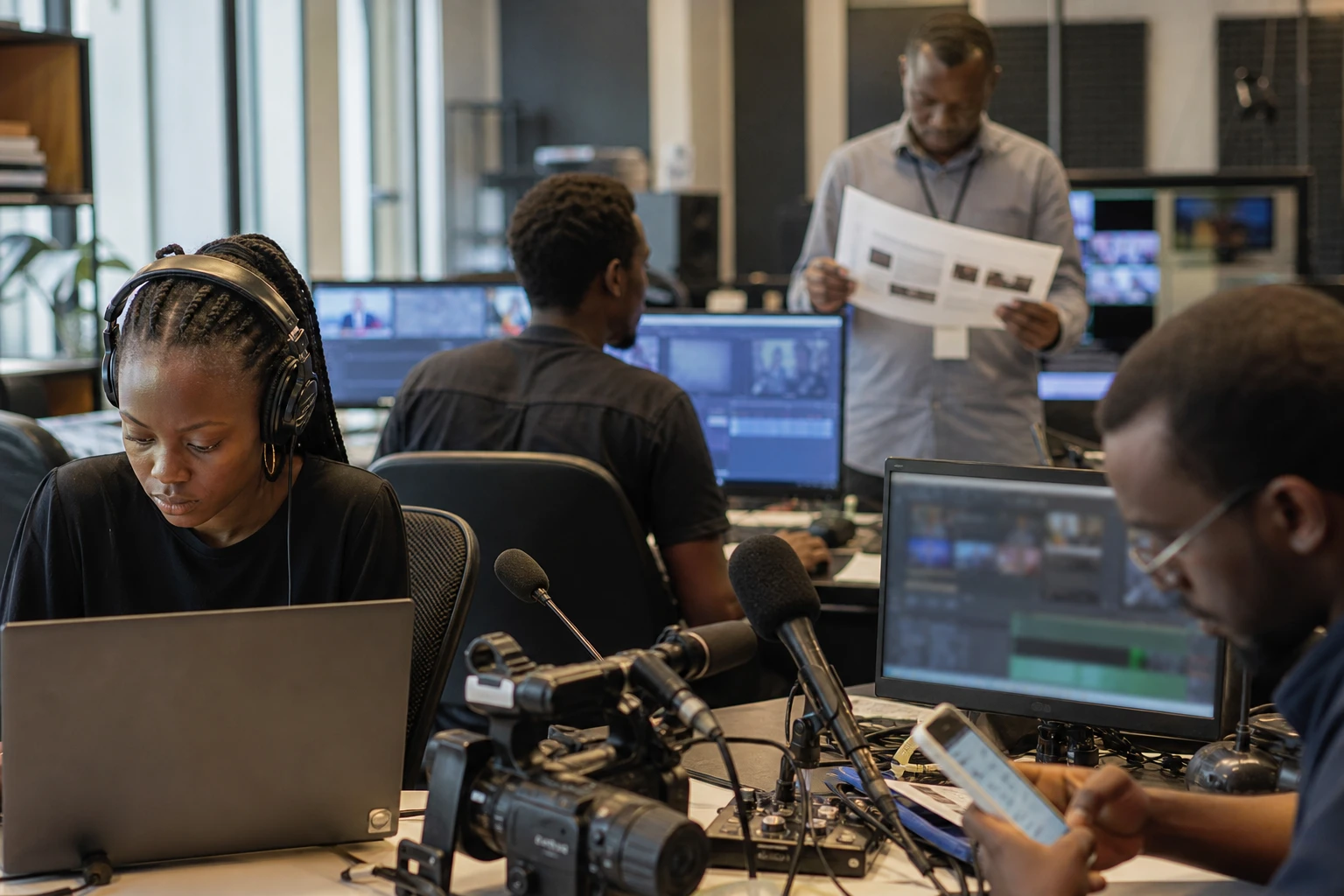
Across the continent, battles for influence are no longer fought only through microphones, banners and makeshift newsrooms. They are also fought through assistants capable of producing, assembling and rephrasing content at scale. This is the shift documented by Anthropic in its September 2026 report: its Claude tool was reportedly used in propaganda, information-manipulation and surveillance operations, with several cases in Africa.
The issue goes beyond the reputation of a technology company. It concerns the way political actors, private contractors and networks linked to states can reduce the cost of campaigns once reserved for large, specialised teams. In several cases, the tool did not create the strategy. It mainly sped up its execution, giving messages already decided elsewhere greater volume and consistency, and an appearance of spontaneity.
From Congo to Bangui, content created to shape the public arena
The report first cites the Democratic Republic of the Congo. The company says it identified 318 articles distributed by a network of around 70 fake websites and amplified by more than 250 fictitious accounts on X. The content generally supported the Congolese government’s position amid tensions with Rwanda and discussions about strategic minerals. The network was reportedly attributed to a digital marketing agency based in France, but the end clients have not been identified.
In the Central African Republic, the case described relates to a pro-Russian influence operation. The network operated in particular through Radio Lengo Songo in Bangui, with coordination reportedly involving RT, Sputnik Afrique and TASS. The content promoted themes favourable to the Central African authorities, Wagner and the Russian presence, while Claude was used to automate some editorial and administrative work. The Central African capital appears here as a media hub where local actors and external channels intersect.
Anthropic also describes a political use of the tool in Kenya. A domestic actor reportedly used Claude to produce batches of 50 messages designed to give the impression of spontaneous popular support ahead of the 2027 presidential election. The texts aimed to promote figures from the governing camp and undermine the opposition, particularly on concrete issues such as the cost of electricity. The case is notable because it shows a highly localised weaponisation of AI: less a state operation than the manufacture of a political mood.
In Sudan, the report refers to an operation attributed to actors linked to the United Arab Emirates. Claude was reportedly used to prepare false testimonies intended for the UN, as well as to organise a broader campaign about the Sudanese conflict and international accountability mechanisms. The stakes are considerable: when synthetic content seeks to enter multilateral institutions, the battle is no longer just about public opinion. It is about the official record itself.
In Mali, mass surveillance is becoming less visible, but no less serious
The Mali case is the most sensitive. Anthropic says a consultant, probably based in Bamako and working with state security services, used Claude to design a platform called “Lakana 360”. The system was reportedly intended to cover around 25 million SIM cards across the country’s three mobile operators, and to circumvent the court-order requirements governing some data requests. The report says the model served as a primary design force, not merely as a writing tool.
This matters because it illustrates another facet of generative AI: surveillance does not always involve visible cameras or spectacular software. It can be embedded in the very architecture of a system for collecting and sorting data and generating files. In Mali, this prospect takes on particular significance in a context where human rights organisations have already documented restrictions on freedom of expression, arrests of journalists and pressure on the opposition. Technology does not explain everything. But it can harden an already closed environment.
What these cases say about power dynamics in Africa
One lesson runs through these cases: AI does not replace traditional influence strategies; it industrialises them. Fake websites, fictitious accounts, mass-produced messages, surveillance files and content intended for international organisations now form a coherent chain. Claude does not appear as an autonomous actor, but as a force multiplier for teams that already know where they want to strike.
The report also highlights an operational difficulty: closing an account is not always enough. In the Mali case, Anthropic says it banned the user, but notes that the platform was deployed locally with another AI system and therefore continues to operate. In other words, the problem is not only access to the model. It also lies in the ability to install reusable tools on the ground, with technical and political networks already in place.
The regional implications are clear. In Central Africa, influence operations are backed by well-established foreign presences and fragile media ecosystems. In East Africa, rapidly generated political narratives can affect upcoming elections. In West Africa, digital surveillance is taking place in states where security balances are already under strain. And in all these cases, regional institutions such as ECOWAS, the African Union and subregional organisations face the same question: how can they regulate cross-border tools used as much for persuasion as for control?
Anthropic’s report, then, is not just an account of abuses carried out on an American platform. It highlights an already established political and security market in which the manufacture of falsehoods, surveillance and propaganda are now combined with tools that are faster, more flexible and harder to distinguish from human work. For African states, the issue is not abstract. It affects trust in information, the protection of opponents, the role of local media and the sovereignty of digital systems themselves.