Algeria
 Egypt
 Libya
 Morocco
 Sudan
 Tunisia
 Benin
 Burkina Faso
 Cabo Verde
 Côte d'Ivoire
 Ghana
 Guinea
 Guinea-Bissau
 Liberia
 Mali
 Mauritania
 Niger
 Nigeria
 Senegal
 Sierra Leone
 The Gambia
 Togo
 Cameroon
 Central African Republic
 Chad
 DR Congo
 Equatorial Guinea
 Gabon
 Republic of the Congo
 São Tomé and Príncipe
 Burundi
 Comoros
 Djibouti
 Eritrea
 Ethiopia
 Madagascar
 Malawi
 Mauritius
 Mozambique
 Rwanda
 Seychelles
 Somalia
 South Sudan
 Tanzania
 Uganda
 Angola
 Botswana
 Eswatini
 Lesotho
 Namibia
 South Africa
 Zambia
 Zimbabwe
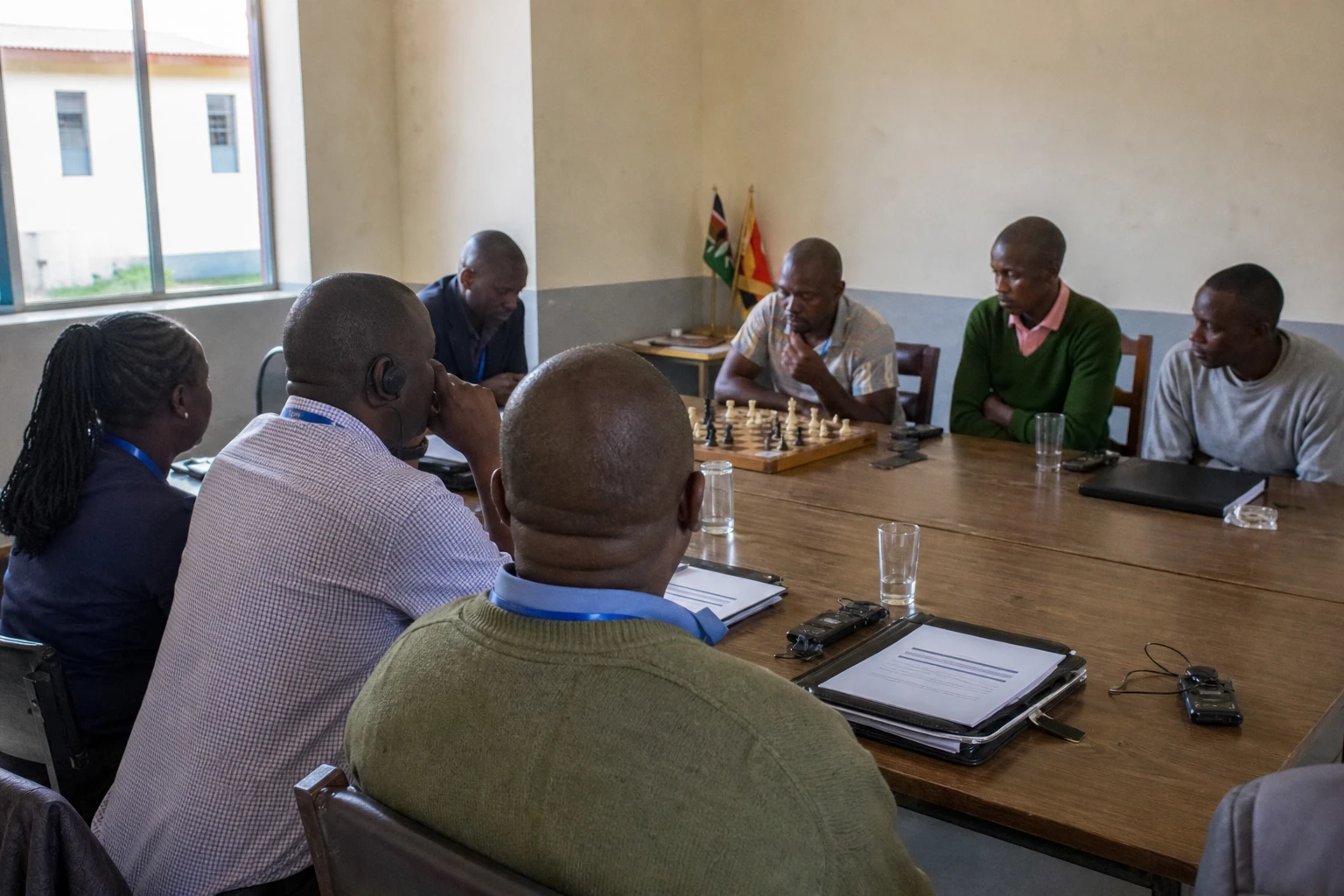
At Maranjau, in central Kenya, a chess game is under way far from any competition hall. In the prison yard, each move demands that players slow down, observe and weigh the consequences of the next move. For inmates taking part in the programme, the game is an exercise in self-control as much as a leisure activity.
This approach accompanies the evolution of Kenya’s prison policies. The Kenya Correctional Service is seeking to complement detention with education, training and preparation for a return to society. Chess fits this approach, with one particular advantage: it requires little equipment but engages concentration, memory and dialogue.
A practice spreading through Kenyan prisons
Maranjau prison houses about 450 inmates. Some now choose the chessboard in their free time rather than resting or playing football. Games also bring inmates and officers together, creating a space for interaction that differs from the usual relationships imposed by the prison environment.
Brian Gatonye, 27, is serving a three-year sentence for assault. After about 18 months in detention, he says he has learnt not to act hastily.
“Chess has taught me a lot. It has taught me to stay calm and make my decisions wisely. Before I act, I have to think about the consequences of what I do, then decide,” he explains.
His testimony alone does not prove the programme is effective. It does, however, illustrate the link prison officials are seeking between the game and rehabilitation. In chess, an impulsive decision can quickly expose the king. In everyday life, an uncontrolled reaction can make a conflict worse.
Humphrey Young, head of Maranjau prison, believes the activity can help inmates develop their problem-solving skills. He also highlights its value for people convicted of offences such as assault or family disputes.
“Chess teaches them to manage their anger and live better with members of their community,” he says.
From the prison yard to international competition
Chess programmes have been running in several Kenyan prisons since at least 2022. Their development brings together the government, Chess Kenya, the International Chess Federation, known as FIDE, and the US organisation The Gift of Chess, which provides games and educational materials, among other support.
The programme reached a new milestone in October 2024, when Kenya took part for the first time in the Intercontinental Online Chess Championship for Prisoners, organised as part of the Chess for Freedom initiative. Three Kenyan teams competed in the open, women’s and youth categories.
The participation gave an international dimension to an initiative that had until then been carried out mainly within prisons. The teams played remotely against inmates from many countries. The competition also required participating prisons to organise supervision, internet access and player preparation.
The programme is therefore about more than placing chessboards in prison yards. Officers are trained to oversee games. Competitions can be held between prisons. The activity also builds shared habits: following the rules, waiting one’s turn, accepting defeat and analysing a mistake.
A useful tool, but not a solution on its own
Chess advocates point to several benefits. The game engages the mind, strengthens concentration and encourages interaction. It can also give inmates a regular goal in an environment marked by routine and restrictions.
Phyllis Ngigi, international relations officer at The Gift of Chess, believes the activity can help prepare inmates for release rather than keep them in a confined space. She links playing chess with learning patience, decision-making and anger management.
These effects should nevertheless be treated with caution. No independent study has yet measured the precise impact of Kenya’s programme on behaviour, reoffending or employment after release. Regular play cannot replace psychological support, education or vocational training.
Rehabilitation also depends on the conditions people face after release. A former inmate must be able to find housing, reconnect with family, earn an income and manage any difficulties linked to a criminal record. Chess can support this preparation, but it cannot resolve these social and economic obstacles on its own.
An initiative with resonance in East Africa
Kenya’s choice reflects a broader trend towards using sport and intellectual activities in rehabilitation policies. Across East Africa, prisons face common challenges: overcrowding, unequal access to training and difficulties maintaining family ties.
Kenya is a member of the East African Community, or EAC, which brings together several countries in the region around economic and political projects. Prison initiatives can also contribute to this co-operation, particularly when digital tools make exchanges between institutions in different countries possible.
In Nairobi as in rural counties, the central question remains how inmates return to their communities. A group activity has a lasting impact only if it is part of a more comprehensive pathway. The challenge is to connect chess with classes, vocational training, social support and family relationships.
At Maranjau, players focus first on the next square. For Kenyan authorities and their partners, the next step will be to assess what the practice actually achieves after release. Participation numbers, the regularity of sessions and follow-up with former inmates will help distinguish initial enthusiasm from a genuine effect on rehabilitation.